

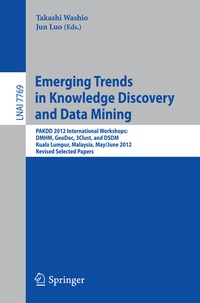
Emerging Trends in Knowledge Discovery and Data Mining
Description

The 12 revised papers presented were carefully reviewed and selected from numerous submissions. DMHM 2012 aimed at providing a common platform for the discussion of challenging issues and potential techniques in this emerging field of data mining for health care management; 3Clust 2012 focused on solving emerging problems such as clustering ensembles, semi-supervised clustering, subspace/projective clustering, co-clustering, and multi-view clustering; GeoDoc 2012 highlighted the formalization of geospatial concepts and relationships with a focus on the extraction of geospatial relations in free text datasets to offer to the database community a unified framework for geodata discovery; and DSDM 2012 provided the opportunity for Ph.D. students and junior researchers to discuss their work on data mining foundations, techniques and applications.
More details
Other editions
Additional editions
Content
Modality Classification for Medical Images Using Sparse Coded Affine-Invariant Descriptors.- Mining Web Data for Epidemiological Surveillance.- Getting a Grasp on Clinical Pathway Data: An Approach Based on Process Mining.- ALIVE: A Multi-relational Link Prediction Environment for the Healthcare Domain.- The Relevance of Spatial Relation Terms and Geographical Feature Types.- Applying NLP Techniques for Query Reformulation to Information Retrieval with Geographical References.- Adaptive Evidence Accumulation Clustering Using the Confidence of the Objects' Assignments.- An Explicit Description of the Extended Gaussian Kernel.- An Improved Genetic Clustering Algorithm for Categorical Data.- Instance-Ranking: A New Perspective to Consider the Instance Dependency for Classification.- Triangular Kernel Nearest-Neighbor-Based Clustering Algorithm for Discovering True Clusters.- DisClose : Dis covering Colossal Closed Itemsets via a Memory Efficient Compact Row-Tree.- Mining Web Data for Epidemiological Surveillance.- Getting a Grasp on Clinical Pathway Data: An Approach Based on Process Mining.- ALIVE: A Multi-relational Link Prediction Environment for the Healthcare Domain.- The Relevance of Spatial Relation Terms and Geographical Feature Types.- Applying NLP Techniques for Query Reformulation to Information Retrieval with Geographical References.- Adaptive Evidence Accumulation Clustering Using the Confidence of the Objects' Assignments.- An Explicit Description of the Extended Gaussian Kernel.- An Improved Genetic Clustering Algorithm for Categorical Data.- Instance-Ranking: A New Perspective to Consider the Instance Dependency for Classification.- Triangular Kernel Nearest-Neighbor-Based Clustering Algorithm for Discovering True Clusters.- DisClose : Dis covering Colossal Closed Itemsets via a Memory Efficient Compact Row-Tree.
