

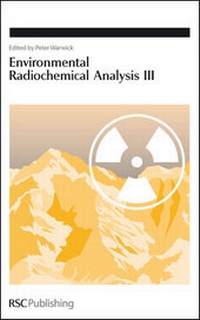
Environmental Radiochemical Analysis III
1st Edition
Published on 31. October 2007
230 pages
978-1-84755-786-5 (ISBN)
Description

Environmental Radiochemical Analysis III is an authoritative, up to date review of research contributions presented at the 10th International Symposium on Environmental Radiochemical Analysis. Representing the work of leading scientists across the globe this edition provides information on:
- new methods of radioanalyses
- waste steams during decommissioning
- radioactivity measurements in the environment
- hazard assessment in decommissioning
- improvements in measurement instrumentation
- application of software to measurements
- current IAEA activities for the ALMERA network
- pro ciency testing and research and development in the NDA. This exceptional work o ers an insight into topical areas of research and is a key point of reference for graduates and professionals alike who work across elds involving analytical chemistry, environmental science and technology, and hazards and waste research and disposal.
- new methods of radioanalyses
- waste steams during decommissioning
- radioactivity measurements in the environment
- hazard assessment in decommissioning
- improvements in measurement instrumentation
- application of software to measurements
- current IAEA activities for the ALMERA network
- pro ciency testing and research and development in the NDA. This exceptional work o ers an insight into topical areas of research and is a key point of reference for graduates and professionals alike who work across elds involving analytical chemistry, environmental science and technology, and hazards and waste research and disposal.
More details
Series
Edition
1. Auflage
Language
English
Place of publication
Cambridge
United Kingdom
Target group
Professional and scholarly
ISBN-13
978-1-84755-786-5 (9781847557865)
DOI
10.1039/9781847557865
Copyright in bibliographic data and cover images is held by Nielsen Book Services Limited or by the publishers or by their respective licensors: all rights reserved.
Schweitzer Classification
Other editions
Additional editions
Peter Warwick
Environmental Radiochemical Analysis III
Book
07/2007
Royal Society of Chemistry
€129.50
Shipment within 3-4 weeks
Person
The Editor Peter Warwick, BA, MSc, PhD, FRSC, CCHem is Professor of Environmental Radiochemistry, Director of the Centre for Environmental Studies and Head of the Department of Chemistry at Loughborough University. Professor Warwick is a part Chairman of the Radiochemical Methods Group, Analytical Division, the Royal Society of Chemistry and was awarded the Becquerel Medal by them in 2002 for "outstanding contributions to radiochemistry". His major research interests are in the chemistry of nuclear active wastes disposal and in developing new methods of analyses for decommissioning wastes.
Content
Radiochemical accumulation at a hydroelectric power dam;
Determination of transfer of tritium to crops fertilised with contaminated sewage sludge;
Technetium-99 in marine food webs in Norwegian Seas. Results from the Norwegian Radnor Project;
Meaduring Thoron (220Rn) in natural waters;
The determination of gross alpha sna gross beta activity in solids, filters and water - validation of Dutch pre-norms;
Environmental measurements of radioxenon;
Uptake of uranium in spinach grown in andosols accumulating trace amounts of fertiliser-derived uranium;
Mineralogical and particle size controls on 137Cs abundances in Dounreay offshore and foreshore sands;
Assessment of possible sources of artificial long-lived radionuclides in environmental samples by measurement of isotopic composition;
A rapid method for the preconcentration of non-refactory Am and Pu from 100g soil samples;
Improvements in underground gamma-ray spectroscopy and the application of measuring radioactivity in agricultural samples;
Responses of U and Pu to microbially driven nitrate reduction in sediments;
An efficient and optimised total combustion method for total H-3 and C-14 in environmental and decommissioning samples;
The analytical impact of tritium data from storing nuclear decommissioning samples under different conditions;
Radionuclide recording levels and prioritisation of chemical/radiochemical analyses of Magnox wastes for Nirex compliance;
Application of the Radiological Hazard Potential (RHP) to radionuclides in Magnox reactor decommissioning;
Determination of tritium radionuclide and lithium precursor in Magnox reactor steels;
Sequential determination of Ca-41/45 and Sr-90 in an activated concrete core;
The chemistry of ultra-radiopure materials;
Independent radiological monitoring: results of a recent intercomparison exercise;
Routine application of CN2003 software to laboratory scintillation calibration;
Easy method of concentration of strontium isotopes from radioactive aqueous wastes for the determination of 90Sr by liquid scintillation counting. Application of Strontium EmporeTM Rad disks;
Performance of a portable, electromagnetically cooled HPGe detector for site characterization;
Nuclear Decommissioning Authority research and development needs, risks and opportunities;
The performance of UK and overseas laboratories in proficiency tests for the measurement of 2Am-241;
Current IAEA activities and future plans for the Almera network;
Determination of transfer of tritium to crops fertilised with contaminated sewage sludge;
Technetium-99 in marine food webs in Norwegian Seas. Results from the Norwegian Radnor Project;
Meaduring Thoron (220Rn) in natural waters;
The determination of gross alpha sna gross beta activity in solids, filters and water - validation of Dutch pre-norms;
Environmental measurements of radioxenon;
Uptake of uranium in spinach grown in andosols accumulating trace amounts of fertiliser-derived uranium;
Mineralogical and particle size controls on 137Cs abundances in Dounreay offshore and foreshore sands;
Assessment of possible sources of artificial long-lived radionuclides in environmental samples by measurement of isotopic composition;
A rapid method for the preconcentration of non-refactory Am and Pu from 100g soil samples;
Improvements in underground gamma-ray spectroscopy and the application of measuring radioactivity in agricultural samples;
Responses of U and Pu to microbially driven nitrate reduction in sediments;
An efficient and optimised total combustion method for total H-3 and C-14 in environmental and decommissioning samples;
The analytical impact of tritium data from storing nuclear decommissioning samples under different conditions;
Radionuclide recording levels and prioritisation of chemical/radiochemical analyses of Magnox wastes for Nirex compliance;
Application of the Radiological Hazard Potential (RHP) to radionuclides in Magnox reactor decommissioning;
Determination of tritium radionuclide and lithium precursor in Magnox reactor steels;
Sequential determination of Ca-41/45 and Sr-90 in an activated concrete core;
The chemistry of ultra-radiopure materials;
Independent radiological monitoring: results of a recent intercomparison exercise;
Routine application of CN2003 software to laboratory scintillation calibration;
Easy method of concentration of strontium isotopes from radioactive aqueous wastes for the determination of 90Sr by liquid scintillation counting. Application of Strontium EmporeTM Rad disks;
Performance of a portable, electromagnetically cooled HPGe detector for site characterization;
Nuclear Decommissioning Authority research and development needs, risks and opportunities;
The performance of UK and overseas laboratories in proficiency tests for the measurement of 2Am-241;
Current IAEA activities and future plans for the Almera network;
