
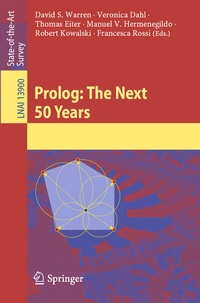
Prolog: The Next 50 Years
Description
Alles über E-Books | Antworten auf Fragen rund um E-Books, Kopierschutz und Dateiformate finden Sie in unserem Info- & Hilfebereich.
After a first chapter that gently introduces the Prolog programming language using examples, the next 7 papers discuss general views of the language, possible extensions for the future, and how Prolog can generally be used to solve problems; the next 5 papers explore ideas and experiences of teaching Prolog programming and then 2 papers discuss technology that has been developed for help in that teaching; the next 3 papers describe new languages based on Prolog which show future directions for logic programming; the next 5 chapters explain the applications that were the finalists for the 2022 Alain Colmerauer Prize; and the final 8 papers describe applications developed using the Prolog language, demonstrating the language's range.
More details
Other editions
Additional editions

Persons
Content
System requirements
File format: PDF
Copy protection: Watermark-DRM (Digital Rights Management)
System requirements:
- Computer (Windows; MacOS X; Linux): Use the free software Adobe Reader, Adobe Digital Editions, or any other PDF viewer of your choice (see eBook Help).
- Tablet/Smartphone (Android; iOS): Install the free app Adobe Digital Editions or another reading app for eBooks, e.g., PocketBook (see eBook Help).
- E-reader: Bookeen, Kobo, Pocketbook, Sony, Tolino and many more (only limited: Kindle).
The file format PDF always displays a book page identically on any hardware. This makes PDF suitable for complex layouts such as those used in textbooks and reference books (images, tables, columns, footnotes). Unfortunately, on the small screens of e-readers or smartphones, PDFs are rather annoying, requiring too much scrolling.
This eBook uses Watermark-DRM, a „soft” copy protection. This means that there are no technical restrictions to prevent illegal distribution. However, there is a personalised watermark embedded in the eBook that can be used to identify the purchaser of the eBook in the event of misuse and to provide evidence for legal purposes.
For more information, see our eBook Help page.