

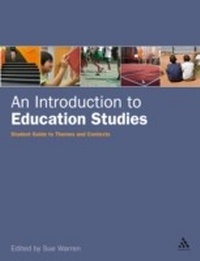
An Introduction to Education Studies
The Student Guide to Themes and Contexts
1st Edition
Published on 8. March 2009
176 pages
978-1-4411-3640-4 (ISBN)
Description

An Introduction to Education Studies presents a concise overview for students who are new to this area of academic study.
Part 1 introduces the reader to the main themes they will encounter in their study of education such as the sociology of education, the philosophy of education, comparative education, and ethics for educators.
Part 2 explores the contexts within which education takes place in order to stimulate further thinking about education in action. Issues such as disaffection, pupil voice and breaking barriers to learning are introduced to give the reader a feel for such issues and how they might approach them.
Through discussions of relevant literature and research, and the use of case studies and exploratory activities, students are encouraged to actively engage with their learning about theories and disciplines within the study of education and the contexts in which learners live and work. Each chapter is written in an accessible style and provides the reader with start points for further study.
This book serves as a true course companion to meet the needs of students and lecturers working on Education Studies programmes. Prospective teachers may also find the book of interest as the subject matter is discussed in terms of theory and practical applications in a range of educational contexts.
Part 1 introduces the reader to the main themes they will encounter in their study of education such as the sociology of education, the philosophy of education, comparative education, and ethics for educators.
Part 2 explores the contexts within which education takes place in order to stimulate further thinking about education in action. Issues such as disaffection, pupil voice and breaking barriers to learning are introduced to give the reader a feel for such issues and how they might approach them.
Through discussions of relevant literature and research, and the use of case studies and exploratory activities, students are encouraged to actively engage with their learning about theories and disciplines within the study of education and the contexts in which learners live and work. Each chapter is written in an accessible style and provides the reader with start points for further study.
This book serves as a true course companion to meet the needs of students and lecturers working on Education Studies programmes. Prospective teachers may also find the book of interest as the subject matter is discussed in terms of theory and practical applications in a range of educational contexts.
Reviews / Votes
"A lively and stimulating introduction to themes and contexts fundamental to a course in Education Studies. It enables the reader to engage with underpinning complexities that marry together theory and practice, facilitate understanding of issues and challenge preconceived ideas." Angela Rees, Sheffield Hallam University, UK 'Takes a challenging approach from the start, urging students to look beyond the obvious and seemingly self-evident for deeper meanins in the learning experiences of themselves and others... This book will be a real asset to students beginning the study of Education at undergraduate degree level, but it should also be read by those in training to teach in schools and colleges.' Bob Waugh, Senior Lecturer Human Development, Oxford Brookes University, UKMore details
Edition
1. Auflage
Language
English
Place of publication
New York
United States
ISBN-13
978-1-4411-3640-4 (9781441136404)
Copyright in bibliographic data and cover images is held by Nielsen Book Services Limited or by the publishers or by their respective licensors: all rights reserved.
Schweitzer Classification
Other editions
Additional editions

Book
03/2009
Continuum International Publishing Group Ltd.
€191.10
Shipment within 15-20 days
Book
03/2009
Continuum International Publishing Group Ltd.
€48.70
Shipment within 15-20 days
Person
Content
1 Introduction to Education as a Field of Study (Sue Warren, Leeds Metropolitan University)
Part 1 Themes in the Study of Education
2 'Doing Theory' on Education (Julian McDougall and David Trotman, Newman College of Higher Education)
3 Comparative Education (Brendan Bartram, Wolverhampton University)
4 Ethics for Educators (Sue Warren and Susan Waltham, Leeds Metropolitan University)
5 Sociological Perspectives on Education (Jon Tan and Colin Harrison, Leeds Metropolitan University)
6 Affective Issues in Education (Bridget Cooper, Leeds Metropolitan University)
Part 2 Contexts for Education
7 Breaking Barriers to Learning (Pat Hughes, Liverpool Hope University)
8 Safeguarding Children and Adults in Educational Settings (Gary Walker, Leeds Metropolitan University)
9 Disaffection, Society and Education (Barbara Murphy, Bishop Grossteste University College)
10 Listening to Pupils' Voices (Margaret Woods, York St John University College)
11 Education Beyond Schools (Les Hankin, Liverpool Hope University)
Index
Part 1 Themes in the Study of Education
2 'Doing Theory' on Education (Julian McDougall and David Trotman, Newman College of Higher Education)
3 Comparative Education (Brendan Bartram, Wolverhampton University)
4 Ethics for Educators (Sue Warren and Susan Waltham, Leeds Metropolitan University)
5 Sociological Perspectives on Education (Jon Tan and Colin Harrison, Leeds Metropolitan University)
6 Affective Issues in Education (Bridget Cooper, Leeds Metropolitan University)
Part 2 Contexts for Education
7 Breaking Barriers to Learning (Pat Hughes, Liverpool Hope University)
8 Safeguarding Children and Adults in Educational Settings (Gary Walker, Leeds Metropolitan University)
9 Disaffection, Society and Education (Barbara Murphy, Bishop Grossteste University College)
10 Listening to Pupils' Voices (Margaret Woods, York St John University College)
11 Education Beyond Schools (Les Hankin, Liverpool Hope University)
Index
