

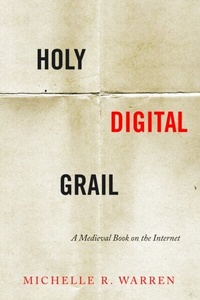
Holy Digital Grail
A Medieval Book on the Internet
Published on 29. March 2022
360 pages
978-1-5036-3117-5 (ISBN)
Description

Medieval books that survive today have been through a lot: singed by fire, mottled by mold, eaten by insects, annotated by readers, cut into fragments, or damaged through well-intentioned preservation efforts. In this book, Michelle Warren tells the story of one such manuscript-an Arthurian romance with textual origins in twelfth-century England now diffused across the twenty-first century internet. This trajectory has been propelled by a succession of technologies-from paper manufacture to printing to computers. Together, they have made literary history itself a cultural technology indebted to colonial capitalism.
Bringing to bear media theory, medieval literary studies, and book history, Warren shows how digital infrastructures change texts and books, even very old ones. In the process, she uncovers a practice of "tech medievalism" that weaves through the history of computing since the mid-twentieth century; metaphors indebted to King Arthur and the Holy Grail are integral to some of the technologies that now sustain medieval books on the internet. This infrastructural approach to book history illuminates how the meaning of literature is made by many people besides canonical authors: translators, scribes, patrons, readers, collectors, librarians, cataloguers, editors, photographers, software programmers, and many more. Situated at the intersections of the digital humanities, library sciences, literary history, and book history, Holy Digital Grail offers new ways to conceptualize authorship, canon formation, and the definition of a "book."
Bringing to bear media theory, medieval literary studies, and book history, Warren shows how digital infrastructures change texts and books, even very old ones. In the process, she uncovers a practice of "tech medievalism" that weaves through the history of computing since the mid-twentieth century; metaphors indebted to King Arthur and the Holy Grail are integral to some of the technologies that now sustain medieval books on the internet. This infrastructural approach to book history illuminates how the meaning of literature is made by many people besides canonical authors: translators, scribes, patrons, readers, collectors, librarians, cataloguers, editors, photographers, software programmers, and many more. Situated at the intersections of the digital humanities, library sciences, literary history, and book history, Holy Digital Grail offers new ways to conceptualize authorship, canon formation, and the definition of a "book."
Reviews / Votes
"Deeply learned, self-reflective and ethical, and a really good read, Holy Digital Grail represents a lifetime's worth of thinking deeply."-Sian Echard, University of British Columbia "Book history built around the precarious adventures of a single-and singularly embattled-Arthurian manuscript. Michelle Warren is among the most original, creative, and technologically alert medieval scholars of our time."-Paul Strohm, Columbia University "This is the kind of book history scholarship we need in the twenty-first century: connective, imaginative, and unafraid to follow the histories of books wherever they lead. Michelle Warren's fascinating account of a single manuscript and its many afterlives connects our digital present and the medieval past with insight and verve, deftly combining the study of manuscripts, digitization, and media history in a remarkable synthesis."-Alan Galey, University of Toronto "Warren's book is praiseworthy not just for her knowledge about MS 80, but also for her detailed understanding of the work involved in creating digital editions and the clarity with which she explains (what may be) unfamiliar technical terminology and processes to the reader. Warren's focus on the paratextual features of the manuscript, along with the attention she pays to processes of editing, collating, and preservation, make a thoughtful contribution to publishing studies in highlighting much of the unseen (and frequently unacknowledged) work that shapes audience interactions with medieval manuscripts."-Martha Claire Baldon, The Medieval Review "Warren's personal approach presents a tangible expression of how new digital platforms have allowed and even prompted new avenues in manuscript studies."-C. E. M. Henderson, Modern Philology "As with the search for the Holy Grail, the goal is not always entirely tangible, but the journey itself is very enlightening-and, in this case, also entertaining.... [Holy Digital Grail] is about much more than merely tracing the history of the records of one manuscript. The book addresses key questions about interactions between digital infrastructure and book history as well as the making and remaking of books. Ultimately, one could also see behind this a reflection of research data in the humanities, which results from the source, its digitization, and the multilayered enrichment over time."-Luise Borek, H-Sci-Med-Tech "Holy Digital Grail is a carefully constructed and refreshing account of the history of a medieval book, from the origins of its text to its digital existence. Warren's interdisciplinary and reflective approach allows her to successfully disentangle the intricate connections between text, matter, technology, politics, and people."-Renske Annelize Hoff, Jarbuch fuer Kommunikationsgeschichte "Warren's full title, Holy Digital Grail: A Medieval Book on the Internet, already hints at some of her book's qualities: it is original, witty, iconoclastic, and historically inclusive of everything from the Middle Ages to today."-Sarah Kay, Exemplaria "Holy Digital Grail is invaluable reading for anyone who works with digitized medieval manuscripts. Yet while medievalists will benefit from reading it, the book's appeal is larger than this. Holy Digital Grail speaks to medieval studies, literary studies, material texts, digital humanities, library sciences, and the history of information. It is an indispensable account of how new technologies change old books; it transforms not only how we understand texts but also how we understand our work."-Daniel Davies, Modern Language Quarterly "Holy Digital Grail succeeds on many levels. For literary scholars, Warren offers an incisive interpretation of Lovelich's texts that illuminates how the legend of Arthur was adapted and appropriated in fifteenth-c. London. Scholars of mss will value her deft reading of the codex, particularly her analysis of how content and form collude to produce meaning. Social historians will appreciate Warren's learned analysis of a London mercantile community, its politics, and its books. Editors, cataloguers, and coders will appreciate her reflections on how they remake a work through their choices. All readers, I suspect, will be challenged to think outside their comfort zones."-K. Winstead, ScriptoriumAll prices
More details
Series
Edition
New edition
Language
English
Place of publication
Palo Alto
United States
Target group
Professional and scholarly
Edition type
New edition
Illustrations
29 halftones
ISBN-13
978-1-5036-3117-5 (9781503631175)
Copyright in bibliographic data and cover images is held by Nielsen Book Services Limited or by the publishers or by their respective licensors: all rights reserved.
Schweitzer Classification
Other editions
Additional editions
Book
03/2022
Stanford University Press
€141.50
Shipment within 15-20 days
Book
03/2022
Stanford University Press
€35.50
Shipment within 15-20 days
Person
Michelle R. Warren is Professor of Comparative Literature at Dartmouth College, Her publications include History on the Edge: Excalibur and the Borders of Britain (2000) and Creole Medievalism: Colonial France and Joseph Bedier's Middle Ages (2011), along with several edited volumes.
Content
Introduction: Medieval Literature in the Digital Dark Ages
1. Translating Arthur: Books, Texts, Machines
2. Performing Community: Merchants, Chivalry, Data
3. Marking Manuscripts: Makers, Users, Coders
4. Cataloguing Libraries: History, Romance, Website
5. Editing Romance: Poetry, Print, Platform
6. Reproducing Books: Binding, Microfilm, Digital
Conclusion: Indexing the Grail, Romancing the Internet
1. Translating Arthur: Books, Texts, Machines
2. Performing Community: Merchants, Chivalry, Data
3. Marking Manuscripts: Makers, Users, Coders
4. Cataloguing Libraries: History, Romance, Website
5. Editing Romance: Poetry, Print, Platform
6. Reproducing Books: Binding, Microfilm, Digital
Conclusion: Indexing the Grail, Romancing the Internet

