


The Embodied Word
Female Spiritualities, Contested Orthodoxies, and English Religious Cultures, 1350-1700
1st Edition
Published on 15. November 2010
277 pages
978-0-268-09668-7 (ISBN)
Description

In The Embodied Word: Female Spiritualities, Contested Orthodoxies, and English Religious Cultures, 1350-1700, Nancy Bradley Warren expands on the topic of female spirituality, first explored in her book Women of God and Arms, to encompass broad issues of religion, gender, and historical periodization. Through her analyses of the variety of ways in which medieval spirituality was deliberately and actively carried forward to the early modern period, Warren underscores both continuities and revisions that challenge conventional distinctions between medieval and early modern culture.
The early modern writings of Julian of Norwich are an illustrative starting point for Warren's challenge to established views of English religious cultures. In a single chapter, Warren follows the textual and devotional practices of Julian as they influence two English Benedictine nuns in exile, and then Grace Mildmay, a seventeenth-century Protestant gentry woman, "to shed light on the ways in which individual encounters of the divine, especially gendered bodily encounters expressed textually, signify for others both personally and socio-historically." In subsequent chapters, Warren discusses St. Birgitta of Sweden's Imitatio Christi in the context of the importance of Spain and Spanish women in shaping a distinctive form of early modern Englishness strongly aligned with medieval religious culture; juxtaposes the fifteenth-century mystic Margery Kempe with the life and writings of Anna Trapnel, a seventeenth-century Baptist; and treats Catherine of Siena together with the Protestant Anne Askew and Lollard and Recusant women. In the final chapters she focuses on the interplay of gender and textuality in women's textual representations of themselves and in works written by men who used the traditions of female spirituality in the service of competing orthodoxies.
The early modern writings of Julian of Norwich are an illustrative starting point for Warren's challenge to established views of English religious cultures. In a single chapter, Warren follows the textual and devotional practices of Julian as they influence two English Benedictine nuns in exile, and then Grace Mildmay, a seventeenth-century Protestant gentry woman, "to shed light on the ways in which individual encounters of the divine, especially gendered bodily encounters expressed textually, signify for others both personally and socio-historically." In subsequent chapters, Warren discusses St. Birgitta of Sweden's Imitatio Christi in the context of the importance of Spain and Spanish women in shaping a distinctive form of early modern Englishness strongly aligned with medieval religious culture; juxtaposes the fifteenth-century mystic Margery Kempe with the life and writings of Anna Trapnel, a seventeenth-century Baptist; and treats Catherine of Siena together with the Protestant Anne Askew and Lollard and Recusant women. In the final chapters she focuses on the interplay of gender and textuality in women's textual representations of themselves and in works written by men who used the traditions of female spirituality in the service of competing orthodoxies.
Reviews / Votes
"As medievalists have become less defensive on this issue, it has become easier to explore the possibility that the Middle Ages can teach us something we didn't know about selfhood; in this case, an exploration of the diffusions of personhood that is both traditional and radical." -Medium Aevum"Warren recasts medievalism itself innovatively as the reception of a medieval literary and religious culture doubly gendered as female, in its origins and in its use by women recipients-that is, as a culture both private and spiritually heterodox and characteristic of a feminized guidance outside masculinized and public conventions." -Modern Philology
"Warren's book offers an insight into how medieval and early modern women used books to share the experiences of a dead man (and living God) in their own lives." -Sixteenth Century Journal
"Throughout this book, Nancy Bradley Warren shows her skill as an English scholar in her thoughtful engagement with and analysis of primary texts. She focuses particularly on the writings of Birgitta of Sweden, Catherine of Siena, and Julian of Norwich. These texts attest both to the particularities of the female experience, while also offering a message that is more universal." -Anglican and Episcopal History
"Nancy Bradley Warren's The Embodied Word boldly and often brilliantly examines an array of texts that express and depict female spirituality in the medieval and early modern periods." -Comitatus
". . . the lives and texts encountered in The Embodied Word serve as beautiful, sometimes startling reminders of the significance of the word made flesh and challenge us to consider ways in which we may carry forward the often unsettling legacies of these female figures who refuse to stay inside the lines." -Theology
"Warren's provocative work highlights previously unexplored aspects and influences of English female religiosity in medieval and early-modern Europe. . . . Warren succeeds in demonstrating the important connections between women's physical/textual corpus and interwoven religio-political events of this era." -The Catholic Historical Review
"The power of Warren's book to contest orthodoxies is perhaps best encapsulated in these remarks: it leaves the reader wanting to know how far posing the question from these new starting-points actually transforms old verdicts, as well as performing a valuable service in encouraging greater analytical precision in all researchers." -English Historical Review
"Perhaps the most notable feature of the book is its scope, bridging divides not only of periodization and reformation, but also of geography in considering national and expatriate English women and their European inspirations and protectors." -Church History
"Warren's intriguing study joins a growing body of continuity-themed scholarship. . . . Warren's study would be of most value to scholars interested in the 'religious turn' in literary studies, well-versed students of late medieval and early modern female embodiment as it relates to spirituality, and researchers working on a religious phenomenology. In the Embodied Word, such readers will find an appealing call to explore the historical and textual nature of sameness." -Clio: A Journal of Literature, History and the Philosophy of History
More details
Series
Language
English
Place of publication
Notre Dame IN
United States
Target group
Professional and scholarly
Illustrations
2 figures - 2 Figures
ISBN-13
978-0-268-09668-7 (9780268096687)
Copyright in bibliographic data and cover images is held by Nielsen Book Services Limited or by the publishers or by their respective licensors: all rights reserved.
Schweitzer Classification
Other editions
Additional editions
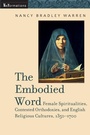
Nancy Bradley Warren
The Embodied Word
Female Spiritualities, Contested Orthodoxies, and English Religious Cultures, 1350-1700
Book
11/2010
University of Notre Dame Press
€46.10
Shipment within 10-20 days
Person
Nancy Bradley Warren is professor of English at Florida State University. She is the author of Women of God and Arms: Female Spirituality and Political Conflict, 1380-1600 and Spiritual Economies: Female Monasticism in Later Medieval England.
Content
- Cover
- Half title
- Series page
- Title page
- Copyright
- Dedication
- Contents
- Acknowledgments
- Introduction
- Chapter One: The Incarnational and the International
- Chapter Two: Medieval Legacies and Female Spiritualities across the "Great Divide"
- Chapter Three: Embodying the "Old Religion" and Transforming the Body Politic
- Chapter Four: Women's Life Writing, Women's Bodies, and the Gendered Politics of Faith
- Chapter Five: The Embodied Presence of the Past
- Notes
- Index
