

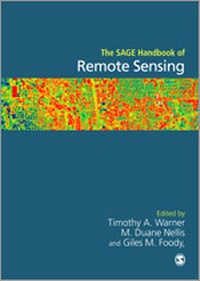
The SAGE Handbook of Remote Sensing
1st Edition
Published on 18. June 2009
568 pages
978-1-4462-0676-8 (ISBN)
Description

'A magnificent achievement. A who's who of contemporary remote sensing have produced an engaging, wide-ranging and scholarly review of the field in just one volume' - Professor Paul Curran, Vice-Chancellor, Bournemouth University
Remote Sensing acquires and interprets small or large-scale data about the Earth from a distance. Using a wide range of spatial, spectral, temporal, and radiometric scales Remote Sensing is a large and diverse field for which this Handbook will be the key research reference.
Organized in four key sections:
* Interactions of Electromagnetic Radiation with the Terrestrial Environment: chapters on Visible, Near-IR and Shortwave IR; Middle IR (3-5 micrometers); Thermal IR ; Microwave
* Digital sensors and Image Characteristics: chapters on Sensor Technology; Coarse Spatial Resolution Optical Sensors ; Medium Spatial Resolution Optical Sensors; Fine Spatial Resolution Optical Sensors; Video Imaging and Multispectral Digital Photography; Hyperspectral Sensors; Radar and Passive Microwave Sensors; Lidar
* Remote Sensing Analysis - Design and Implementation: chapters on Image Pre-Processing; Ground Data Collection; Integration with GIS; Quantitative Models in Remote Sensing; Validation and accuracy assessment;
* Remote Sensing Analysis - Applications: LITHOSPHERIC SCIENCES: chapters on Topography; Geology; Soils; PLANT SCIENCES: Vegetation; Agriculture; HYDROSPHERIC and CRYSOPHERIC SCIENCES: Hydrosphere: Fresh and Ocean Water; Cryosphere; GLOBAL CHANGE AND HUMAN ENVIRONMENTS: Earth Systems; Human Environments & Links to the Social Sciences; Real Time Monitoring Systems and Disaster Management; Land Cover Change
Illustrated throughout, an essential resource for the analysis of remotely sensed data, the SAGE Handbook of Remote Sensing provides researchers with a definitive statement of the core concepts and methodologies in the discipline.
Remote Sensing acquires and interprets small or large-scale data about the Earth from a distance. Using a wide range of spatial, spectral, temporal, and radiometric scales Remote Sensing is a large and diverse field for which this Handbook will be the key research reference.
Organized in four key sections:
* Interactions of Electromagnetic Radiation with the Terrestrial Environment: chapters on Visible, Near-IR and Shortwave IR; Middle IR (3-5 micrometers); Thermal IR ; Microwave
* Digital sensors and Image Characteristics: chapters on Sensor Technology; Coarse Spatial Resolution Optical Sensors ; Medium Spatial Resolution Optical Sensors; Fine Spatial Resolution Optical Sensors; Video Imaging and Multispectral Digital Photography; Hyperspectral Sensors; Radar and Passive Microwave Sensors; Lidar
* Remote Sensing Analysis - Design and Implementation: chapters on Image Pre-Processing; Ground Data Collection; Integration with GIS; Quantitative Models in Remote Sensing; Validation and accuracy assessment;
* Remote Sensing Analysis - Applications: LITHOSPHERIC SCIENCES: chapters on Topography; Geology; Soils; PLANT SCIENCES: Vegetation; Agriculture; HYDROSPHERIC and CRYSOPHERIC SCIENCES: Hydrosphere: Fresh and Ocean Water; Cryosphere; GLOBAL CHANGE AND HUMAN ENVIRONMENTS: Earth Systems; Human Environments & Links to the Social Sciences; Real Time Monitoring Systems and Disaster Management; Land Cover Change
Illustrated throughout, an essential resource for the analysis of remotely sensed data, the SAGE Handbook of Remote Sensing provides researchers with a definitive statement of the core concepts and methodologies in the discipline.
Reviews / Votes
A magnificent achievement. A who's who of contemporary remote sensing have produced an engaging, wide-ranging and scholarly review of the field in just one volumeProfessor Paul Curran
Vice-Chancellor, Bournemouth University
This volume covers all the main fields of remote sensing in a very comprehendible
manner. Most of the chapters are presented in a semi-historic account that
shows the development of the field or in methods of data processing. The discussion
is accompanied by high-quality color images and graphs in order to provide as
full coverage of the topics as possible. The structure of the book is organized very
systematically into sections, sub-sections and chapters. It may thus be used as a text
book in various courses of remote sensing or as a book for independent learning in
advanced studies. The target audiences are students and researchers from different
fields such as geography, geology, and the natural and engineering science.
Yitzhak August
Geography Research Forum -- Professor Paul Curran
All prices
More details
Edition
First Edition
Language
English
Place of publication
London
United Kingdom
Target group
Professional and scholarly
ISBN-13
978-1-4462-0676-8 (9781446206768)
Copyright in bibliographic data and cover images is held by Nielsen Book Services Limited or by the publishers or by their respective licensors: all rights reserved.
Schweitzer Classification
Other editions
Additional editions
Timothy A. Warner | M. Duane Nellis | Giles M. Foody
The SAGE Handbook of Remote Sensing
Book
06/2009
1st Edition
SAGE Publications Inc
€201.00
Shipment within 10-20 days
Persons
Timothy A. Warner is Professor of Geology and Geography at West Virginia University, in Morgantown, West Virginia, USA. He received a BSc (Hons) in Geology from the University of Cape Town, and a PhD from Purdue University in Remote Sensing. His research specialties include the spatial properties of images, high resolution remote sensing, and lidar. He served as a founding board member and Secretary of AmericaView. He received the 2006 Outstanding Contributions Award from the Remote Sensing Special ty Group (RSSG) of the Association of American Geographers, and the 2006 Boeing Award for Best Paper in Image Analysis and Interpretation from the American Society of Photogrammetry and Remote Sensing. He has had two Fulbright appointments, one at the University of Louis Pasteur, in Strasbourg, France (2007) and a second at the Universidad de Concepcion, Chile (2013). He served as a co-editor of Progress in Physical Geography (2010 - 2014). He currently serves on the editorial board of Geographical Compass, is a co-editor of Remote Sensing Letters, and editor in chief of the International Journal of Remote Sensing.
M. Duane Nellis began serving as the University of Idaho's 17th president on July 1, 2009.
As the university's chief executive officer, President M. Duane Nellis provides robust and engaging leadership for the University of Idaho by: supporting 42 statewide extension offices and university center locations in Boise, Coeur d'Alene and Idaho Falls; working with the WWAMI (Washington, Wyoming, Alaska, Montana, and Idaho) program to ensure that medical education in Idaho is supported, along with the 20 first-year medical students on the Moscow campus each year; and by being actively engaged with the university alumni, friends, donors, faculty, staff and students around the world to create a university that is more entrepreneurial, sustainable, international, interdisciplinary and diverse. Previously, Dr. Nellis served as provost and senior vice president of Kansas State University and oversaw 12 deans and 10 other units, including the offices of the vice provost for information technology services and the vice president for research. Dr. Nellis is recognized nationally and internationally for his research utilizing satellite data and geographic information systems to analyze various dimensions of the earth's land surface. President M. Duane Nellis is a native of the Northwest. He was born in Spokane, Wash. He met and married his wife, Ruthie, while pursuing his bachelor's degree in earth sciences/geography at Montana State University. He received his master's and doctoral degrees in geography at Oregon State University.
M. Duane Nellis began serving as the University of Idaho's 17th president on July 1, 2009.
As the university's chief executive officer, President M. Duane Nellis provides robust and engaging leadership for the University of Idaho by: supporting 42 statewide extension offices and university center locations in Boise, Coeur d'Alene and Idaho Falls; working with the WWAMI (Washington, Wyoming, Alaska, Montana, and Idaho) program to ensure that medical education in Idaho is supported, along with the 20 first-year medical students on the Moscow campus each year; and by being actively engaged with the university alumni, friends, donors, faculty, staff and students around the world to create a university that is more entrepreneurial, sustainable, international, interdisciplinary and diverse. Previously, Dr. Nellis served as provost and senior vice president of Kansas State University and oversaw 12 deans and 10 other units, including the offices of the vice provost for information technology services and the vice president for research. Dr. Nellis is recognized nationally and internationally for his research utilizing satellite data and geographic information systems to analyze various dimensions of the earth's land surface. President M. Duane Nellis is a native of the Northwest. He was born in Spokane, Wash. He met and married his wife, Ruthie, while pursuing his bachelor's degree in earth sciences/geography at Montana State University. He received his master's and doctoral degrees in geography at Oregon State University.
Content
Remote Sensing Data Selection Issues - Timothy A. Warner, Duane Nellis, and Giles M. Foody
PART ONE: INTRODUCTION
Remote Sensing Data Selection Issues - Timothy A. Warner, Duane Nellis, and Giles M. Foody
Remote Sensing Policy - Ray Harris
PART TWO: ELECTROMAGNETIC RADIATION & THE TERRESTRIAL ENVIRONMENT
Visible, Near-IR & Shortwave IR Spectral Characteristics of Terrestrial Surfaces - Willem van Leeuwen
Interactions of Middle Infrared (3-5?m) Radiation with the Environment - Arthur Cracknell and D. S. Boyd
Thermal Remote Sensing in Earth Science Research - Dale Quattrochi and Jeffrey C. Luvall
Polarimetric SAR Phenomenology and Inversion Techniques for Vegetated Terrain - Mahta Moghaddam
PART THREE: DIGITAL SENSORS AND IMAGE CHARACTERISTICS
Optical Sensor Technology - John Kerekes
Fine spatial resolution optical sensors - Thierry Toutin
Moderate Spatial Resolution Optical Sensors - Samuel N. Goward, Terry Arvidson, Darrel L. Williams, Richard Irish and Jim Irons
Coarse Resolution Optical Sensors - Chris Justice and Compton Tucker
Airborne Digital Multispectral Imaging - Doug Stow, Lloyd L. Coulter and Cody A. Benkelman
PART FOUR: REMOTE SENSING ANALYSIS: DESIGN AND IMPLEMENTATION
Imaging Spectrometers - Michael Schaepma
Active and Passive Microwave Systems - Josef Kellndorfer and Kyle McDonald
Airborne Laser Scanning - Juha Hyyppae, W. Wagner, M. Hollaus and H. Hyyppae
Radiometry and reflectance: From terminology concepts to measured quantities - Gabriela Schaepman-Strub, Michael E. Schaepman, John V. Martonchik, Thomas H. Painter and Stefan Dangel
Pre-Processing of Optical Imagery - Freek van der Meer and Harald van der Werff and Steven de Jong
Surface Reference Data Collection - Chris Johannsen and Craig S. T. Daughtry
Integrating Remote Sensing and Geographic Information Systems - James Merchant and Sunil Narumalani
Image Classification - John Jensen, Jungho Im, Perry Hardin, Ryan R. Jensen
Quantitative Models and Inversion in Optical Remote Sensing - Shunlin Liang
Accuracy Assessment - Steve Stehman, Giles Foody
PART FIVE: REMOTE SENSING ANALYSIS: APPLICATIONS
A. LITHOSPHERIC SCIENCES
Making Sense of the Third Dimension Through Topographic Analysis - Yongxin Deng
Remote Sensing of Geology - Xianfeng Chen and David Campagna
Remote Sensing of Soils - Jim Campbell
B. PLANT SCIENCES
Remote sensing for studies of vegetation condition: Theory and application - Mike Wulder, Joanne C. White, Nicholas C. Coops and Stephanie Ortlepp
Remote Sensing of Cropland Agriculture - M. Duane Nellis, Kevin Price and Don Rundquist
C. HYDROSPHERIC & CRYSOPHERIC SCIENCES
Optical Remote Sensing of the Hydrosphere: From the open ocean to inland waters - Samantha Lavender
Remote Sensing of the Cryosphere - Jeff Dozier
D. GLOBAL CHANGE AND HUMAN ENVIRONMENTS
Remote Sensing for Terrestrial Biogeochemical Modeling - Greg Asner and Scott V. Ollinger
Remote Sensing of Urban Areas - Janet Nichol
Remote sensing and the social sciences - Kelley Crews and Stephen J. Walsh
Hazard Assessment and Disaster Management using Remote Sensing - Richard Teeuw, Paul Aplin, Nick McWilliam, Toby Wicks, Matthieu Kervyn and Gerald Ernst
Remote Sensing of Land Cover Change - Timothy A. Warner, Abdullah Almutairi and Jong Yeol Lee
PART SIX:. CONCLUSIONS
Remote Sensing: A Look to the Future - Giles M. Foody, Timothy A. Warner and M. Duane Nellis
PART ONE: INTRODUCTION
Remote Sensing Data Selection Issues - Timothy A. Warner, Duane Nellis, and Giles M. Foody
Remote Sensing Policy - Ray Harris
PART TWO: ELECTROMAGNETIC RADIATION & THE TERRESTRIAL ENVIRONMENT
Visible, Near-IR & Shortwave IR Spectral Characteristics of Terrestrial Surfaces - Willem van Leeuwen
Interactions of Middle Infrared (3-5?m) Radiation with the Environment - Arthur Cracknell and D. S. Boyd
Thermal Remote Sensing in Earth Science Research - Dale Quattrochi and Jeffrey C. Luvall
Polarimetric SAR Phenomenology and Inversion Techniques for Vegetated Terrain - Mahta Moghaddam
PART THREE: DIGITAL SENSORS AND IMAGE CHARACTERISTICS
Optical Sensor Technology - John Kerekes
Fine spatial resolution optical sensors - Thierry Toutin
Moderate Spatial Resolution Optical Sensors - Samuel N. Goward, Terry Arvidson, Darrel L. Williams, Richard Irish and Jim Irons
Coarse Resolution Optical Sensors - Chris Justice and Compton Tucker
Airborne Digital Multispectral Imaging - Doug Stow, Lloyd L. Coulter and Cody A. Benkelman
PART FOUR: REMOTE SENSING ANALYSIS: DESIGN AND IMPLEMENTATION
Imaging Spectrometers - Michael Schaepma
Active and Passive Microwave Systems - Josef Kellndorfer and Kyle McDonald
Airborne Laser Scanning - Juha Hyyppae, W. Wagner, M. Hollaus and H. Hyyppae
Radiometry and reflectance: From terminology concepts to measured quantities - Gabriela Schaepman-Strub, Michael E. Schaepman, John V. Martonchik, Thomas H. Painter and Stefan Dangel
Pre-Processing of Optical Imagery - Freek van der Meer and Harald van der Werff and Steven de Jong
Surface Reference Data Collection - Chris Johannsen and Craig S. T. Daughtry
Integrating Remote Sensing and Geographic Information Systems - James Merchant and Sunil Narumalani
Image Classification - John Jensen, Jungho Im, Perry Hardin, Ryan R. Jensen
Quantitative Models and Inversion in Optical Remote Sensing - Shunlin Liang
Accuracy Assessment - Steve Stehman, Giles Foody
PART FIVE: REMOTE SENSING ANALYSIS: APPLICATIONS
A. LITHOSPHERIC SCIENCES
Making Sense of the Third Dimension Through Topographic Analysis - Yongxin Deng
Remote Sensing of Geology - Xianfeng Chen and David Campagna
Remote Sensing of Soils - Jim Campbell
B. PLANT SCIENCES
Remote sensing for studies of vegetation condition: Theory and application - Mike Wulder, Joanne C. White, Nicholas C. Coops and Stephanie Ortlepp
Remote Sensing of Cropland Agriculture - M. Duane Nellis, Kevin Price and Don Rundquist
C. HYDROSPHERIC & CRYSOPHERIC SCIENCES
Optical Remote Sensing of the Hydrosphere: From the open ocean to inland waters - Samantha Lavender
Remote Sensing of the Cryosphere - Jeff Dozier
D. GLOBAL CHANGE AND HUMAN ENVIRONMENTS
Remote Sensing for Terrestrial Biogeochemical Modeling - Greg Asner and Scott V. Ollinger
Remote Sensing of Urban Areas - Janet Nichol
Remote sensing and the social sciences - Kelley Crews and Stephen J. Walsh
Hazard Assessment and Disaster Management using Remote Sensing - Richard Teeuw, Paul Aplin, Nick McWilliam, Toby Wicks, Matthieu Kervyn and Gerald Ernst
Remote Sensing of Land Cover Change - Timothy A. Warner, Abdullah Almutairi and Jong Yeol Lee
PART SIX:. CONCLUSIONS
Remote Sensing: A Look to the Future - Giles M. Foody, Timothy A. Warner and M. Duane Nellis
