

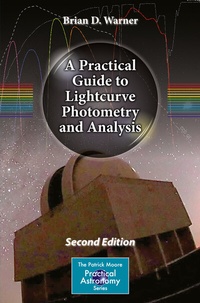
A Practical Guide to Lightcurve Photometry and Analysis
Description

For those with access to even a modest telescope and CCD camera, this new and improved guide delivers all the information needed to take part in the scientific study of asteroids and variable stars. New techniques in photometry continue to be refined, and expert Brian Warner covers the developing territory in detail for those both new and experienced. Updated to reflect changes in telescope and CCD technology, it also includes an expanded chapter on the analysis of asteroid lightcurves to cover some of the common pitfalls that lead to incorrect answers as well as how to discover an asteroid satellite via lightcurves. With this information, amateur astronomers can use commercially available equipment to determine the rotation rate, size, and shape of asteroids. Similarly, it is possible to discover the size, temperature, and orbits of stars in binary systems by using this powerful technique.
Brian Warner yet again delivers all the material needed for readers to understand the theory, and avoid the practical pitfalls of lightcurve photometry. Detailed examples are given for obtaining data, and of course for the exciting and rewarding task of analyzing the data to determine the physical properties of the objects. It also includes many detailed finder charts with magnitudes for reference and detailed steps on how to go about gathering data for specific projects without misinterpretation. Any college student or amateur astronomer who wants to go beyond mere imaging with a CCD camera and enter the challenging world of "real science" via the lightcurves of asteroids and binary stars will find everything necessary in this updated book.
Reviews / Votes
"What an excellent book. And not just because it refreshed my mind on all those things you should do to get your CCD photometry right, but because I find I have got them right! ... if you feel you need to improve the standard of your photometry, be it asteroids or variable stars, or indeed anything else, then this book comes highly recommended." (Roger Pickard, The Observatory, Vol. 137 (1258), June, 2017)More details
Other editions
Additional editions
Person
Brian Warner has been an astronomer for 40 years, and has been honored with the 2006 AAS Chambliss Award for Amateur Achievement, the 2007 RTMC Astronomy Expo Clyde Tombaugh Technology Achievement Award, and ALPO's 2013 Walter H. Haas Award. A member of DPS and on the board of trustees of the SAS, he received a Master of Astronomy degree from James Cook University in 2006. He ran the Minor Planet Observer for ten years, and has contributed more than 60 papers to the Minor Planet Bulletin, along with regular articles. He lives in Colorado, USA.
