

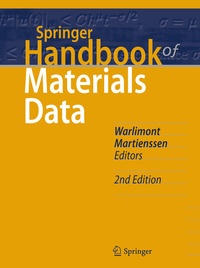
Springer Handbook of Materials Data
Description

The second edition of this well-received handbook is the most concise yet comprehensive compilation of materials data. The chapters provide succinct descriptions and summarize essential and reliable data for various types of materials. The information is amply illustrated with 900 tables and 1050 figures selected primarily from well-established data collections, such as Landolt-Börnstein, which is now part of the SpringerMaterials database.
The new edition of the Springer Handbook of Materials Data starts by presenting the latest CODATA recommended values of the fundamental physical constants and provides comprehensive tables of the physical and physicochemical properties of the elements. 25 chapters collect and summarize the most frequently used data and relationships for numerous metals, nonmetallic materials, functional materials and selected special structures such as liquid crystals and nanostructured materials.
Along with careful updates to the content and the inclusion of timely and extensive references, this second edition includes new chapters on polymers, materials for solid catalysts and low-dimensional semiconductors.
This handbook is an authoritative reference resource for engineers, scientists and students engaged in the vast field of materials science.
More details
Other editions
Additional editions
Persons
Hans Warlimont is a physical metallurgist and has worked on numerous topics at several research institutions and industrial companies. He graduated in physical metallurgy from the School of Mines Clausthal in 1956 and received his Ph.D. from Stuttgart University of Technology in 1959. After spending a few years as a research fellow at the U.S. Steel Corporation, USA, he became head of a research group at the Max Planck Institute for Metals Research in Stuttgart. Between 1977 and 1991, he was director of research at Vacuumschmelze, Hanau before becoming scientific director of the Leibniz Institute of Solid State and Materials Research Dresden and professor of materials science at Dresden University of Technology. In 2002, Hans Warlimont founded DSL Dresden Material-Innovation where he invented and industrialized a novel technology for the galvanoforming of composite battery grids.
Werner Martienssen (1923-2010) was for many years editor-in-chief of the data collection Landolt-Börnstein, which is now part of SpringerMaterials. He studied physics and chemistry at the Universities of Würzburg and Göttingen, and obtained his Ph.D. in physics with R.W. Pohl, Gottingen. Before joining the University of Frankfurt/Main in 1961 as a full professor, he was visiting professor at the Cornell University, Ithaca, USA, and taught physics at the University of Stuttgart. His research focused on condensed matter physics, quantum optics and chaotic dynamics. Two of his former students and coworkers, Gerd K. Binnig and Horst L. Stormer, became Nobel laureates in physics. Werner Martienssen was a member of the German Academy of Sciences Leopoldina, Halle and of the Academy of Sciences in Göttingen.
