

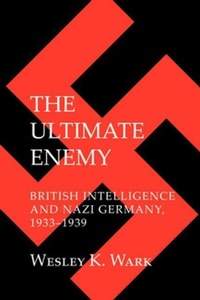
The Ultimate Enemy
British Intelligence and Nazi Germany, 1933-1939
1st Edition
Published on 31. May 2018
304 pages
978-1-5017-1707-9 (ISBN)
Description

How realistically did the British government assess the threat from Nazi Germany during the 1930s? How accurate was British intelligence's understanding of Hitler's aims and Germany's military and industrial capabilities? In The Ultimate Enemy, Wesley K. Wark catalogues the many misperceptions about Nazi Germany that were often fostered by British intelligence.This book, the product of exhaustive archival research, first looks at the goals of British intelligence in the 1930s. He explains the various views of German power held by the principal Whitehall authorities-including the various military intelligence directorates and the semi-clandestine Industrial Intelligence Centre-and he describes the efforts of senior officials to fit their perceptions of German power into the framework of British military and diplomatic policy. Identifying the four phases through which the British intelligence effort evolved, he assesses its shortcomings and successes, and he calls into question the underlying premises of British intelligence doctrine.Wark shows that faulty intelligence assessments were crucial in shaping the British policy of appeasement up to the outbreak of World War II. His book offers a new perspective on British policy in the interwar period and also contributes a fascinating case study in the workings of intelligence services during a period of worldwide crisis.
More details
Series
Language
English
Place of publication
NY
United States
Edition type
Digital original
Illustrations
5 charts and graphs
5 charts and graphs - 5 Graphs
ISBN-13
978-1-5017-1707-9 (9781501717079)
Copyright in bibliographic data and cover images is held by Nielsen Book Services Limited or by the publishers or by their respective licensors: all rights reserved.
Schweitzer Classification
Other editions
Additional editions

Book
04/2010
Cornell University Press
€39.62
Shipment within 10-20 days

Book
10/1985
Cornell University Press
€58.19
Shipment within 10-20 days
Person
WarkWesley K.:
Wesley K. Wark is Associate Professor of History at the University of Toronto.
Wesley K. Wark is Associate Professor of History at the University of Toronto.
Content
- Cover
- Contents
- Preface
- Abbreviations
- Introduction: Naming the Enemy
- 1. Entering the 1930s-the DRC Report
- 2. Air Force and Aircraft Industry Intelligence, 1933-1936
- 3. The Final Phases in Air Intelligence, 1936-1939
- 4. Army and Armaments Industry Intelligence, 1933-1936
- 5. The Final Phases in Army Intelligence, 1936-1939
- 6. Naval Intelligence, 1933-1939
- 7. The IIC and German Economic Preparations for War
- 8. Four Strategic Appreciations of War against Germany in 1939
- Conclusion: The Four Phases of Intelligence
- APPENDIXES
- 1. The organization of British intelligence, 1933-1939
- 2. Principal senior military officers, attachés, and intelligence staffs
- 3. The growth of the Luftwaffe, 1933-1939
- 4. Squadron composition of the Luftwaffe
- 5. Luftwaffe first-line strength in August 1938 and September 1939
- 6. British long-range predictions of Luftwaffe first-line strength by 1939
- 7. IIC estimates of monthly German airframe production (1933-1939) and of complete aircraft produced (1939)
- 8. IIC estimates of monthly German aeroengine production, 1933-1939
- 9. IIC estimates of employment in the German airframe industry
- 10. German army expansion, 1933-1939
- 11. Comparative naval strengths of Britain and Germany, 1933 and 1939
- Notes
- Selected Bibliography
- Index
- A
- B
- C
- D
- E
- F
- G
- H
- I
- J
- K
- L
- M
- N
- O
- P
- R
- S
- T
- U
- V
- W
- X
- Y
