

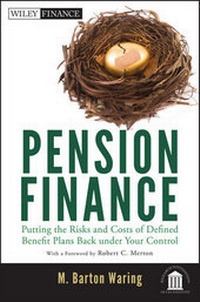
Pension Finance
Putting the Risks and Costs of Defined Benefit Plans Back Under Your Control
Published on 13. September 2011
336 pages
978-1-118-13836-6 (ISBN)
Description

Pension plans around the world are in a state of crisis. U.S. plans alone are facing a total accrued liability funding deficit of almost $4 trillion (of the same order of magnitude as the federal debt), a potential financial catastrophe that ranks among the largest ever seen. It has become clear that many government, corporate, and multi-employer pension sponsors will not be able to cope with this crippling debt and may default on promised benefits. And many of those sponsors that might be able to cope are exasperated by continuous, ongoing negative surprises-large unexpected deficits and higher-than-expected required contributions and pension expense-and are choosing to terminate their plans.
But it need not be so. Pension Finance: Putting the Risks and Costs of Defined Benefit Plans Back under Your Control walks the reader through the conventional actuarial and accounting approaches to financing pension benefits and investing plan assets, showing that the problems described happen as a natural consequence of the dated methods still in use. It shows in detail how modern methods based on market value will easily minimize these risks: Pension plans can in fact be comfortable for employers to sponsor and safe for employees to contribute todepend on for their retirement needs.
This book is must-read for defined benefit pension plan sponsors and employee representatives, plan executives, board members, accountants, fund managers, consultants, and regulators., Research sponsored by the CFA Institute, this book demystifies pension finance, previously accessible only to actuaries. It teaches the topic in lay terms by drawing complete analogies to ordinary transactions such as paying off a mortgage or saving for college. Armed with this book, anyone comfortable with finance and investments in any other context can be comfortable with pension finance and pension investment policy. And further armed with a handheld financial calculator, any layperson can quickly estimate the contributions needed to keep a given plan comfortably solvent, giving them a powerful tool for oversight.
Reviews / Votes
"Represents a timely and valuable contribution. Waring hasbeen studying pension management for decades, and his soundeconomic foundation is grounded in reality through his work in thetrenches. Drawing on this expertise, he has produced a perfectresource for anyone hoping to understand the practical aspects ofmeasuring defined benefit risks. . . Waring is writing to leave alegacy for pension advisers. He has succeeded in creating one ofthe definitive works on the structure and management of definedbenefit plans. Pension Finance forcefully dispels any notionthat easy solutions exist. No accounting magic or special portfoliostrategy can rid companies of underfunding. Although the soberingtruth is hard to swallow, Waring's clarity makes this bookessential."-- CFA Institute PublicationsMore details
Other editions
Additional editions
M. Barton Waring
Pension Finance
Putting the Risks and Costs of Defined Benefit Plans Back Under Your Control
Book
12/2011
Wiley
€88.00
Shipment within 15-20 days
Persons
M. BARTON WARING is a financial economist and lawyer, and an active researcher in pension finance and investing. He retired in 2009 from his role as CIO for investment strategy and policy, emeritus, at Barclays Global Investors. Mr. Waring is well known in the pension industry for his many thoughtful and often prizewinning articles. He serves on the editorial board of the Financial Analysts Journal and as an Associate Editor of the Journal of Portfolio Management.
Content
- Intro
- Pension Finance : Putting the Risks and Costs of Defined Benefit Plans Back under Your Control
- Contents
- List of Figures
- List of Propositions
- Foreword
- Preface
- Acknowledgments
- CHAPTER 1 Achieving Long Term Health for Pension Plans Using Improved Managerial Accounting Tools
- Perspectives on DB Plans
- What Is Economic or Market Value Accounting?
- What the Following Chapters Provide
- CHAPTER 2 Today's Conventional Pension Finance Practices
- Why Managers Need to Adopt the Economic Accounting Perspective
- Where Are We Today?
- The Accounting Always Follows the Economics
- Historical Context: The Actuaries' Contribution to the Existence of Pensions
- Conclusion
- CHAPTER 3 Measuring Meaningful Present Values
- What Is the Right Discount Rate to Use?
- The Liability-Matching Portfolio: General Perspective
- Risk-Free Rate vs. Expected Return on Assets
- "If We Can Earn 7.5 Percent Per Year Over The Long Term": Happy and Unhappy Asset Return Distributions
- The Employer's Experience
- The Discount Rate Is in Fact the Same on Both Sides of the Full Economic Balance Sheet, But That Doesn't Mean That the Liability Changes Its Value with Changes in Investment Strategy!
- GASB's White Paper and Public Employee Fund Discount Rates
- Conclusion: Discount Rates
- Appendix: Are There Market Values for Pension Plans?
- CHAPTER 4 The Full Economic Liability: The Off-Book Starting Point for Management of Pension Costs
- The Liability: Inherently an Economic Entity
- A Newly Formed Pension Plan
- Multiple Correct Measures of the Accrued Portion of the Liability but Only One PARENT Measure
- Building a Pension Budget Identity
- CHAPTER 5 Core Principles of Pension Accounting: The Full Economic Liability Meets Accrual Accounting and Normal Costs
- Full Economic Normal Cost
- Enter the Matching Principle: Normal Costs Accruing Over Time
- Normal Costs and Retirees, Active Employees, and Future Employees
- Allocating Pension Costs to Current Employees
- Payment Patterns Other Than Level Payments
- Illustrating Normal Costs and Accrued and Total Liabilities over Time
- Comparing Normal Cost Methods
- Normal Costs and Contributions: Multiple Measures?
- Normal Cost and Agreed Levels of Benefit Security: An Accrual Method Not Reliant on the Matching Principle
- Balance Sheet with Accruals of an Economic Measure of Periodic Normal Cost
- Updating the Beginning-Period Pension Budget Identity
- Summary of Discussion of Normal Costs
- Appendix: Computing Level Payment Contributions and Normal Costs with a Handheld Calculator in Order to Gain Understanding of the Nature of the Problem
- CHAPTER 6 Credit Risk and the Discount Rate
- Two Useful Views of the Liability's Value
- Termination and Default Risk
- Conclusion
- CHAPTER 7 Paying for the Plan
- Pension Expense and Contributions
- Other Components of Pension Expense in Addition to Normal Cost
- Distinguishing Economic from Conventional Supplemental Costs
- Strict Economic Pension Expense
- Economic Pension Expense in an Accrual System
- Contributions to the Asset Pool, and the Sponsor's Credit Risk
- Investment Returns on Contributed Assets
- Benefit Payments
- The Components of Economically Determined Contributions
- An Example Immediately Usable in the Boardroom: Analyzing Contributions for the Aggregate Plan with an HP 12c
- The Volatility Of The Deficit Is Equal To The Volatility of Contributions
- Conclusion
- CHAPTER 8 Investment Strategy I: Liability-Relative Optimization
- Investment Policy and Strategy for Investors with Liabilities
- The Augmented Balance Sheet: Optimizing on the Combined Risks of the Sponsor and the Plan
- Brief Review of the Theory of Surplus Return and Surplus Asset Allocation
- The Elephant in the Strategic Asset Allocation Room
- CHAPTER 9 Investment Strategy II: Managing Risks to the Plan's Surplus, to Pension Expense, and to Contributions Using the Liability-Matching Asset Portfolio
- Show Me the Money: Risk Control Through the Liability-Matching Asset Portfolio
- What Liability Should Be Hedged in the Surplus Asset Allocation Process?: Defining Capital Gains and Losses in the Accrued Liability
- Hurdles to Adoption of Surplus Asset Allocation and to Holding an LMAP Portfolio: Why Isn't This Easier to Implement?
- The Shape of Investment Strategy for Pension Plans Using Surplus Optimization and the Two-Fund Theorem
- Conclusion
- Appendix: Why Use Dual Durations in the Liability Measures?
- CHAPTER 10 Investment Strategy III: Risk Tolerance and the Decision to Hold Risky Assets Over and Above the Liability-Matching Asset Portfolio
- Why Hold Any Equities or Risky Assets?
- Can the Sponsor Afford the Risk if It Happens? One Part of Identifying the Organization's Tolerance for Risk
- Visualizing and Comparing Return/Risk Tradeoffs Among Alternative Investment Strategy Choices
- Controlling Economic Risk to the Surplus Equals Controlling Accounting Risks to the Plan
- Implementing a RAP in Addition to a Liability-Matching Portfolio
- Benefits of Surplus Optimization and the LMAP When a RAP Is Held
- Conclusion
- Appendix: When Is a Plan Truly in Surplus?
- CHAPTER 11 Investment Strategy IV: Asset/Liability Studies-The Conventional Approach
- Traditional Actuarial Asset/Liability Studies
- Modeling in the Traditional Actuarial Pension Approach
- Possible False Correlations and Bad Investment Strategy Results
- Do the Results Prove the Asset/Liability Method?
- Managing the Present Value of Future Contributions through Investment Strategy
- Conclusion
- CHAPTER 12 A Retirement Party for the Required Rate of Return
- Visualizing the Required Rate of Return
- The Effect of Investment Risk on Surplus Risk and Contribution Risk Over Time
- Effect of the Required Rate of Return on Investment Strategy
- Actuarial Confidence in High Expected Returns
- Presenting the Gold Watch
- Postscript
- CHAPTER 13 The Fully Generalized Pension Budget Identity
- The Inviolability of the FEL
- CHAPTER 14 Tough Love: Saving the Underfunded Pension Plan
- An Action Plan: Something Has to Be Done, but It Isn't Going to Be Easy
- Accounting and Reporting Policy
- Contribution Policy and Benefit Policy
- Investment Policy and Strategy
- Making These Changes Is Important!
- CHAPTER 15 Public Policy Suggestions-Revising Accounting and Actuarial Standards for Pensions
- Only One Accrued Liability, Please!
- Articulation between Financial Statements
- Pension Expense
- Smoothing and Amortizations?
- Pension Contributions
- Financial Amortization Rather Than Actuarial Amortization
- Reconfiguring the Elements of Pension Expense on the Income Statement
- Should the Pension Trust Be Off the Sponsor's Balance Sheet, or On?
- Financing the PBGC's Guarantee, or Financing Pension Plans Directly?
- The IRS and Pension Deductibility
- Summary of Public Policy Suggestions
- Beyond Managerial Accounting: Should Accounting and Actuarial Regulatory Frameworks Be Changed?
- CHAPTER 16 Beyond the Crisis: Making Better Management Decisions and Managing Plans at Lower Risk
- Mark-to-Market Accounting Is Not a Reason to Terminate the Plan
- The Intuition Is Already Out There
- Our Legacy as Pension Advisors
- APPENDIX A Variables and Terms Used in the Book
- APPENDIX B Implicit Options in the Pension Plan
- Termination or Default Option
- PBGC Put
- Participant Call on Economic Surplus
- APPENDIX C Use of Protective Put Options in the Investment Strategy
- References
- About the Author
- Index
