

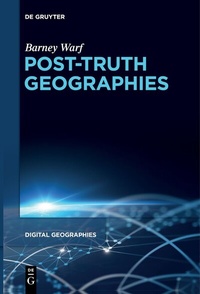
Post-Truth Geographies
Description

This book explores the geographical dimensions and implications of the post-truth era. Opening with a defense of the Enlightenment and the continued significance of science, objectivity, and truth, it then provides three key perspectives on the concept:
The first is a philosophical analysis of post-truth. Social theory in various forms has sutured knowledge and power, in the process relativizing the nature of truth. This process reaches its apogee under post-modernism, which questions the very nature of truth itself.
The second is the examination of the historical origins and development of the post-truth world. While post-truth has a history that can be traced back to the 18 th and 19 th centuries, more recently it has growth prolifically through the use of social media. The book examines post-truth as it appears in the yellow journalism of the Hearst newspapers, Holocaust denial, and contemporary attacks on science itself (e.g., the anti-vaccine movement, denial of evolution). Post-truth becomes a central issue in Western politics following Brexit and the election of Donald Trump, who uses it frequently to advance a reactionary political agenda. Russian hackers weaponize it to interfere in the politics of Europe and the U.S. Fox News and other right-wing outlets also play a central role. One result is the proliferation of unfounded conspiracy theories such as QAnon. Today, autocrats and dictators the world over use fake news to maintain their power.
Finally, this book links the rise of a post-truth society to the dynamics of contemporary economic geography. Knowledge-intensive capitalism has greatly elevated the significance of symbolic workers or the creative class. Geographically, contemporary capitalism has accentuated the agglomeration of producer services in large urban areas in which such workers labor. Conversely, rural areas and small towns have largely become repositories of the undereducated, and thus are more susceptible to fake news.
More details
Other editions
Additional editions
Person
Barney Warf is a human geographer with interests in political and economic geography with decades of experience publishing. Much of his work has concerned information systems, particularly the internet, but he is also interested in social theory and epistemology. He has studied Donald Trump extensively and recently edited a book about him ( Political Landscapes of Donald Trump , 2021, Routledge). He has also recently co-edited the Handbook on Geographies of Media (forthcoming, Routledge).
