

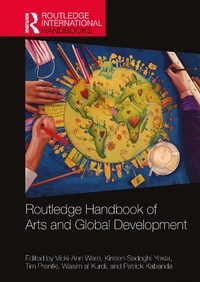
Routledge Handbook of Arts and Global Development
1st Edition
Published on 29. August 2024
564 pages
978-1-040-11366-0 (ISBN)
Description

This book brings together a leading team of international experts in arts and global development to showcase effective practice and to explore how this vibrant interdisciplinary field has developed and what the latest research can teach us.
Although arts play a central role in human development, and in the health and wellbeing of individuals and communities, few have attempted to comprehensively explore arts practice as global development. This Handbook first provides a theoretical framework for exploring arts and global development, before surveying a comprehensive range of art forms and development practices to explore the potential of the arts to strategically and beneficially contribute to more just and equitable conditions for communities across the globe. Stretching across the arts from theatre, dance, and music to poetry, film, and visual arts, the book covers topics as diverse as health, education, peacebuilding, livelihoods, sustainability, activism, and arts as research method in programming. The Handbook also identifies gaps in the literature, pointing towards the most pressing and promising avenues for further research over the next few years.
This book will be an essential resource for any researcher, student, or practitioner wishing to understand the role of the arts in global development and in the global south more generally.
Although arts play a central role in human development, and in the health and wellbeing of individuals and communities, few have attempted to comprehensively explore arts practice as global development. This Handbook first provides a theoretical framework for exploring arts and global development, before surveying a comprehensive range of art forms and development practices to explore the potential of the arts to strategically and beneficially contribute to more just and equitable conditions for communities across the globe. Stretching across the arts from theatre, dance, and music to poetry, film, and visual arts, the book covers topics as diverse as health, education, peacebuilding, livelihoods, sustainability, activism, and arts as research method in programming. The Handbook also identifies gaps in the literature, pointing towards the most pressing and promising avenues for further research over the next few years.
This book will be an essential resource for any researcher, student, or practitioner wishing to understand the role of the arts in global development and in the global south more generally.
Reviews / Votes
'This is an excellent volume, breath-taking in both the breadth of its field of reference and clarity in its analysis of what we know about the potential of arts as (rather than in) development, and about what more work is required. Similarly impressive is the way the volume balances theoretical rigour with the pragmatic requirements of delivering arts-led development projects. This is a must-read volume for academics and practitioners working in this fast-growing area.'Paul Cooke, Centre for World Cinemas and Digital Cultures, School of Languages, Cultures and Societies, University of Leeds, UK
'It seems increasingly improbable to hope for a more just and equitable world. This book joyfully reminds us of the power, possibilities and limitations of the arts to reimagine our futures.'
Peter O'Connor, FRSNZ, The University of Auckland, New Zealand
'This ground-breaking handbook is vital reading for scholars, practitioners, policy makers, funders, and educators interested in harnessing the potential of the arts as global development. It critically charts the latest developments in the field, valuably outlines key concepts and frameworks, and showcases a wide array of practice, programs, and thinking from leading researchers and practitioners across the world. The handbook is engagingly structured around some of the most pressing issues facing our generation, and makes a compelling case for the essential role the arts can play in wellbeing, healing, social interaction, and enabling communities to imagine their own aspirations for development. Powerful, thought-provoking, and extraordinarily timely for the world we live in right now. Highly recommended reading!'
Brydie-Leigh Bartleet, Lead Editor of The Oxford Handbook of Community Music; Professor at the Creative Arts Research Institute, Griffith University, Australia
More details
Series
Edition
1. Auflage
Language
English
Place of publication
London
United Kingdom
Publishing group
Taylor & Francis Ltd
Target group
College/higher education
Professional and scholarly
Illustrations
8 Line drawings, black and white; 36 Halftones, black and white; 44 Illustrations, black and white
ISBN-13
978-1-040-11366-0 (9781040113660)
Copyright in bibliographic data and cover images is held by Nielsen Book Services Limited or by the publishers or by their respective licensors: all rights reserved.
Schweitzer Classification
Other editions
Additional editions
Vicki-Ann Ware | Kirsten Sadeghi-Yekta | Tim Prentki
Routledge Handbook of Arts and Global Development
Book
05/2026
1st Edition
Routledge
€63.50
Shipment within 10-20 days

Vicki-Ann Ware | Kirsten Sadeghi-Yekta | Tim Prentki
Routledge Handbook of Arts and Global Development
Book
09/2024
Taylor & Francis
Unfortunately, price unknown
Available (delivery time upon request)
Vicki-Ann Ware | Kirsten Sadeghi-Yekta | Tim Prentki
Routledge Handbook of Arts and Global Development
Book
08/2024
1st Edition
Routledge
€335.20
Shipment within 10-20 days
Persons
Vicki-Ann Ware lectures in development studies at Deakin University, Australia. An ethnomusicologist, widely published with 30 years of experience in arts-based community work, she researches arts-based community development/peacebuilding. Having worked in mainland Southeast Asia, she currently works in Bangladesh and Indonesia. She convenes the Arts/Sports Community Development Network and is the artistic director for Casey Philharmonic Orchestra.
Kirsten Sadeghi-Yekta holds a PhD in applied theatre from The University of Manchester, UK. She is Associate Professor at the University of Victoria, Canada. Currently, she is working on her SSHRC grants on Coast Salish language revitalisation through theatre. Sadeghi-Yekta has published many articles in a variety of journals.
Tim Prentki is Emeritus Professor of Theatre for Development at the University of Winchester, where, for many years, he created and ran the MA in theatre and media as development. This programme trained students to become facilitators of theatre and video processes designed to assist communities in addressing issues in relation to their self-development. Students ran projects throughout the world. Prentki has been involved in projects, NGO training, and academic collaborations in Asia, Africa, and South America. He has served on the editorial and advisory boards of Research in Drama Education and Applied Theatre Research. A past winner of a Southern Arts award, he has written and directed for theatre for 50 years, including Shakespeare, contemporary writing, and his own scripts, two of which, Half Measures and Lear in Brexitland, were recently presented at the Shakespeare North Playhouse. His current works are Henry VII: Shakespeare's 'Lost' Play and Empire's Edge or What You Will.
Wasim al Kurdi is a poet, writer, and practitioner in drama and theatre in education. He served as Director of the Educational Programme at Palestine's A.M. Qattan Foundation and as Academic Director of DiE Summer School in Jordan. He has authored books on education, culture, and the arts.
Patrick Kabanda is the author of The Creative Wealth of Nations (2018). He has consulted for the World Bank and the United Nations Development Programme. A Juilliard and Fletcher graduate, he was awarded the 2013 Presidential Award for Citizenship and Public Service from Tufts University, Massachusetts (www.musikaba.net).
Kirsten Sadeghi-Yekta holds a PhD in applied theatre from The University of Manchester, UK. She is Associate Professor at the University of Victoria, Canada. Currently, she is working on her SSHRC grants on Coast Salish language revitalisation through theatre. Sadeghi-Yekta has published many articles in a variety of journals.
Tim Prentki is Emeritus Professor of Theatre for Development at the University of Winchester, where, for many years, he created and ran the MA in theatre and media as development. This programme trained students to become facilitators of theatre and video processes designed to assist communities in addressing issues in relation to their self-development. Students ran projects throughout the world. Prentki has been involved in projects, NGO training, and academic collaborations in Asia, Africa, and South America. He has served on the editorial and advisory boards of Research in Drama Education and Applied Theatre Research. A past winner of a Southern Arts award, he has written and directed for theatre for 50 years, including Shakespeare, contemporary writing, and his own scripts, two of which, Half Measures and Lear in Brexitland, were recently presented at the Shakespeare North Playhouse. His current works are Henry VII: Shakespeare's 'Lost' Play and Empire's Edge or What You Will.
Wasim al Kurdi is a poet, writer, and practitioner in drama and theatre in education. He served as Director of the Educational Programme at Palestine's A.M. Qattan Foundation and as Academic Director of DiE Summer School in Jordan. He has authored books on education, culture, and the arts.
Patrick Kabanda is the author of The Creative Wealth of Nations (2018). He has consulted for the World Bank and the United Nations Development Programme. A Juilliard and Fletcher graduate, he was awarded the 2013 Presidential Award for Citizenship and Public Service from Tufts University, Massachusetts (www.musikaba.net).
Content
Foreword: Culture is Development Section 1: Introduction Section Introduction 1. Introduction: Arts and Global Development - Uneasy Bedfellows? 2. Core Concepts in Arts & Global Development Section 2: Promoting Health and Wellbeing Through Arts Section Introduction 3. Art-Making as the 'Journey of the Heart' 4. Social Theatre of the Affects: Social Theatre as a Tool to Talk About Sexual Violence Within High Schools in Sao Paulo, Brazil 5. Art therapy training in South Africa: Pedagogical Strategies for Social Action During and Beyond the COVID-19 pandemic Section 3: Education and Knowledge Transmission Section Introduction 6. Integrating the Arts of Indigenous Religion Adherents into Global Development for Education: A Case Study from Indonesia 7. On The Pathway to Critical Consciousness: Fostering Critical Thinking Through Drama in a Chilean 'Vulnerable' School 8. Empowerment Through the Pedagogical Application of Ancient Persian Dramatic Storytelling 9. Language Reawakening Through Theatre 10. In the Mayhem of Dance: A Vernacular Dance Pedagogy 11. The Right to An Aesthetic Experience: Theatre and Restoration of Rights for Victims of Sexual Commercial Child Exploitation Section 4: Peacebuilding and Conflict Transformation Section Introduction 12. Restoring Arts Practices After Armed Conflict: The Critical Junctures That Support Collaborative Arts-Based Interventions 13. Performing Democracy, Building Peace: The Case of Speak Out! 14. Arts and Conscientisation in Asset-Based Community Development and Peacebuilding: A Case Study in the Midst of Ethnic Cleansing in Myanmar 15. Bards of Dadaab: Oral Poetry and Psychological Healing Among Somali Refugees in Kenya 16. Kinaesthetic Empathy: The Others in Me 17. Assessment and Cultural Sensitivity Regarding International Graffiti on the Separation Wall in Palestine 18. Hamdeli: Theatre, Culture, and Displacement in Afghanistan 19. Theatre as Mode of Empowerment: Understanding The Reawakening of Independent Theatre in Assam Section 5: Socio-Political Activism and Change Section Introduction 20. Drama Practice Within Development 21. The Art of Development: From Arts and Development to Arts as Development 22. The Coalition of Immokalee Workers: Farmworkers' Rights Through Activism and Art 23. 'Alive' Community Culture in Chile: Connective Challenges 24. Community Artistic Practices and Participation - Dialogues Between Southern Europe and Latin America 25. Art, Activism and Rock n Roll: Radical Art Collectives in South East Asia Section 6: Gender Issues and the Arts Section Introduction 26. Becoming public: Institutional Music Education and Gender Equality in Afghanistan 27. Formulating experience through reflective practice: Human practice from artistic production to aesthetic perception 28. Feminist Artivism: Deconstructing Contested Spaces of Masculinity Section 7: Livelihoods and Cultural Sector Development Section Introduction 29. Ethical Practice and Financial Precarity: A Case Study of The Economic and Social Contexts for Arts and Development Practitioners in Kisumu, Kenya 30. Opportunities for Hope and the Support to Fly: The Role of an Intermediary in the Craft and Design Sector in South Africa 31. Action for Hope's School of Music: The Pedagogy of Heart to Heart Section 8: Environmental Sustainability and the Arts Section Introduction 32. With One Breath: Creating Art on the Climate Crisis between the UK and Uganda 33. WaterAid: Representing Development through Art and Developing Artists through Representation 34. Shifting from Development to Empowerment through Eco-Creative Knowledge Transmission 35. An Achipelagic Ethnography: Stories Emerging from Climate Change, Everyday Acts of Emancipation, and Applied Theatre in Island Community in the Philippines Section 9: Conclusions: Emerging Evidence and Research Agenda Section Introduction 36. Drawing It Together: The Art of Development
