

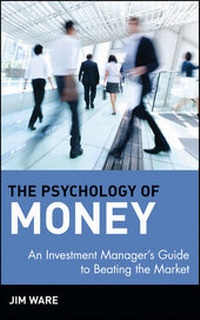
The Psychology of Money
Description

Reviews / Votes
"The Psychology of Money is a well-written and entertaining bookthat challenges money managers and individual investors to rethinktheir view of the investment decision-making process."(FinancialAnalysts Journal) "This book should be read by everyone!" (Mimi Lord, MorningstarSenior Editor)More details
Other editions
Additional editions
Person
Content
Chapter 2
The Eight Great Traits
Habit is habit, and not to be flung out of the window by any man, but coaxed downstairs a step at a time.
—Mark Twain
Don’t you hate those books—with titles like “The Secret to Prosperity: Investing in Bull Markets”—that take a simple concept and stretch it over five lifetimes? I read one recently where the author’s point was that leadership involves managing opposing forceslike the interests of shareholders versus the interests of employees. Valid point, but it didn’t require 281 pages to pound it into my brain. So in this chapter, I present the guts of my findings … briefly. That way there will be room for some other neat material in the book and you’ll still be able to finish this by the time the plane lands. Here are the eight great traits of master investors.
1. BREADTH: TAKING IN INFORMATION
Breadth refers to a person’s ability to take in data. Like radar that constantly scans the horizon, these five investors are ravenous for information. Their interests include not only domestic common stocks, but foreign stocks and other asset classesand interests outside of investing as well. Soros, for example, was a philosophy major and is deeply involved in world politics. Lynch is involved in charitable causes.
Consider Peter Lynch’s schedule when he was actively managing the Magellan Fund. He visited with about 50 managements per month, which meant more than 500 per year, traveling more than 100,000 miles. When not traveling, he received upwards of 50 broker calls per day and timed each one with an egg timer. Each salesperson had 90 seconds to make the pitch. Why? Because Lynch was hungry for more information. He wanted to free up the line for the next blip on the radar screen.
2. OBSERVATION: RETAINING DETAILS
Sherlock Holmes once remarked to Watson, “You see, but you do not observe.” What the legendary detective meant, of course, was that Watson did not see the significance of the small clues, the ones that unlocked the mystery. Again, all five of the masters share this capacity for details. This trait is different from the first (breadth). Two analysts might go to the same conference, but one would come away with a wealth of important details, whereas the other might retain very little. Retention of details, then, is key to successful investing. Ralph Wanger remarks, in his book A Zebra in Lion Country (Simon & Schuster 1997), that most research is just plain hard detail work. Likewise, Buffett is famous for his encyclopedic knowledge of the facts. He is able to recite the financial condition of all the businesses in his home town of Omaha, as if their balance sheets were printed on the facades of their buildings.
3. OBJECTIVITY: THINKING CLEARLY
The behavioral finance people have explored this area rather thoroughly, discussing such phenomena as overreaction, overconfidence, anchoring, and the like. Their point is that the economic assumptionthat humans are rational decision makersis false. Rather, we make systematic errors in our thinking that lead to predictable and exploitable investment mistakes.
The most powerful example of this in my experience occurred in 1989. Iben Browning, a climatologist for PaineWebber, predicted that a major earthquake would strike northern California in the fall. Iben was a great presenter, a good storyteller with provocative subjects: earthquakes, tidal waves, and volcanoes. I cannot remember any of his predictions coming true, but he followed the adage: often in error, never in doubt. (My own guess about Iben’s position at PaineWebber is that the firm’s economists wanted him on board to make their economic forecasts appear more credible.) Rather surprisingly, Iben’s prediction about the quake in Northern California proved accurate. Immediately thereafter, Iben’s stock as a forecaster shot up. The Wall Street Journal carried a story about him and his accurate prediction. Soon he issued another warning: that the New Madrid fault, which runs through St. Louis and the Midwest, would shift later that year. (This event was not unprecedented; in the nineteenth century an earthquake occurred in that area and shook church bells as far away as Boston.)
Iben predicted a similarly shocking blast. Closer to home, the news of this prediction began to affect my colleagues in Chicago, all of whom were professional investors and most of whom had advanced degrees and designations like Chartered Financial Analyst (read: intelligent). One by one these intelligent professionals bought earthquake insurance. That’s how strong panic mania can be. Of course, having studied behavioral finance and learned about our tendency to succumb to irrational fears, I was able to resist much longer than most before calling my insurance agent, Arnie.
Me: “Arnie, can you give me a quote on earthquake insurance?”
Arnie: “On what?”
Me: (softly) “Earthquake insurance.”
Arnie: “I’ve never quoted that before. Just a second.”
Returning after a few moments:
Arnie: “How would you like to buy some deep mining insurance?
Me: “What is that?”
Arnie: “Well, if someone is mining near your house and they set off an explosive that damages it, then your house is covered.”
Me: “Why would I want that?”
Arnie: “Well, it’s cheaper than earthquake insurance, and since you won’t need either, I thought I’d save you some money.”
As you know, of course, the joke was on my colleagues and me. We got pulled into the panic mentality, believing that there might be an earthquake. There never was. But the point is about objectivity and how hard it is to maintain. Dostoevsky, the great Russian novelist, was of the opinion that you can say anything you want about human beings, but don’t say they are rational. Behavioral finance people agree.
Despite the difficulty of remaining objective, Soros is known to be cool as ice under pressure, even when the stakes are high. As Lynch is fond of saying, “The stock doesn’t know that you own it, so don’t take it personally.”
4. DISCIPLINE: BEING CONSISTENT AND ORGANIZED
This trait is so important that several firms use it in their advertising. One firm proclaims, “Solid Performance Built on Discipline, Consistency, and Teamwork.” Zweig, the technician, agrees. He instructs investors never to “fight the tape.” In his book, Marty Zweig’s Winning on Wall Street (Warner Books 1997), he gives examples of the times when Jesse Livermore (his idol) went against this wisdom and regretted it.
Similarly, Buffett believes that the secret to investing isto use a baseball metaphorswinging at the perfect pitch. Wait for the fat one; don’t flail away at all the wild, crazy noise in the market. That is discipline. Hence his suggestion that each new investor be given a card with 20 punches on it. He believes that each investor will probably only have 20 or so great ideas in a lifetime of investing. So, wait for them.
Lynch admits that in his career he has fallen off his path several times. He says that he’s fallen for about 30 whisper stock recommendations. (These are the mysterious phone calls where someone whispers the name of a hot stock. Lynch comments: “Don’t they realize that the SEC can amplify these conversations?”) In any event, all of these stocks went bad for Lynch, reminding him yet again that he needed to stick with his strategy of extensively researching the management and business and learning the “story” behind the stock.
5. DEPTH: THINKING IN FOCUS AND INDEPENDENTLY
The French mathematician Pascal once remarked that most of the world’s troubles are caused by the inability of men to sit quietly in a room. This dictum can be applied to many investment analysts. How many of us can shut the door and think deeply and independently, rather than falling under the influence of what others say? The trait of depth acknowledges the importance of such thinking. Soros is known to permit no distractions when he is working. He is said to have unremitting concentration. It is this sort of focus that allows him to develop and implement winning trading strategies.
Similarly, Richard Feynman, the Nobel prizewinner mentioned earlier, made the same request when he started teaching physics after his work in Los Alamos on the atom bomb. He asked for several hours of uninterrupted time each morning so that he could think deeply and do the kind of thought experiments that Einstein had already made famous.
6. CREATIVITY: SEEING THE BIG PICTURE AND USING METAPHORS
A recent issue of Forbes magazine contained 12 ads for financial firms, all stressing their creative edge. Success in today’s rapidly changing world requires innovation at all levels: portfolio selection, asset allocation, marketing, recruiting, and so on. Ralph Wanger, one of our masters, is a fan of the metaphor as a creative tool. He encourages analysts to use metaphors to play with their ideas and avoid “hardening of the categories.” Furthermore, Wanger believes that intuition is a valuable ally, especially when it is developed through experience on the job. (More on intuition later.)
Also important is humor. Humor is a sign of a creative mind. These masters all have their own brand of wit, revealing their creativity. Lynch playfully speaks of finding...
