

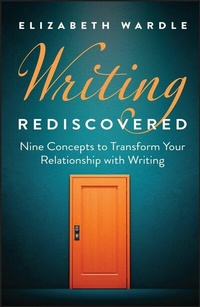
Writing Rediscovered
Description

Reframe Your Ideas About Writing. Reclaim Your Power as a Writer.
In Writing Rediscovered, author and writing scholar Elizabeth Wardle invites you to transform your approach to writing through nine powerful "threshold concepts." These foundational ideas will reshape how you think, feel, and act as a writer.
Rather than offering generic writing tips, this book dives deep into what's holding you back from seeing yourself as a writer. You'll challenge your beliefs about what writing is, who can be a writer, and what makes writing "good." Dr. Wardle helps you reflect on past experiences with writing instruction and replace damaging ideas with more productive ones.
Writing Rediscovered blends decades of research with accessible, interactive methods, offering practical tools to help you reshape your writing identity. Whether you're writing reports, emails, or poetry, this book will change how you approach writing.
Inside the Book:
- Research-based strategies for building writing confidence and understanding your relationship with writing.
- Insights into how your experiences, emotions, body, and tools influence your writing process.
- Reflective activities to actively engage you in transforming your writing life.
- Exercises for developing your personal writing process and toolkit.
- Guidance for creating a Writer's Manifesto to shape your writing going forward.
From the author of Writing About Writing-the groundbreaking textbook that revolutionized college writing instruction-Writing Rediscovered dismantles harmful myths about writing. As Director of the Howe Center for Writing Excellence at Miami University, Elizabeth Wardle brings decades of experience helping writers of all kinds redefine their relationship with writing.
It's time to reframe your writing. Reclaim your voice. And rediscover the power of your words.
More details
Other editions
Additional editions
Person
ELIZABETH WARDLE is the Howe Distinguished Professor of Written Communication and Director of the Howe Center for Writing Excellence at Miami University (Ohio), where she leads innovative faculty development programs that help educators across disciplines rethink their relationship with writing in both academic and professional settings. Based in Oxford, OH, Wardle is the co-author of Writing about Writing and Naming What We Know, both considered seminal works in the field of writing studies.
Content
Introduction: You Make Meaning with Language, So You Are a Writer vii
1 You Are a Writer 1
2 Learning Is Lifelong 13
3 Writing Gets Things Done 29
4 Genres Guide Your Choices 39
5 Good Writing Is Effective Writing 57
6 Good Writers Adapt 75
7 You Need Readers, Revision, and Time 93
8 You Write with Your Whole Self and the Tools You Choose 109
9 You Write to Learn 123
10 Applying What You've Learned: Think Differently, Do Differently 131
Bibliography 149
Acknowledgments 153
About the Author 155
Index 157
Threshold 1
You Are a Writer
"If you are not afraid of the voices inside you, you will not fear the critics outside you."
-Natalie Goldberg
Our culture is full of bad ideas about writing, and one of the most common is that some people are born good writers and others are not. This bad idea often starts at home, continues throughout our schooling, and is reinforced in popular culture. In school, early on we are often placed in ability groups and praised or criticized for what teachers sometimes might call our "natural ability" as readers and writers.
In later schooling, the sorting continues, and some of us are placed in Advanced English or AP English, while others are sorted in what my friend Daphne, who found herself there, still calls "the stupid kids' class." The effects of this sorting are strong and damaging. We are told from a very young age that our reading and writing abilities are simply inherent, natural, or part of our DNA. If we are bad at writing, there's nothing to be done. If we are good at it, we are told again and again how "naturally" writing comes to us. Supreme Court Justice Sonia Sotomayor once said, "Writing remains a challenge for me even today-everything I write goes through multiple drafts-I am not a natural writer." No matter how high she (and others) rise in the world, early ideas about our identities as writers tend to stick with us forever.
These messages about natural writers are reinforced strongly outside of school as well. "Writers" are understood as "artists," and the implication is that an artist is someone born with a genius the rest of us will never have. Our culture is full of images of genius writers, who might be tortured and eccentric, but whose abilities are simply God-given, natural, and part of who they are. "Writing is a calling, not a choice," novelist Isabel Allende said, implying that some people just "have" this ability and others don't.
In fourth grade, my friend Melody put all she had into a play she wrote for Mrs. Braden's class. She expected and hoped for enthusiasm about the imaginary land she had devised. Instead, Mrs. Braden laughed at her for not using the word "enhance" correctly. Melody told me recently that she "decided then and there" that she was not born with "talent for writing"-and never pursued any formal or creative writing again if it was not required for work.
Reflective Activity 1-1
Time: About 10 minutes
- What are your most vivid memories of writing as a child?
- What are the messages you tell yourself about your abilities as a writer? Where do you think those messages came from?
- When you need to write something, whose voices do you hear criticizing or praising you?
Inaccurate and Harmful Messages About Writing
Whether you are criticized for having no natural writing talent or praised as a natural-born writer, the damage of this kind of feedback and messaging can be great. Such messages are full of implied beliefs about writing that are simply wrong.
Such messages misunderstand what writing actually is. They assume that "writing" is formal, long-form text that adheres to some standard of excellence-usually "correctness," followed closely by "beauty" or "original thought." Using "enhance" correctly, for example, is seen as the most important element of a student's writing.
These beliefs about writing discount all the reasons why we write, the many forms writing can take, and more realistic ideas about what makes writing "good" (a point I come back to in Threshold 5). We might not enjoy writing essays or long formal texts, but we might be very good at pithy and funny social media posts or poems or podcasting. We might write fantastical stories about creatures never before imagined, even as we misspell "enhance." But standard beliefs about "good writers" typically overlook any form of writing beyond the correctness, formulas, and processes valued in school.
We are rewarded for being "fast" or "fluent" school writers, usually without any recognition that our home life has an equally great impact on our ability to write quickly, fluently, or "correctly." Some of us come from homes where we are encouraged to write and given the means of writing from a very young age, with parents who also wrote and read extensively. Others of us come from families where our parents worked three jobs and didn't have a lot of free time to spend encouraging us to read or write. Some of us are from immigrant families, and our parents spoke and wrote in other languages and couldn't help us write in English.
Some of us have disabilities that impact our ability to write quickly or fluently. Daphne, for example, was sorted into the lower-level English class because, as she learned later, she had dyslexia. In the 1980s, teachers had little understanding of learning disabilities, and misspelling was often seen as laziness or unwillingness to try. Writing slowly as a result of dyslexia was seen as making someone like Daphne a "bad writer."
Many factors influence how "easily" writing comes to us in a school setting. If we discount those experiences, then it's easy to believe we are inherently able or unable to write well, and that belief becomes a core part of our identities.
High-stakes testing can contribute to this common sense belief about our "innate" ability as writers: we are put in rooms with other students and presented with a test that determines some important aspect of our future. In a short period of time, we are expected to write quickly and correctly on topics we know little to nothing about. If we perform poorly on such tests, we are often further stigmatized as bad writers, sorted, and told again that writing is not our inherent strength.
Being criticized and corrected for mechanical errors while we are still learning can have lifelong consequences. Mrs. Braden's criticisms and mockery stayed with Melody throughout her life. She is a very successful political science professor now, but the childhood message remains: "I would say my dominant emotion around writing has always been fear. I had to cut out caffeine while writing because I was already so anxious every time I tried to write."
Over many years of inaccurate messaging and sorting, we come to believe we are simply "good at" writing-or not. And if we think we are not inherently capable of writing, then we avoid it. We seek out classes and experiences where we don't have to write much. We lean on friends, on autocorrect, on Grammarly-and now on AI. Or we simply freeze, not knowing where to turn for help. We hope no one notices how badly we write. We choose-or are tracked into-jobs where extensive writing is not required.
Those of us who have absorbed the opposite message about our "inherent gifts" track differently-into jobs with a lot of writing, sometimes even as teachers, where we repeat the messaging cycle all over again. But inevitably, "natural-born writers" encounter a writing situation that challenges us, where we can't quickly and fluently produce "good writing" on the first try. Our manager lets us know that we have no idea how to write an annual report or that our letter to the holiday volunteers misses the mark. And we berate ourselves, unsure what to do, since as "natural" writers we have never been taught how to go about engaging in the process of writing and revising (more on that in Thresholds 6 and 7).
Unfortunately, our culture is full of people who have absorbed terrible ideas about writing and themselves as writers. Those terrible ideas keep us from engaging in the fullness and reward of writing as a lifelong process of getting things done, learning, and engaging with feedback and revision.
Better Ideas About Writing
We can change our ideas about writers and writing, based on what research and some basic common sense tell us.
Writing Is Capacious
First, "writing" is many things (I like to say it's "capacious"). Long-form essays written in formal prose for an evaluator are just one kind of writing. Many of us are terrible at this kind of writing because we don't see why it matters, and it is frustrating to write to a reader who ignores our ideas and instead focuses only on comma splices, how we spell "enhance," or whether we use big words like "capacious." But we may thrive when presented with real-world audiences who really respond to and take up our ideas: when we are able to write and record TikTok videos about a hobby we love and find that people respond with questions and praise. When we find a book we enjoy and realize that if we write imaginative fan fiction about Twilight or City of Bones, other readers from across the world engage with our ideas. When someone we just started dating tears up over a poem we write them. When we realize we enjoy reading and writing technical manuals about motorcycles.
Jordan dropped out of college, believing she could not write or succeed there. As a dropout, she started...
