

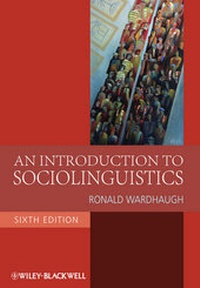
An Introduction to Sociolinguistics
Description

* A fully revised new edition of Ronald Wardhaugh's popularintroduction to sociolinguistics, which now includes over 150 newand updated references and new study features throughout
* Features new "Explorations" sections in eachchapter incorporating suggested readings, discussion sections, andexercises - all designed to encourage students to developtheir own skills and ideas
* Reflects new developments in the field, providing greater focuson ideas such as identity, solidarity, and markedness
* Provides balanced coverage of a range of topics, including:language dialects, pidgins and Creoles, codes, bilingualism, speechcommunities, variation, words and culture, ethnographies,solidarity and politeness, talk and action, gender, disadvantage,and planning
* Comprehensive and accessible, it is the ideal introduction forstudents coming to sociolinguistics for the first time
More details
Other editions
Additional editions
Person
Content
Acknowledgements.
1. Introduction
Knowledge of Language
Variation
Language and Society
Sociolinguistics and the Sociology of Language
Methodological Concerns
Overview
Further Reading
Part I: Languages and Communities:
2. Languages, Dialects, and Varieties
Language or Dialect?
Standardization
Regional Dialects
Social Dialects
Styles, Registers, and Beliefs
Further Reading
3. Pidgins and Creoles
Lingua Francas
Definitions
Distribution and Characteristics
Origins
From Pidgin to Creole and Beyond
Further Reading
4. Codes
Diglossia
Bilingualism and Multilingualism
Code-Switching
Accommodation
Further Reading
5. Speech Communities
Definitions
Intersecting Communities
Networks and Repertoires
Further Reading
Part II: Inherent Variety:
6. Language Variation
Regional Variation
The Linguistic Variable
Social Variation
Data Collection and Analysis
Further Reading
7. Some Findings and Issues
An Early Study
New York City
Norwich and Reading
A Variety of Studies
Belfast
Controversies
Further Reading
8. Change
The Traditional View
Some Changes in Progress
The Process of Change
Further Reading
Part III: Words at Work:
9. Words and Culture
Whorf
Kinship
Taxonomies
Color
Prototypes
Taboo and Euphemism
Further Reading
10. Ethnographies
Varieties of Talk
The Ethnography of Speaking
Ethnomethodology
Further Reading
11. Solidarity and Politeness
Tu and Vous
Address Terms
Politeness
Further Reading
12. Talk and Action
Speech Acts
Cooperation
Conversation
Further Reading
Part IV: Understanding and Intervening:
13. Gender
Differences
Possible Explanations
Further Reading
14. Disadvantage
Codes Again
African American English
Consequences for Education
Further Reading
15. Planning
Issues
A Variety of Situations
Further Examples
Winners and Losers
Further Reading
16. Conclusion
References
Index
2 Languages, Dialects, and Varieties
I stated in the introductory chapter that all languages exhibit internal variation, that is, each language exists in a number of varieties and is in one sense the sum of those varieties. But what do we mean byvariety?Hudson (1996, p. 22) defines a variety of language as‘a set of linguistic items with similar distribution,’ a definition that allows us to say that all of the following are varieties: Canadian English, London English, the English of football commentaries, and so on. According to Hudson, this definition also allows us ‘to treat all the languages of some multilingual speaker, or community, as a single variety, since all the linguistic items concerned have a similar social distribution.’ A variety can therefore be something greater than a single language as well as something less, less even than something traditionally referred to as a dialect. Ferguson (1972, p. 30) offers another definition of variety: ‘any body of human speech patterns which is sufficiently homogeneous to be analyzed by available techniques of synchronic description and which has a sufficiently large repertory of elements and their arrangements or processes with broad enough semantic scope to function in all formal contexts of communication.’ Note the words ‘sufficiently homogeneous’ in this last quotation. Complete homogeneity is not required; there is always some variation whether we consider a language as a whole, a dialect of that language, the speech of a group within that dialect, or, ultimately, each individual in that group. Such variation is a basic fact of linguistic life.
Hudson and Ferguson agree in definingvarietyin terms of a specific set of ‘linguistic items’ or ‘human speech patterns’ (presumably, sounds, words, grammatical features, etc.) which we can uniquely associate with some external factor (presumably, a geographical area or a social group). Consequently, if we can identify such a unique set of items or patterns for each group in question, it might be possible to say there are such varieties as Standard English, Cockney, lower-class New York City speech, Oxford English, legalese, cocktail party talk, and so on. One important task, then, in sociolinguistics is to determine if such unique sets of items or patterns actually do exist. As we proceed we will encounter certain difficulties, but it is unlikely that we will easily abandon the concept of ‘variety,’ no matter how serious these difficulties prove to be.
Language or Dialect?
For many people there can be no confusion at all about what language they speak. For example, they are Chinese, Japanese, or Korean and they speak Chinese, Japanese, and Korean respectively. It is as simple as that; language and ethnicity are virtually synonymous (Coulmas, 1999). A Chinese may be surprised to find that another person who appears to be Chinese does not speak Chinese, and some Japanese have gone so far as to claim not to be able to understand Caucasians who speak fluent Japanese. Just as such a strong connection between language and ethnicity may prove to be invaluable in nation-building, it can also be fraught with problems when individuals and groups seek to realize some other identity, e.g., to be both Chinese and American, or to be Canadian rather than Korean-Canadian. As we will see (p. 391), many Americans seem particularly reluctant to equate language with ethnicity in their own case: although they regard English as the ‘natural’ language of Americans, they do not consider American to be an ethnic label. The results may be the same; only the reasons differ.
Most speakers can give a name to whatever it is they speak. On occasion, some of these names may appear to be strange to those who take a scientific interest in languages, but we should remember that human naming practices often have a large ‘unscientific’ component to them. Census-takers in India find themselves confronted with a wide array of language names when they ask people what language or languages they speak. Names are not only ascribed by region, which is what we might expect, but sometimes also by caste, religion, village, and so on. Moreover, they can change from census to census as the political and social climate of the country changes.
Linguists use the termvernacularto refer to the language a person grows up with and uses in everyday life in ordinary, commonplace, social interactions. We should note that this variety may meet with social disapproval from others who favor another variety, sometimes one heavily influenced by the written form of the language. Therefore, vernacular often has pejorative associations when used in public discourse.
While people usually can give a name to the vernacular they speak, they may not always claim to be fully qualified speakers of a bona fide language. They may experience difficulty in deciding whether what they speak should be called alanguageproper or merely adialectof some language. Such indecision is not surprising: exactly how do you decide what is a language and what is a dialect of a language? What criteria can you possibly use to determine that, whereas variety X is a language, variety Y is only a dialect of a language? What are the essential differences between a language and a dialect?
Haugen (1966a) has pointed out thatlanguageanddialectare ambiguous terms. Ordinary people use these terms quite freely in speech; for them a dialect is almost certainly no more than a local non-prestigious (therefore powerless) variety of a real language. In contrast, scholars may experience considerable difficulty in deciding whether one term should be used rather than the other in certain situations. As Haugen says, the terms ‘represent a simple dichotomy in a situation that is almost infinitely complex.’ He points out that the confusion goes back to the Ancient Greeks. The Greek language that we associate with Ancient Greece was actually a group of distinct local varieties (Ionic, Doric, and Attic) descended by divergence from a common spoken source with each variety having its own literary traditions and uses, e.g., Ionic for history, Doric for choral and lyric works, and Attic for tragedy. Later, Athenian Greek, thekoiné –or ‘common’ language - became the norm for the spoken language as the various spoken varieties converged on the dialect of the major cultural and administrative center. Haugen points out (p. 923) that the Greek situation has provided the model for all later usages of the two terms with the resulting ambiguity.Languageis used to refer either to a single linguistic norm or to a group of related norms, anddialectis used to refer to one of the norms.
The situation is further confused by the distinction the French make betweenun dialecteandun patois.The former is a regional variety of a language that has an associated literary tradition, whereas the latter is a regional variety that lacks such a literary tradition. Therefore,patoistends to be used pejoratively; it is regarded as something less than a dialect because it lacks an associated literature. Even a language like Breton, a Celtic language still spoken in parts of Brittany, is called apatoisbecause it lacks a strong literary tradition and it is not some country’s language. However,dialectein French, likeDialektin German, cannot be used in connection with the standard language, i.e., no speaker of French considers Standard French to be a dialect of French. In contrast, it is not uncommon to find references to Standard English as being a dialect -admittedly a very important one - of English.
Haugen points out that, while speakers of English have never seriously adoptedpatoisas a term to be used in the description of language, they have tried to employ bothlanguageanddialectin a number of conflicting senses.Dialectis used both for local varieties of English, e.g., Yorkshire dialect, and for various types of informal, lower-class, or rural speech. ‘In general usage it therefore remains quite undefined whether such dialects are part of the “language” or not. In fact, the dialect is often thought of as standing outside the language.… As a social norm, then, a dialect is a language that is excluded from polite society’ (pp. 924-5). It is often equivalent tononstandardor evensubstandard,when such terms are applied to language, and can connote various degrees of inferiority, with that connotation of inferiority carried over to those who speak a dialect.
We can observe too that questions such as ‘Which language do you speak?’ or ‘Which dialect do you speak?’ may be answered quite differently by people who appear to speak in an identical manner. As Gumperz (1982a, p. 20) has pointed out, many regions of the world provide plenty of evidence for what he calls ‘a bewildering array of language and dialect divisions.’ He adds:
Exploration 2.1: English Vowels
Wells (1982, pp. xviii-xix) provides the following set of key words’ for use in dialect studies in Britain or North America: kit, dress, trap, lot, strut, foot, bath, cloth, nurse, fleece, face, palm, thought, goat, goose, price, choice, mouth, near, square, start, north, force, and cure. All the sounds in the words are relevant. Foulkes and Docherty (1999) add happy, letter, horse, and comma to this list but only for the final unstressed vowels.
Ask people you know who come from different parts of the English-speaking world to...
