

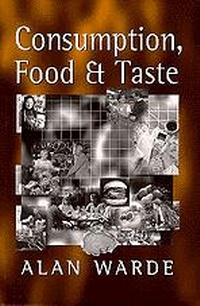
Consumption, Food and Taste
1st Edition
Published on 17. February 1997
240 pages
978-1-4462-6416-4 (ISBN)
Description

Exploring the expression of taste through the processes of consumption this book provides an incisive and accessible evaluation of the current theories of consumption, and trends in the representation and purchase of food.
Alan Warde outlines various theories of change in the twentieth century, and considers the parallels between their diagnoses of consumer behaviour and actual trends in food practices. He argues that dilemmas of modern practical life and certain imperatives of the culture of consumption make sense of food selection. He suggests that contemporary consumption is best viewed as a process of continual selection among an unprecedented range of generally accessible items which are made available both commercially and informally.
Alan Warde outlines various theories of change in the twentieth century, and considers the parallels between their diagnoses of consumer behaviour and actual trends in food practices. He argues that dilemmas of modern practical life and certain imperatives of the culture of consumption make sense of food selection. He suggests that contemporary consumption is best viewed as a process of continual selection among an unprecedented range of generally accessible items which are made available both commercially and informally.
Reviews / Votes
`Alan Warde, professor in sociology at the University of Lancaster, makes here a well argued and important contribution, on the basis of empirical research, to current theories of consumption. The book is in three parts: `Issues of Taste', `Indicators of Taste: Changing Food Habits', and`Interpretations of Taste'. In each, fresh material is usefully explored and new viewpoints presented regarding the relationship between consumption patterns and processes of economic production of
food' -
`Food is of immediate interest to work, employment and society. It straddles a number of sectors, from agriculture through processing and retailing to catering. As such it is the source of a wide variety of jobs, in number and type. Further, food is not fodder; it is prepared both in and out of the home, has enormous symbolic significance, and is intimately related to social and economic reproduction. Warde's carefully constructed and argued book is primarily concerned with food and consumption...
This book does much to clear the ground of other, over-generalized theories of food consumption, and it provides a considerable range of alternative perspectives informed by empirical material. As such, it will prove invaluable to those examining food and consumption. It opens the way for further analytical advance if wedded to, and reconstructed on the basis of , a more detailed attention to specific foods and how they are provided' - Work, Employment and Society
All prices
More details
Language
English
Place of publication
London
United Kingdom
Target group
College/higher education
Professional and scholarly
ISBN-13
978-1-4462-6416-4 (9781446264164)
Copyright in bibliographic data and cover images is held by Nielsen Book Services Limited or by the publishers or by their respective licensors: all rights reserved.
Schweitzer Classification
Other editions
Additional editions
Alan Warde
Consumption, Food and Taste
Book
02/1997
1st Edition
SAGE Publications Inc
€287.20
Shipment within 15-20 days
Alan Warde
Consumption, Food and Taste
Book
02/1997
1st Edition
SAGE Publications Inc
€127.90
Shipment within 15-20 days
Person
Alan Warde is Professor of Sociology at the University of Manchester. He has worked in the sociology of consumption over the last 15 years and has published extensively on the topic. He was Co-Director of the ESRC Centre for Research in Innovation and Competition, between 1999 and 2007, where he was responsible for a programme of research on consumption. He has written a dozen books and edited a further eleven.
Content
PART ONE: ISSUES OF TASTE
Consumption, Taste and Social Change
The New Manners of Food
Trends and their Sociological Interpretation
Measuring Change in Taste
PART TWO: INDICATORS OF TASTE: CHANGING FOOD HABITS
Novelty and Tradition
Health and Indulgence
Economy and Extravagance
Convenience and Care
PART THREE: INTERPRETATIONS OF TASTE
The Reconstruction of Taste
Theories of Consumption and the Case of Food
Consumption, Taste and Social Change
The New Manners of Food
Trends and their Sociological Interpretation
Measuring Change in Taste
PART TWO: INDICATORS OF TASTE: CHANGING FOOD HABITS
Novelty and Tradition
Health and Indulgence
Economy and Extravagance
Convenience and Care
PART THREE: INTERPRETATIONS OF TASTE
The Reconstruction of Taste
Theories of Consumption and the Case of Food
