

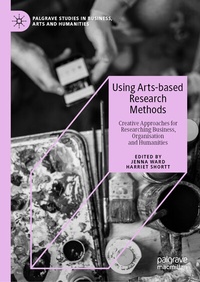
Using Arts-based Research Methods
Description

More details
Other editions
Additional editions
Persons
Jenna Ward is Associate Professor of Work, Organisation and Emotion at the School of Business, University of Leicester, UK. Jenna's research focuses on exploring emotionality within organisations, organising and managing. Prioritising marginalised voices, Jenna's areas of interest include: emotional labour, dirty work, visual and arts-based methods, creative industries, death work and the management and organisation of voluntary work and volunteers. Jenna's research has included working with the Department of Health, the National Trust, the City of London and the NHS. Jenna is Director of the Art of Management and Organization.
Harriet Shortt is Associate Professor of Organisation Studies at Bristol Business School, at the University of the West of England, Bristol, UK. Harriet's research focuses on organisational space, artefacts, the materiality of work, and visual methodologies. Her research has been published in leading journals including Human Relations, Organizational Research Methods, and Management Learning. Harriet is a founding member of the ESRC funded International Network for Visual Studies in Organization, 'inVisio.' Harriet has led research projects in both public and private sector organisations, such as the Environment Agency, the NHS, Stride Treglown Architects, and ISG Construction.
Content
1. Using arts-based methods of research: a critical introduction to the development of arts-based research methods.- 2. Drawing out emotion in organisational life.- 3. Designing dance into qualitative research.- 4. Researching and learning through pocket-film making.- 5. Food as an arts-based method for understanding organisational life.- 6. The ways of the hand: Knitting and handicraft as a method of research.- 7. Life in letters - a method of qualitative inquiry.- 8. A poetic approach to researching silence on organisations.- 9. Using Instagram in participant-led field studies.
