

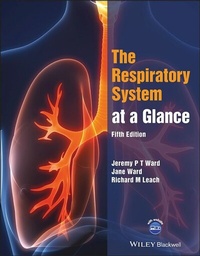
The Respiratory System at a Glance
Description

The market-leading at a Glance series is popular among healthcare students and newly qualified practitioners for its concise, simple approach and excellent illustrations.
Each bite-sized chapter is covered in a double-page spread with clear, easy-to-follow diagrams, supported by succinct explanatory text.
Covering a wide range of topics, books in the at a Glance series are ideal as introductory texts for teaching, learning and revision, and are useful throughout university and beyond.
Everything you need to know about The Respiratory System... at a Glance!
Highly-illustrated overview of the structure and function of the lungs and airways, with sections on history, examination, pathophysiology, treatment and management
Respiratory System at a Glance is a comprehensive guide to normal lung structure and function and associated pathophysiology, featuring key information on all major respiratory disorders.
As per the familiar, easy-to-use 'at a Glance' format, each topic is presented as a double-page spread, with key facts accompanied by clear diagrams that encapsulate essential knowledge. This 'one-stop' resource has been revised and updated for this 5thedition to include recent advances in our understanding and/or treatment of asthma, COPD, pulmonary vasculitis, sarcoidosis, cystic fibrosis, respiratory infections (including COVID-19), and the most recent national clinical management guidelines.
The accompanying website includes self-assessment case studies, flashcards and MCQs to support learning or for review.
Respiratory System at a Glance also provides information on:
- Structure and function of the respiratory system, the thoracic cage and respiratory muscles, gas laws, diffusion, and elastic forces
- Acid-base balance and disorders, control of breathing through chemical and neural mechanisms, and pulmonary circulation and ventilation-perfusion matching
- Exercise, altitude, and diving, complications of development and congenital disease, lung defense mechanisms, and immunology of the lungs
- Public health and smoking, respiratory failure, and the pathophysiology and management of asthma, chronic obstructive pulmonary disease and other respiratory disorders
With accompanying self-assessment clinical cases and multiple-choice questions, The Respiratory System at a Glance is the ideal companion for anyone about to start a respiratory module or rotation, and will appeal to medical students and junior doctors, as well as nurses, dentists, physiotherapists, technicians, and biomedical scientists.
For more information on the complete range of Wiley nursing and health publishing, please visit: www.wiley.com
To receive automatic updates on Wiley books and journals, join our email list. Sign up today at www.wiley.com/email
All content reviewed by students for students
Wiley Medical Education books are designed exactly for their intended audience. All of our books are developed in collaboration with students. This means that our books are always published with you, the student, in mind.
If you would like to be one of our student reviewers, go to www.reviewmedicalbooks.com to find out more.
This new edition is also available as an e-book. For more details, please see www.wiley.com
More details
Other editions
Additional editions
Persons
Jeremy P.T. Ward, PhD, Emeritus Professor of Respiratory Cell Physiology, Asthma UK Centre in Allergic Mechanisms of Asthma, Faculty of Life Sciences and Medicine, King's College London, London, UK.
Jane Ward, MBChB, PhD, Senior Lecturer (retired), Department of Physiology, King's College London, London, UK.
Richard M. Leach, MD, FRCP, Medical Director, Cardiorespiratory and Critical Care Medicine Guy's and St Thomas' Hospital Trust, and Honorary Professor of Medicine Kings College London, London, UK.
Content
Preface to Fifth Edition vii
Units and Symbols viii
Abbreviations x
Glossary xiii
About the companion website xvi
Part 1 Structure and function 1
1 Structure of the respiratory system: lungs, airways and dead space 2
2 The thoracic cage and respiratory muscles 4
3 Pressures and volumes during normal breathing 6
4 Gas laws 8
5 Diffusion 10
6 Lung mechanics: elastic forces 12
7 Lung mechanics: airway resistance 14
8 Carriage of oxygen 16
9 Carriage of carbon dioxide 18
10 Acid-base balance 20
11 Acid-base disorders 22
12 Control of breathing I: chemical mechanisms 24
13 Control of breathing II: neural mechanisms 26
14 Pulmonary circulation and anatomical right- to- left shunts 28
15 Ventilation-perfusion mismatching 30
16 Exercise, high altitude and diving 32
17 Development of the respiratory system and birth 34
18 Complications of development and congenital disease 36
19 Lung defence mechanisms 38
20 Immunology of the lung 40
Part 2 History, examination and investigation 43
21 History and examination 44
22 Pulmonary function tests 46
23 Chest imaging and bronchoscopy 48
Part 3 Diseases and treatment 51
24 Public health and smoking 52
25 Respiratory failure 54
26 Asthma: pathophysiology 56
27 Asthma: treatment 58
28 Chronic obstructive pulmonary disease 60
29 Pulmonary hypertension 62
30 Venous thromboembolism and pulmonary embolism 64
31 Pulmonary vasculitis 66
32 Interstitial (diffuse parenchymal) lung disease 68
33 Sarcoidosis 70
34 Pleural diseases 72
35 Occupational and environment- related lung disease 74
36 Cystic fibrosis and bronchiectasis 76
37 Pneumothorax 78
38 Community- acquired pneumonia 80
39 Hospital- acquired (nosocomial) pneumonia 82
40 Pulmonary tuberculosis 84
41 The immune- compromised patient 86
42 Lung cancer 88
43 Acute respiratory distress syndrome 90
44 Mechanical ventilation 92
45 Oxygenation and oxygen therapy 94
46 Sleep disordered breathing 96
47 Coronavirus disease 2019 98
Index 100
Abbreviations
2,3-DPG 2,3- di(or bi)phosphoglycerate ABG arterial blood gas AHI apnoea plus hypopnoea index AIDS acquired immune deficiency syndrome AIP acute interstitial pneumonia/pneumonitis (Hamman-Rich syndrome) ALK anaplastic lymphoma kinase ANA anti-nuclear antibody ANCA anti-neutrophil cytoplasmic antibody AP anteroposterior aPAH pulmonary arterial hypertension associated with other conditions ARDS acute (formerly adult) respiratory distress syndrome APC antigen-presenting cell ATPS ambient temperature and pressure saturated ATS American Thoracic Society BAL bronchoalveolar lavage BCG bacille Calmette-Guérin BCR B-cell receptor BHL bihilar lymphadenopathy BiPAP bilevel positive airway pressure, biphasic positive airway pressure BMPR2 bone morphogenetic protein receptor type 2 BPD bronchopulmonary dysplasia BPF bronchopleural fistula BTPS body temperature and pressure saturated BTS British Thoracic Society CA carbonic anhydrase cAMP cyclic adenosine monophosphate CAP community-acquired pneumonia CF cystic fibrosis CFTR cystic fibrosis transmembrane conductance regulator cGMP cyclic guanosine monophosphate CMV cytomegalovirus CNS central nervous system CO2 carbon dioxide COHb carboxyhaemoglobin COP cryptogenic organising pneumonia COPD chronic obstructive pulmonary disease CoV coronavirus COX cyclooxygenase CPAP continuous positive airway pressure CRB-65 confusion, respiratory rate, blood pressure, 65 years of age and older CRP C-reactive protein CRS cytokine release syndrome CSA central sleep apnoea CSF cerebrospinal fluid CT computed tomography CTD connective tissue disease CTPA computed tomography pulmonary angiogram CURB-65 confusion, urea nitrogen, respiratory rate, blood pressure, 65 years of age and older CWP coal worker's pneumoconiosis CXR chest X-ray DAH diffuse alveolar haemorrhage DIP desquamative interstitial pneumonia D L CO diffusing capacity of the lungs for carbon monoxide D L O 2 diffusing capacity of the lungs for oxygen DNase deoxyribonuclease DRG dorsal respiratory group DVT deep venous thrombosis ECG electrocardiogram ECMO extracorporeal membrane oxygenation ECP eosinophil cationic protein EEG electroencephalogram EGF epidermal growth factor EGPA eosinophilic granulomatosis with polyangiitis EOG electrooculogram ERV expiratory reserve volume Fab fragment antigen-binding region Fc fragment crystallisable region FDG-PET fluorodeoxyglucose positron emission tomography FEF25-75 mean forced expiratory flow over middle 50% of forced vital capacity FeNO fractional exhaled nitric oxide FER forced expiratory ratio FEV1 forced expiratory volume in one second FEV1/FVC = FER.(FEV1 as a fraction or percentage of FVC) FGF fibroblast growth factor F iO2 fraction of inspired oxygen F O 2 fraction of oxygen FRC functional residual capacity FVC forced vital capacity GBM glomerular basement membrane GPA granulomatosis with polyangiitis H2CO3 carbonic acid HAART highly active antiretroviral therapy HAP hospital acquired pneumonia Hb haemoglobin [Hb] haemoglobin concentration HbA adult haemoglobin HbF fetal haemoglobin HbS sickle haemoglobin HCAP healthcare-associated pneumonia HCO3- bicarbonate HIV human immunodeficiency virus HLH haemophagocytic lymphohistiocytosis HRCT high-resolution computed tomography ICS Inhaled corticosteroids ICU intensive care unit ...
