

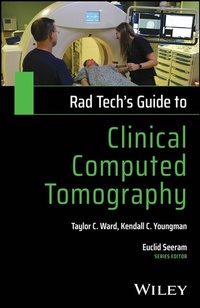
Rad Tech's Guide to Clinical Computed Tomography
Description

Concise guide to the essential components of Computed Tomography
Rad Tech's Guide to Clinical Computed Tomography offers a clear and concise exploration of the essential principles and practices of clinical CT. Presented in an accessible format, the book blends foundational knowledge with the latest advancements in the field, including the integration of artificial intelligence (AI) and photon-counting computed tomography (PCCT). It also provides practical tools to help readers prepare for computed tomography registry examinations.
Core topics include patient care principles for safe, effective, and ethical imaging; standard protocols for imaging neuroanatomy, musculoskeletal and thoracic systems, and abdominopelvic structures; interventional CT techniques; and quality assurance measures. The guide further explores the rapidly evolving landscape of CT, highlighting innovations such as remote scanning-technology that enables technologists to operate CT systems from off-site locations.
Readers will find:
- Clinical applications of AI and PCCT, emphasizing their potential to enhance diagnostic accuracy and workflow efficiency
- Guidelines for the safe administration of contrast media, including patient screening and premedication protocols
- Key considerations in radiation safety, covering photon interactions, dose metrics (CTDI and DLP), and strategies to minimize exposure
- Protocol recommendations for imaging the neurological, musculoskeletal, thoracic, and abdominopelvic systems, along with interventional CT techniques and quality assurance measures
Rad Tech's Guide to Clinical Computed Tomography is an essential learning resource for students and new technologists in radiography, nuclear medicine, radiation therapy, and those pursuing post-primary CT certification, as well as for practicing technologists seeking up-to-date knowledge of emerging technologies and best practices.
More details
Other editions
Additional editions
Persons
Dr. Taylor C. Ward, PhD, RT(R)(CT)(MR)(ARRT), Associate Professor, CT Educational Director, Weber State University, School of Radiologic Sciences, Ogden, Utah.
Kendall C. Youngman, MSRS, RT(R)(CT)(MR)(ARRT), Associate Professor, MRI/CT Program Director, Arkansas State University, Jonesboro, Arkansas.
Content
Acknowledgements xi
SECTION I Patient Care and Safety 1
1. Assessment. 3
Obtaining Medical History and Consent 3
Verification 4
Medical History 4
Consent: Informed Consent 5
Monitoring Vital Signs 6
Patient Transfers 9
Documentation 12
Intercommunication Within Healthcare Team 13
2. Contrast Media Administration 15
Screening and Preparation 15
Contraindications 16
Necessary Lab Values 18
Premedication 19
Contrast Administration Routes 20
Contrast Administration Methods 21
Classifications 22
Water-Soluble (Iodinated) Properties 23
Barium Properties 26
Adverse Reactions 27
Adverse Reaction Classifications 27
Adverse Reaction Categories 28
Complications 29
Post-Procedure Care 31
3. Radiation Safety Considerations 33
Target Interactions 33
Photon Interactions with Matter 34
General Units of Radiation Measurement 36
CT Radiation Dosimetry (CTDI, DLP, etc.) 36
Scan Geometry 38
Imaging Parameters to Reduce Patient Exposure 39
Technologist Considerations to Reduce Patient Exposure 43
National Guidelines and Advocacy Campaigns 46
Personnel Protection 47
SECTION II Procedural Protocols 49
4. Neuroanatomy Imaging Procedures 57
General Positioning Considerations for Head 57
Equipment Specifications for Head Protocols 57
CT Head Without (and With) Contrast 58
CT Temporal Bones/Internal Auditory Canals (IACs) Without (or With) Contrast 61
CT Orbits Without (or With) Contrast 63
CT Sinuses Without (or With) Contrast 65
CT Facial Bones Without (or With) Contrast 67
CTA Circle of Willis (COW) 67
CTV Dural Sinuses 70
CT Brain Perfusion 70
General Positioning Considerations for Spine 74
Equipment Specifications for Spine Protocols 75
Contrast Administration for Spine Imaging 76
CT Cervical Spine Without (or With) Contrast 76
CT Thoracic Spine Without (or With) Contrast 78
CT Lumbar Spine Without (or With) Contrast 79
5. Musculoskeletal Imaging Procedures 81
General Positioning Considerations for Musculoskeletal 81
Equipment Specifications for Musculoskeletal Protocols 82
Contrast Administration for Musculoskeletal Imaging 83
CT Shoulder and/or Scapula Without (or With) Contrast 84
CT Elbow Without (or With) Contrast 84
CT Hand/Wrist Without (or With) Contrast 87
CT Bony Pelvis and/or Hip(s) Without (or With) Contrast 89
CT Knee Without (or With) Contrast 89
CT Ankle/Foot Without (or With) Contrast 89
Additional Considerations for CTA/CTV of Extremities 93
CTA/CTV Upper Extremity 94
CTA/CTV Lower Extremity 94
6. Thoracic Imaging Procedures 101
General Positioning Considerations for Neck and Chest 101
Equipment Specifications for Neck and Chest Protocols 101
Contrast Administration for Neck and Chest Imaging 102
CT Soft Tissue Neck With (or Without) Contrast 103
CTA Neck Carotid Arteries 105
CTV Neck Jugular Veins 106
CT Chest With (or Without) Contrast 108
Low-Dose CT (LDCT) Chest 108
High-Resolution CT (HRCT) Chest 111
Additional Considerations for CTA/CTV of the Chest 111
Coronary Artery Calcium Score 114
CT Pulmonary Arteriography (CTPA)/ Pulmonary Embolism (PE) Study 116
CTA Chest Thoracic Aorta 118
CTV Chest Superior Vena Cava (SVC) 120
Coronary CT Angiography (CCTA) 120
CTA Transcatheter Aortic Valve Replacement (TAVR) 123
7. Abdomen and Pelvis Imaging Procedures 125
General Positioning Considerations for the Abdomen and Pelvis 125
Equipment Specification for Abdomen and Pelvis Protocols 125
Contrast Administration for Abdomen and Pelvis Imaging 126
CT Abdomen/Pelvis With (and/or Without) Contrast 127
CT Renal Stone Study 130
CT Kidneys (Urogram) 132
Additional Considerations for CT Angiography (CTA)/CT Venography (CTV) of the Abdomen and Pelvis 132
CTA Abdomen/Pelvis 134
CTA GI Bleed 135
CT Enterography 137
CTV Abdomen/Pelvis 139
8. Additional Procedures 141
Interventional CT-Guided Procedures 141
Coagulation Lab Work 142
Imaging Acquisition Methods 142
Radiation Considerations 144
Indications 144
Risks and Complications 146
Quality Control (QC) Procedures 147
QC Team Members 147
QC Testing Frequency 148
QC Records 148
Action Limits 150
QC Phantom Tests and Methods 150
Other QC Tests and Measures 155
Preventive Maintenance 157
SECTION III Emerging Trends and Future Directions in Clinical Practice 159
9. Remote Scanning 161
Premise of Remote Scanning 161
Personnel Roles and Responsibilities in Remote Scanning 162
Professional Society and Organizational Position Statements 164
Benefits and Opportunities 166
Safety Considerations 167
Challenges 167
Future of Remote Scanning 169
10. Photon-Counting CT and Artificial Intelligence (AI) 171
Photon-Counting CT (PCCT) 171
Benefits and Opportunities 171
Challenges 173
Artificial Intelligence (AI) 174
Current Practices 174
Benefits and Opportunities 178
Challenges 180
References 183
Index 193
1
Assessment
One of the first tasks a computed tomography (CT) technologist encounters is patient assessment. From the moment a CT technologist meets the patient, they should be visually assessing the patient's current state (e.g. skin coloration, respiratory rate, dilation of the eyes, and overall health) and watching for any changes while the patient is in their care. This monitoring often incorporates both visual and verbal assessment. Aspects of assessment include obtaining a medical history and consent, monitoring vital signs, transferring patients, documenting, and communicating with other members of the healthcare team.
Obtaining Medical History and Consent
- The technologist must have good communication skills to obtain a thorough medical history and consent from patients.
- Communication with patients should be professional, respectful, attentive, and focused.
- Interactive communication allows the patient to feel safe, valued, and involved in their care.
- The technologist should aim to personalize care to the specific needs of the patient.
- Effective communication enables technologists to work efficiently while fostering a safer, more trusting environment that reduces risks and enhances patient's perception of care.1-3
Verification
- When obtaining a medical history, it is imperative to verify the patient's identity before starting the exam. Identify the patient using two forms of unique information:
- Name
- Date of Birth (DOB)
- Review the physician's order and ensure it aligns with the patient's medical history.
- Obtain verbal or written consent depending on the invasiveness of the exam (consent).
Medical History
Providing the interpreting radiologist with a detailed medical history offers essential context for the patient's images, aiding accurate image interpretation.
- Use focused questions to help the patient provide relevant information.
- Review previous imaging in the area, if available. Matching previous protocols for reoccurring issues allows for reproducibility and easier comparison between previous and current images.
- Prior surgeries should be noted in patient history and communicated to the radiologist.
- Ask about any history of primary cancer or metastatic disease.
- If contrast is to be administered, verify the patient does not have any contraindications for contrast media (Chapter 2).
Consent: Informed Consent
Studies have a well-established link between effective communication and reducing medical malpractice claims.3,4 Patients feel more satisfied with their care when they are fully informed. Effective communication helps reduce the likelihood of a malpractice claim because it reduces misunderstandings, builds trust, enhances team coordination, encourages transparency, and provides a means to document key interactions and informed consent.
- Types of Consent
- Verbal: An agreement given by the patient's word. Also referred to as basic consent; the technologist explains the procedure to the patient and asks if they agree.
- Written: A more formal type of consent in which a form must be signed (usually with more invasive procedures, contrast administration, etc.).
- Implied: When a patient needs lifesaving care and there is no "do not resuscitate" (DNR) order in place. It is primarily utilized in trauma situations.
- Requirements for Informed Consent
- The patient must be of legal age and deemed mentally competent. If not met, then a parent or legal guardian must provide consent.
- Consent must be voluntary. The patient cannot be forced or coerced.
- All risks and alternatives of the procedure must be discussed.
- Allow the patient time to ask questions prior to signing or providing their decision.
Monitoring Vital Signs
A CT technologist requires knowledge of vital signs and how to accurately assess them on patients. Vital signs are key early indicators of significant physiologic changes in the patient, making it important to know how to measure, recognize when they should be recorded, and distinguish them as normal versus abnormal.
- Blood Pressure
- Blood pressure measures the pulses of heart systole (ventricular contraction) and diastole (atrial contraction/ventricular relaxation) and is reported in millimeters of mercury (mmHg).
- Blood pressure is measured using a sphygmomanometer. If measuring blood pressure manually, a stethoscope is also necessary.
- Hypertension refers to high blood pressure.
- Hypotension refers to low blood pressure.
- Blood pressure can vary based on age and sex (Tables 1.15, 1.2,6, and 1.3,6 for adult, age, and gender blood pressures, respectively).
- Pulse
- Pulse (heart rate) is the measurement of arteries expanding and recoiling, assessed by counting the number of heart beats per minute (bpm). A variety of arteries can be accessed for this measurement, but the most commonly used are radial and carotid arteries.
Table 1.1 Adult Blood Pressure Values
Category Systolic (mmHg) Diastolic (mmHg) Normal <120 <80 Elevated 120-129 <80 Hypertension Stage 1 130-139 80-89 Hypertension Stage 2 140+ 90+ Hypertensive crisis >180 >120 Hypotension <90 <60Table 1.2 Normal Blood Pressure Ranges by Age
Age Systolic (mmHg) Diastolic (mmHg) Newborn-1 month 60-90 20-60 Infants (1-12 months) 87-105 53-66 Toddlers (1-5 years) 95-105 53-66 Children (6-13 years) 97-112 57-71 Adolescents (14-18 years) 112-128 66-80 Adults (18-39) 95-135 60-80 Adults (40-59) 110-145 70-90 Adults (60+) 95-145 70-90Table 1.3 Normal Blood Pressure Ranges by Sex as Assigned at Birth
Age Female (Systolic/Diastolic) (mmHg) Male (Systolic/Diastolic) (mmHg) 18-39 years 110/68 119/70 40-59 years 122/74 124/77 60+ years 139/68 133/69 - Other arteries used for measuring pulse include the temporal, brachial, femoral, popliteal, tibialis posterior, and pedal (dorsal pedis) arteries.
- In addition to the pulse rate, rhythm can indicate a normal or abnormal heart function (arrhythmias), which are typically diagnosed with electrocardiograms (ECGs).
- An adult heart rate above 100 bpm is tachycardia.
- A heart rate below 60 bpm is bradycardia.
- Heart rate varies based on age (Table 1.4).
- Pulse (heart rate) is the measurement of arteries expanding and recoiling, assessed by counting the number of heart beats per minute (bpm). A variety of arteries can be accessed for this measurement, but the most commonly used are radial and carotid arteries.
- Respiration Rate
- Respirations refer to the number of breaths taken per minute.
- One respiration is noted as the rise and fall of the chest or abdomen.
- Respirations can be manipulated by the patient, so best practice is to assess without the patient's awareness.
- When recording respirations, also note the descriptive nature of the breathing (i.e. labored, shallow)
- Respiration rates vary based on age (Table 1.5).
Table 1.4 Normal Heart Rates by Age
Newborn 100-205 bpm 0-1 year 100-180 bpm 3-5 years 80-120 bpm 5-12 years 75-118 bpm 13-18+ years 60-100 bpm Athletic 45-60 bpm ...
