

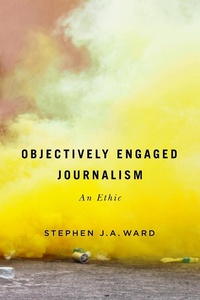
Objectively Engaged Journalism
An Ethic
1st Edition
Published on 16. April 2020
253 pages
978-0-2280-0214-7 (ISBN)
Description

A timely call for a new ethic of journalism engagement for today's troubled media sphere, Objectively Engaged Journalism argues that media should be neither neutral nor partisan but engaged in protecting egalitarian democracy. It shows how journalists, professional or citizen, can be both objective in method and dedicated to improving a global public sphere toxic with disinformation, fake news, and extremism.
Drawing from history, ethics, and current media issues, Stephen Ward rejects the ideals of neutrality and "just the facts" objectivity, showing how they are based on invalid dualistic thinking with deep roots in Western culture. He presents a theory of pragmatic objectivity and applies it to journalism. Journalism's role in interpreting culture, he argues, needs a form of objectivity that embraces human strengths and limitations.
Defining responsible journalism as situated, imperfect inquiry, Objectively Engaged Journalism is one of the first systematic studies of the ethical foundations of engaged journalism for a media that is increasingly perspectival and embedded in society.
Drawing from history, ethics, and current media issues, Stephen Ward rejects the ideals of neutrality and "just the facts" objectivity, showing how they are based on invalid dualistic thinking with deep roots in Western culture. He presents a theory of pragmatic objectivity and applies it to journalism. Journalism's role in interpreting culture, he argues, needs a form of objectivity that embraces human strengths and limitations.
Defining responsible journalism as situated, imperfect inquiry, Objectively Engaged Journalism is one of the first systematic studies of the ethical foundations of engaged journalism for a media that is increasingly perspectival and embedded in society.
Reviews / Votes
"Ward has a gift for writing books that are a coherent whole and he does so here to perfection. This book will become a watershed for all subsequent work on media ethics that is explicitly global." Clifford Christians, University of Illinois at Urbana-ChampaignMore details
Series
Language
English
Place of publication
Montreal
Canada
Target group
College/higher education
Professional and scholarly
File size
8,72 MB
ISBN-13
978-0-2280-0214-7 (9780228002147)
Copyright in bibliographic data and cover images is held by Nielsen Book Services Limited or by the publishers or by their respective licensors: all rights reserved.
Schweitzer Classification
Other editions
Additional editions
Book
04/2020
McGill-Queen's University Press
€47.50
Article not available at the moment
Person
Stephen J.A. Ward is professor emeritus and Distinguished Lecturer in Ethics at the University of British Columbia and award-winning author and editor of 13 books on ethics and media ethics, including Objectively Engaged Journalism: An Ethic.
Content
- Cover
- Copyright
- Contents
- Acknowledgments
- Part One Deconstructing
- 1 Introduction: History, Holism, and Dualism
- 2 Objectivity Naturalized
- 3 Objectivity of Fact
- 4 Objectivity as Correct Construction
- Part Two Reconstructing
- 5 Objectivity with a Human Face, Part 1: Objectivity in Situ
- 6 Objectivity with a Human Face, Part 2: Objectivity in Engagement
- 7 Objectively Engaged Journalism
- 8 Engagement: Methods and Aims
- Epilogue Benefits of Objective Engagement
- Bibliography
- Index
