

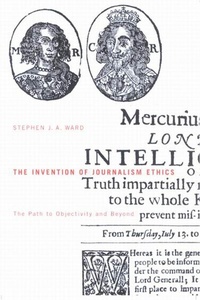
Invention of Journalism Ethics
The Path to Objectivity and Beyond
Published on 8. February 2005
368 pages
978-0-7735-7638-4 (ISBN)
Description

Does objectivity in the news media exist? In The Invention of Journalism Ethics Stephen Ward argues that, given the current emphasis on interpretation, analysis, and perspective, journalists and the public need a new theory of objectivity. He explores the varied ethical assertions of journalists over the past few centuries, focusing on the changing relationship between journalist and audience. This historical analysis leads to an innovative theory of pragmatic objectivity that enables journalists and the public to recognize and avoid biased and unbalanced reporting. Ward convincingly demonstrates that journalistic objectivity is not a set of absolute standards but the same fallible but reasonable objectivity used for making decisions in other professions and public institutions.
More details
Other editions
Additional editions
Stephen J.A. Ward
The Invention of Journalism Ethics, First Edition: Volume 38
The Path to Objectivity and Beyond
Book
04/2006
McGill-Queen's University Press
€52.23
Withdrawn from sale

Book
05/2005
McGill-Queen's University Press
€77.04
Article exhausted; check for reprint
Person
University of British Columbia
Content
- Intro
- Contents
- Acknowledgments
- Introduction: Reinventing Journalism Ethics
- PART ONE: THE ROOTS OF OBJECTIVITY
- 1 Objectivity: Senses and Origins
- 2 Objectivity: Ancient, Early Modern, Positivist
- PART TWO: THE EVOLUTION OF JOURNALISM ETHICS
- 3 The Invention of Journalism Ethics: The Seventeenth Century
- 4 The Invention of a Public Ethic: The Eighteenth Century
- 5 Anticipating Objectivity: The Nineteenth Century
- 6 Objectivity and After: The Twentieth Century
- PART THREE: PRAGMATIC OBJECTIVITY
- 7 Pragmatic Objectivity
- Epilogue: The Future of Objectivity
- References
- Index
- A
- B
- C
- D
- E
- F
- G
- H
- I
- J
- K
- L
- M
- N
- O
- P
- Q
- R
- S
- T
- U
- V
- W
- X
- Y
