

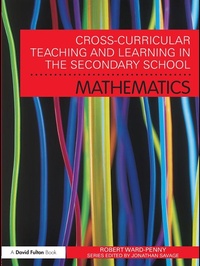
Cross-Curricular Teaching and Learning in the Secondary School... Mathematics
Published on 2. December 2010
168 pages
978-1-136-85783-6 (ISBN)
Description

Why is cross-curricular work so valuable in the mathematics classroom?
Why can pupils sometimes draw graphs in mathematics but not in science?
What might mathematics teachers learn from the performing arts?
Cross-curricular approaches have much to offer the modern mathematics classroom. They can help teachers to present mathematics as a growing, relevant discipline that is central to much of modern life, and help learners to make sense of what they are doing and why. New contexts, new technology and new qualifications all make this an exciting time to be a cross-curricular teacher of mathematics.
But cross-curricular approaches are not always straightforward. Skills do not always transfer easily from one subject area to the other, and a number of important decisions have to be made. How should this type of work be planned, or assessed? How might it fit into the wider curriculum? Are all cross-curricular activities equally useful for learners? Does mathematics have something to share with all of the other curriculum areas?
This book tackles these issues head on, combining educational theory and contemporary research with practical ideas and suggestions. From the mathematics of molecular geometry, wind turbines and impact craters to mathematical haikus, Babylonian clay tablets and juggling, each chapter is packed with examples for use in the secondary classroom.
Key features include:
Discussion of key issues and debates
Case studies to show you how others have used cross-curricular approaches
A wide range of examples and practical activities to help you develop your own practice
Example approaches for planning and assessment
Part of the Cross-Curricular Teaching and Learning in the Secondary School series, this book is essential reading for all students on Initial Teacher Training courses and practising teachers looking to holistically introduce cross-curricular themes and practices into their mathematics teaching.
Why can pupils sometimes draw graphs in mathematics but not in science?
What might mathematics teachers learn from the performing arts?
Cross-curricular approaches have much to offer the modern mathematics classroom. They can help teachers to present mathematics as a growing, relevant discipline that is central to much of modern life, and help learners to make sense of what they are doing and why. New contexts, new technology and new qualifications all make this an exciting time to be a cross-curricular teacher of mathematics.
But cross-curricular approaches are not always straightforward. Skills do not always transfer easily from one subject area to the other, and a number of important decisions have to be made. How should this type of work be planned, or assessed? How might it fit into the wider curriculum? Are all cross-curricular activities equally useful for learners? Does mathematics have something to share with all of the other curriculum areas?
This book tackles these issues head on, combining educational theory and contemporary research with practical ideas and suggestions. From the mathematics of molecular geometry, wind turbines and impact craters to mathematical haikus, Babylonian clay tablets and juggling, each chapter is packed with examples for use in the secondary classroom.
Key features include:
Discussion of key issues and debates
Case studies to show you how others have used cross-curricular approaches
A wide range of examples and practical activities to help you develop your own practice
Example approaches for planning and assessment
Part of the Cross-Curricular Teaching and Learning in the Secondary School series, this book is essential reading for all students on Initial Teacher Training courses and practising teachers looking to holistically introduce cross-curricular themes and practices into their mathematics teaching.
More details
Series
Language
English
Place of publication
London
United Kingdom
Publishing group
Taylor & Francis Ltd
Target group
College/higher education
Product notice
Reflowable
Illustrations
25 s/w Abbildungen
25 Illustrations, black and white
File size
1,39 MB
ISBN-13
978-1-136-85783-6 (9781136857836)
Copyright in bibliographic data and cover images is held by Nielsen Book Services Limited or by the publishers or by their respective licensors: all rights reserved.
Schweitzer Classification
Other editions
Additional editions
Book
11/2010
1st Edition
Routledge
€215.41
Shipment within 15-20 days
Book
11/2010
1st Edition
Routledge
€60.84
Shipment within 15-20 days
Person
Robert Ward-Penny teaches on the Secondary PGCE Mathematics Course at the University of Warwick.
Content
1. The Context for Cross-Curricular Mathematics 2. Where Does Mathematics Belong? Placing Mathematics in a Twenty-First Century Curriculum 3. Application and Transfer: Mathematics and the Science Subjects 4. Construction and Feedback: Mathematics and Technology 5.Critical Thought and Reasoning: Mathematics and English, Citizenship and Geography 6. Different Perspectives: Mathematics and History, RE and Art 7. Procedures, Symbolism and Modelling: Mathematics and ICT, Business Studies and Economics 8. Pattern and Pedagogy: Mathematics and Dance, Drama and Music 9. Putting it into Practice: Mathematics, Modern Foreign Languages and PE 10. Finding Your Own Context for Cross-Curricular Mathematics Bibliography
