

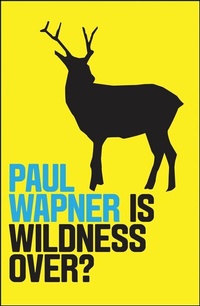
Is Wildness Over?
Description

Wildness was once integral to our ancestors' lives as they struggled to survive in an unpredictable environment. Today, most of us live in relative stability insulated from the vicissitudes of nature. Wildness is over, right?
Wrong, argues leading environmental scholar Paul Wapner. Wildness may have disappeared from our immediate lives, but it's been catapulted up to the global level. The planet itself has gone into spasm - calving glaciers, wildfires, heatwaves, mass extinction, and rising oceans all represent the new face of wildness.
Rejecting paths offered by geoengineering and de-extinction to bring the Earth under control, Wapner calls instead for 'rewilding'. This involves relinquishing the desire for comfort at all costs and welcoming greater uncertainty into our own lives. To save ourselves from global ruin, it is time to stop sanitizing and exerting mastery over the world and begin living humbly in it.
More details
Other editions
Additional editions
Person
Content
Chapter 1: Brave New Wild
Chapter 2: Wild Modernity
Chapter 3: Wild Climate
Chapter 4: Wild Emptiness
Chapter 5: Rewilding
Chapter 6: Wild Ethics
Further Reading
References
1
Brave New Wild
Aldo Leopold, begins his classic environmental text A Sand County Almanac by distinguishing two kinds of people. He writes: "There are some who can live without wild things, and some who cannot" (Leopold, 1989, p. vii). He associates himself with those who cannot. Leopold, who lived from 1887 until 1948, loved the way the world moves on its own. He reveled in watching sunsets, rainstorms, flying geese, and foxes scampering across fresh snow. Encountering wildness, for Leopold, made life worth living. Wildness stands as something beyond human control and comprehension. It excites the mind, exercises the body, and elevates the spirit. Leopold spent his life celebrating wild things and working to protect them.
Leopold was one of the most thoughtful and perceptive environmentalists-a pioneer and visionary of ecology and environmental ethics. His comment about wildness, however, is overly polite. For a person who desperately wanted others to embrace a "land ethic" and care about the Earth, he makes it seem like wildness is a mere preference. Some just happen to love wild things; others not. This leaves out how political power shapes one's attitude to wildness. Moreover, he overestimates how many people share his love of wildness. Most people, even during Leopold's time, hate wildness. They may like sunsets and a season's first snow, but they find insects, thunderstorms, remote areas, and predatory animals irritating and often threatening. These things have their own way about them and this "otherness" can frustrate best-laid plans and prove unnerving in its unpredictability. Far from delight, wildness annoys and threatens. For most people, it is not something to marvel at or be moved by but a source of discomfort, inconvenience, and vulnerability. Over the past few centuries people have gone to great lengths to shove it out of their lives. When Leopold declared his love of wildness, he was a rarity-and he remains one today. Most people couldn't care less about wild things. They see well-being in stability and certainty and resist discomfort. The consequence of this, as I will explain, is catastrophic.
For many people, wildness is what we experience when we go into the woods, ascend a mountain, or explore a desert. Wildness, from this perspective, refers to the unwieldy character of the more-than-human world. In the woods, things happen on their own-in a manner that is indifferent and often resistant to human design. As the word's etymology suggests, 'wild' things are self-willed. They operate according to their own unique dynamics. For Leopold and fellow conservationists, encountering things that refuse to move to a human beat is a rush; it enlivens life. For most others, however, it spells annoyance and peril.
Wildness goes beyond forests and streams. It also shows up in human affairs. The unpredictability of war, mind-boggling complexities of high technology, and chaotic character of large crowds, for instance, share the element of uncertainty, tempestuousness, and danger. Wildness, in this sense, has to do with the capriciousness of living in a world of others. It denotes the unexpected dynamics that emerge in society and take on a life of their own. It is a state of mind where one loses one's bearings or finds oneself unable to manage circumstances. Some may like the unpredictable dimensions of collective life, just as they like wildness in the woods; most, however, detest it and do what they can to avoid it.
These days, the enemies of wildness have finally triumphed. They have largely realized the dream of ridding their lives of wild things. One sees this most dramatically among the affluent. Today the wealthy live protected from the elements, in secure houses or apartments; they avoid inconveniences by traveling in insulated cars or planes; and they have control over their immediate world through an almost infinite number of appliances. (Including transit, the average American spends over 93% of their time indoors: Klepeis et al., 2001.) Most buy food in a grocery store, draw energy from a plug, drink sanitized water, and flush waste down a toilet or sink. They track weather on cell phones, locate themselves through GPS, and flip a switch to get warmer or turn darkness into light. Many reside in stable regimes ruled by law or possess enough power to be otherwise secure. The most privileged have driver's licenses, medical care, protection from theft, education, and Internet service. Indeed, vast numbers of people today possess extraordinary control over their surroundings and find life more secure and enjoyable in the absence of wildness. To be sure, they still have ups and downs and unpredictable things still happen to them. The havens they have created are not impermeable. But they experience inconvenience and risk in increasingly circumscribed ways. For all intents and purposes, they have locked wildness out of their houses, occupations, and daily affairs. They have sent wildness into hiding. For them, wildness is over.
Global Wildness
Or so it seems. Looking around, even the most affluent must admit that the world is far from stable. People may have carved out sanctuaries of security and comfort but, all around them, things are coming undone. Calving glaciers, intensified storms, mass extinction, and the threat of nuclear annihilation suggest that wildness is far from being over. If anything, it has merely taken on a new face. Today unpredictability, instead of inconveniencing people's everyday lives, plagues the Earth as a whole. After centuries of being beaten down, the feral has reemerged-only this time across the planet and on steroids. The world now faces global wildness. Global wildness has come about not as an accident in humanity's long battle with otherness but as a direct consequence of it. In a twist of cosmic irony, by gaining more control and creating more predictability in their day-to-day lives, people have not gotten rid of wildness but transported it up to the planetary level.
Consider climate change. Harnessing energy to heat and cool one's home is the epitome of immunizing oneself from fluctuating weather. Likewise, using cars to travel long distances and manufacturing concrete for buildings enable people to live largely free from environmental imperatives. The same can be said of using lights, refrigerating food, and all carbon-rich activities. They represent attempts to minimize wildness, to enhance ease and predictability, and otherwise to control the world. Such attempts include using fossil fuels to generate wealth and power and to control other people. The problem, of course, is that, in the aggregate, these efforts do not rid life of wildness but merely displace it to the globe. They alter the planet's carbon cycle and thus throw the climate out of whack. Now, while many people may no longer have to battle discomfort locally, they must do so at the global level. And, while some people may have won greater power by harnessing fossil fuels, they must contend with greater powerlessness in the face of climate change.
The same goes for biodiversity loss. For centuries, people have worked to tame and protect themselves from the more-than-human world. They have hunted, built houses, used insecticides, and bred farm animals to insulate themselves from and control other creatures. They have also destroyed habitat by expanding cities and releasing poisons into the environment. The result is that, today, very few of the affluent encounter animals of any kind or even landscapes not significantly designed by humans. This may have solved the wildness problem for some locally-by immunizing them from immediate threats or inconveniences-but it has created a global wildness problem. It has triggered a cascading trophic decline that appears impossible to stop. Whole species are disappearing at rates unseen for the past 65 million years, and almost every species on Earth is facing decline in numbers, habitat, or health. Biodiversity is plummeting and ripping the fabric of life into threads. Despite many efforts to protect against such unraveling, biological collapse continues largely out of human control.
Global wildness goes beyond climate change and biodiversity loss. In search of comfort and security, humans have inserted themselves so deeply into the world around them that all ecosystems and the planet's infrastructure itself are now supercharged with a human signature. People have figured out not only how to extract fossil fuels and kill off innumerable creatures, but how to redirect rivers, deplete stratospheric ozone, cut down forests, release nuclear isotopes, and manufacture concrete and plastics in inordinate amounts, so that the latter now choke the oceans and promise to last indefinitely. Geoscientists note this impact by calling the present geological era the Anthropocene-"the age of humans." This indicates that humans have become the dominant ecological force (and that human influence will be discernible in the Earth's crust millions of years from now). The Anthropocene also means that, in affecting the planet's organic infrastructure, humans have set in motion developments that they can neither fully foresee nor control. Indeed, humanity has introduced so much unpredictability and danger into global systems that it now faces what Aldous Huxley might call "brave new wildness."
Displacing wildness to the globe is more than a strictly ecological event. Nuclear...
