

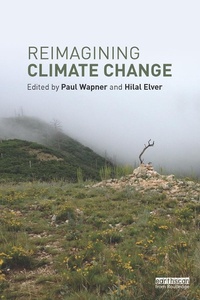
Reimagining Climate Change
Published on 5. February 2016
212 pages
978-1-317-37020-8 (ISBN)
Description

Responding to climate change has become an industry. Governments, corporations, activist groups and others now devote billions of dollars to mitigation and adaptation, and their efforts represent one of the most significant policy measures ever dedicated to a global challenge. Despite its laudatory intent, the response industry, or 'Climate Inc.', is failing.
Reimagining Climate Change questions established categories, routines, and practices that presently constitute accepted solutions to tackling climate change and offers alternative routes forward. It does so by unleashing the political imagination. The chapters grasp the larger arc of collective experience, interpret its meaning for the choices we face, and creatively visualize alternative trajectories that can help us cognitively and emotionally enter into alternative climate futures. They probe the meaning and effectiveness of climate protection 'from below'-forms of community and practice that are emerging in various locales around the world and that hold promise for greater collective resonance. They also question climate protection "from above" in the form of industrial and modernist orientations and examine large-scale agribusinesses, as well as criticize the concept of resilience as it is presently being promoted as a response to climate change.
This book will be of great interest to students and scholars of climate change, global environmental politics, and environmental studies in general, as well as climate change activists.
Reimagining Climate Change questions established categories, routines, and practices that presently constitute accepted solutions to tackling climate change and offers alternative routes forward. It does so by unleashing the political imagination. The chapters grasp the larger arc of collective experience, interpret its meaning for the choices we face, and creatively visualize alternative trajectories that can help us cognitively and emotionally enter into alternative climate futures. They probe the meaning and effectiveness of climate protection 'from below'-forms of community and practice that are emerging in various locales around the world and that hold promise for greater collective resonance. They also question climate protection "from above" in the form of industrial and modernist orientations and examine large-scale agribusinesses, as well as criticize the concept of resilience as it is presently being promoted as a response to climate change.
This book will be of great interest to students and scholars of climate change, global environmental politics, and environmental studies in general, as well as climate change activists.
Reviews / Votes
The introductory chapter by Wapner (global environmental politics, American Univ.), who is also one of the publication's editors, illustrates that he is a wickedly skilled writer. He wastes no time sticking it to what he calls "Climate Inc.," i.e., the "well-meaning people, organizations, and governments" who currently address global climate change. He rhetorically questions what humans have to demonstrate for environmental change efforts over the last few decades. Wapner answers that when the Kyoto Protocol was negotiated in 1997, humans discharged around 24 billion tons of CO2 into the atmosphere. Now, this has amplified to 36 billion tons, which he links to an 0.8 degree Celsius increase in temperature since the 18th century. The book's thesis is that existing environmental approaches are hopelessly inadequate. Climate change requires a complete "envisaging and reformulating [of] first principles." The problem this reviewer finds is that with the exception of a chapter on climate change in the Arabian Peninsula, the volume's nine authors sail off into the leftist intellectual stratosphere, dismissing geoengineering, dissolving national borders, and reordering all societal operations along lines of climate justice. How to accomplish goals is hardly hinted at. However, the chapters do offer well-informed references to radical climate policy movements.--F. T. Manheim, George Mason University, February 2017 issue of CHOICE
More details
Series
Language
English
Place of publication
London
United Kingdom
Publishing group
Taylor & Francis Ltd
Target group
College/higher education
Product notice
Reflowable
Illustrations
1 s/w Abbildung, 1 s/w Zeichnung
1 Line drawings, black and white; 1 Illustrations, black and white
File size
1,22 MB
ISBN-13
978-1-317-37020-8 (9781317370208)
Copyright in bibliographic data and cover images is held by Nielsen Book Services Limited or by the publishers or by their respective licensors: all rights reserved.
Schweitzer Classification
Other editions
Additional editions
Paul Wapner | Hilal Elver
Reimagining Climate Change
Book
06/2017
1st Edition
Routledge
€76.70
Shipment within 10-20 days
Paul Wapner | Hilal Elver
Reimagining Climate Change
Book
02/2016
1st Edition
Routledge
€231.50
Shipment within 10-20 days
Persons
Paul Wapner is Professor of Global Environmental Politics in the School of International Service at American University, USA.
Hilal Elver is the UN Special Rapporteur on the Right to Food, and Global Distinguished Fellow at the UCLA School of Law Resnick Food Law and Policy Program, USA.
Hilal Elver is the UN Special Rapporteur on the Right to Food, and Global Distinguished Fellow at the UCLA School of Law Resnick Food Law and Policy Program, USA.
Content
1. Introduction: Reimagining Climate Change 2. The Sociological Imagination of Climate Futures 3. Climate Security in the Anthropocene: 'Scaling up' the Human Niche 4. Climate Change, Policy Knowledge, and the Temporal Imagination 5. Modernity on Steroids: The Promise and Perils of Climate Protection in the Arabian Peninsula 6. Overcoming Food Insecurities in an Era of Climate Change 7. Reimagining Climate Engineering: The Politics of Tinkering with the Sky 8. Climate of the Poor: Suffering and the Moral Imperative to Reimagine Resilience 9. Re-Imagining Radical Climate Justice 10. The Promise of Climate Fiction: Imagination, Story Telling, and the Politics of the Future
