

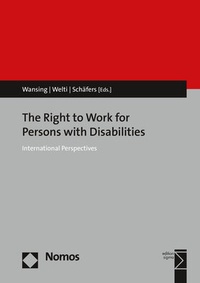
The Right to Work for Persons with Disabilities
International Perspectives
1st Edition
Published on 2. August 2018
361 pages
978-3-8452-9167-3 (ISBN)
Description

The UN Convention on the Rights of Persons with Disabilities (CRPD) has existed for over ten years. What is the state of play with regard to disabled individuals' human right to work as stipulated by the CRPD? How open, inclusive and accessible are the job market and working environments for people with disabilities?
This volume contains contributions to an international conference which took place in Kassel, Germany in March 2017. They address the right to work according to article 27 of the UN Convention on the Rights of Persons with Disabilities and the conditions of its realisation in thorough and concrete terms from a jurisprudential, sociological, political and practical perspective.
With contributions by
Heinz-Willi Bach, Siobhan Barron, Verena Bentele, Jerome Bickenbach, José Carlos do Carmo, Fong Chan, Yi-Chun Chou, Alo Dutta, Eberhard Eichenhofer, Delia Ferri, Wolf Arne Frankenstein, Marie-Renée Hector, Marianne Hirschberg, Martin Kronauer, Madan Kundu, Klaus Lachwitz, Friedrich Mehrhoff, Jürgen Menze, Eva Nachtschatt, Roy Sainsbury, Markus Schäfers, Mario Schreiner, Nai-Yi Sun, Bert Wagener, Gudrun Wansing, Felix Welti, Philine Zölls-Kaser.
The preface, the foreword and the contributions by Eichenhofer, Welti/Nachtschatt, Kronauer, Mehrhoff, Zölls-Kaser, Frankenstein, Bach, Wagener, Sun and Schreiner were translated from German into English by oneword GmbH, Böblingen.
More details
Other editions
Additional editions
Gudrun Wansing | Felix Welti | Markus Schäfers
The Right to Work for Persons with Disabilities
International Perspectives
Book
06/2018
1st Edition
Nomos
€74.00
Shipment within 5-7 days
Persons
Content
- Cover
- Foreword from the German Federal Government Commissioner for Matters relating to Persons with Disabilities
- 1. Fundamental academic contributions in law
- The UN CRPD as an International Social Law
- I. Social policy - A matter for state or international lawmaking?
- II. International human rights
- 1. Human rights - Achievements of the nation-state
- 2. General declaration of human rights: The international bill of rights
- 3. International human rights define the post-war order
- III. International social human rights
- 1. Social human rights and the capability approach
- 2. International human rights - UN CRPD: From banning discrimination to the human rights of those potentially subject to discrimination
- 3. What does the approach towards human rights offer?
- IV. International human rights and the UN CRPD
- 1. Setting the standard
- 2. Institutionalization of protective regulations
- 3. State commitment
- V. Right to work
- VI. Conclusion
- Reasonable Accommodation as a Gateway to the Right to Work for Persons with Disabilities in the European Union. Reflections and Comparative Perspectives
- 1. Introduction
- 2. Reasonable Accommodation in the CRPD and its Relevance in the Employment Context
- 3. Reasonable Accommodation in the Directive 2000/78 at a Glance
- 4. Reasonable Accommodation in National Laws: Trends and Patterns
- 5. Concluding Remarks
- Equal Rights of Persons with Disabilities to Work per Article 27 of the UN Convention on the Rights of Persons with Disabilities
- I. Introduction
- II. Legal sources and validity
- 1. The right to work
- 2. The UN Convention on the Rights of Persons with Disabilities
- 3. International law, European law and German law
- 4. Social human rights and the progressive realization
- 5. Human rights and participation
- 6. Monitoring and enforcement
- III. Fundamental terms and relationships
- 1. Disability
- 2. Equality
- 3. Participation
- 4. Independence
- 5. Inclusion and integration
- 6. Accessibility
- 7. Work and employment
- 8. Labour market
- 9. Right to education
- 10. Rehabilitation
- 11. Right to an adequate standard of living and social protection
- IV. Realization
- 1. Ban on discrimination
- 2. Equal right to fair and favourable working conditions
- 3. Equal employee and trade union rights
- 4. Promotion of work
- 5. Individual promotion
- 6. Promotion of self-employment
- 7. Employment in the public sector
- 8. Positive measures and incentives in the private sector
- 9. Reasonable accommodation at the workplace
- 10. Promotion of work experience
- 11. Vocational rehabilitation
- 12. Sheltered employment and the open labour market
- 13. Welfare and social insurance
- V. Outlook
- 2. Fundamental academic contributions in the social sciences
- Comparability and Convergence of Work Participation Statistics and Documentation
- Introduction
- The socio-economic context of work capacity determination
- Approaches to work capacity assessment
- Work capacity, the ICF and work participation statistics
- Conceptualizations of Disability in ICF and CPRD: Their Contribution to the Realization of the Right to Work
- 1. Introduction
- 2. Classifications as powerful instruments
- 3. Conceptualization of Disability in the ICF
- 3.1 Differentiating Disease and Disability
- 3.2 Disability: no longer a consequence of disease, but the result of the interaction between individual and society
- 3.3 Analysis of the Conceptualisation of the ICF
- 4. Conceptualization of Disability in the CRPD
- 4.1 Disability Rights as Human Rights
- 4.2 Discrimination on the Basis of Disability
- 4.3 Impairments, Disability and Barriers: Definitions according to the CRPD
- 5. Embodiment of Intersectionality in the CRPD and in the ICF
- 6. The relevance of the ICF and the CRPD for the right to work
- 6.1 ICF and Access to the Labour Market
- 6.2 CRPD and Access to the Labour Market
- 6.3 Access to the Labour Market for Persons with Disabilities
- 6.4 Two Instruments for Participation in the Labour Market of the CRPD
- 6.5 Accessibility as a Structural Principle
- 6.6 Instrument of Equality: Reasonable Accommodation
- 7. Conclusions
- Gainful Employment between Inclusion and Exclusion
- The relationship between gainful employment and inclusion
- The relationship between gainful employment and exclusion
- Once again: the right to work
- Labour Market Participation of Persons with Disabilities - How can Europe Close the Disability Employment Gap?
- Introduction
- The UN Convention on the Rights of Persons with Disabilities
- Exploring the disability employment gap
- The DISCIT project ("Making persons with DISabilities full CITizens")
- How are countries addressing the disability employment gap?
- Labour supply strategies
- Labour demand strategies
- Employment protection in the CRPD
- Exploring the effectiveness of Article 27 of the CRPD
- DISCIT data on effectiveness
- Country progress reports on the implementation of the CRPD
- How the UK is addressing the disability employment gap
- Exploring the potential of labour demand strategies
- Sheltered and supported employment
- Social entrepreneurship and social enterprises
- Conclusion
- 3. Transitions
- Return to Work as a Central Aim of Rehabilitation
- 1. Preliminary remarks
- 2. Model of success
- a. Comprehensive approach
- b. Participation management
- c. Participation and inclusion
- 3. Outlook
- Developing International Standards of Competencies for Return-to-Work Professionals: An Overview
- Cost of Staying Out of Labour Force
- Purpose
- Role and Competencies of Return-to-Work Professionals
- An Overview of Training and Certification for Return-to-Work Professionals
- Unified Global Training Standards for Return-to-work Professionals
- Conclusion
- The School-Work Transition of Special Needs Students in the Context of the UN CRPD - Effort towards Systematization
- 1. Introduction
- 2. Initial schooling conditions
- 3. On the transition system from school to work for special needs students
- 1) Mainstream labour market
- 2) The transition system
- 3) Vocational rehabilitation system
- 4. Conclusion
- 4. Inclusive labour market and inclusive workplaces
- The "Why" and "How" of Disability Inclusion in Business
- Introduction
- Benefits of diverse and disability-inclusive workplaces
- Global momentum for disability inclusion
- Measures to create disability-inclusive workplaces
- Conclusion
- Workplace Accessibility and Universal Design
- I. Universal Design - Accessibility
- II. Universal design in accordance with the UN CRPD
- III. Concrete provisions and reception in German law
- IV. Required changes and tools for enforcement
- V. Summary and outlook
- The Situation for Blind and Visually Impaired Persons in the Labour Market, in Employment and in Continuing Education - Including International Perspectives
- 1. How many people are affected with blindness in Germany, how many are employed, and how many are looking for work?
- 2. Possible causes for the low employment rate for blind and visually impaired people
- a) It appears that the pertinent variables on the supply side are:
- b) The demand side - supply of suitable positions:
- c) What service do the information-providing and placement systems provide?
- 3. Promising initiatives for the labour market and jobs
- a) The TriTeam mentoring program
- b) AKTILA-BS (Activation and integration of (long-term) unemployed blind and visually impaired persons)
- c) Innovation and inclusion - new participation approach for work and vocation
- d) iBoB ("Inclusive and accessible vocational education" ["Inklusive berufliche Bildung ohne Barrieren"] - Platform of accessible further education for blind and visually impaired employees or self-employed people/freelancers)
- 4. Findings from partner countries in the European Union regarding the employment of visually impaired people
- 5. Conclusion and appeal
- Through Complex Acts and Measures, Transforming Disbelief into Trust
- Introduction
- Acts and measures
- Independent work evolution
- More is still needed
- Self-confidence and management awareness, Actions for training and informing
- An innovative Job Coaching Club
- Defending Enforcing and Updating
- Conclusion
- The Role of Higher Education in Promoting the Right to Work for Persons with Disabilities
- Inclusion at institutions of higher education
- 1. Accessibility
- 2. Participation
- 3. Creating awareness
- Conclusion
- Employment of Persons with Disabilities - Effective Policy and Outcomes Requires Clear Strategy with All Relevant Actors Engaged
- I. National Disability Authority
- II. Convention on the Rights of Persons with Disabilities and National Disability Action Strategy
- III. What the Data tells us
- IV. Barriers
- V. Strategy on Employment
- VI. Action to Implement the Comprehensive Strategy for Persons with Disabilities
- VII. Conclusions
- Persons with Severe Disabilities as Judges/Prosecutors? A Test Case on the UN Convention on the Rights of Persons with Disabilities in Taiwan
- I. Introduction
- II. Statements from authorities about the need for physical requirements for judges and the public prosecutors
- III. Lack of knowledge about the CRPD as the main problem of its implementation in Taiwan
- 1. The CRPD's implementation process in Taiwan
- 2. The CRPD concepts of equality before the law and the Constitution of the Republic of China
- 3. The foreignness of the term "reasonable accommodation" to the Taiwanese justice system
- 4. Conclusion
- IV. From abolishing the physical requirements in the Regulations for Judicial Examinations to enabling the practice of law for judges and public prosecutors with disabilities
- V. Outlook
- Law of Quotas for People with Disabilities - The Brazilian Experience
- 5. Special forms of employment
- Barriers and Opportunities for Persons with Disabilities to change from Sheltered Employment Settings into an Open and Inclusive Labour Market - Positions of UN Bodies and some Global, Regional and National Disabled People Organizations (DPOs)
- I. Human Rights Approach
- II. The Legal Framework of Art. 27 CRPD
- III. Implementation of Art. 27 CRPD by the UN States Parties with regard to persons with intellectual, psychosocial and multiple disabilities
- IV. Alternatives to Sheltered Work
- V. The Importance of Goal 8.5 of the SDGs for the Right to Work and Employment
- A Need for Sheltered Workshop Reform? Perspectives from Employees and Legal Trends due to the German Federal Participation Act
- I. Perspectives of sheltered workshop employees
- 1. A critical look at sheltered workshops
- 2. Perspectives and ideas of workshop employees on participation in the workforce
- II. Changes to participation in the workforce at sheltered workshops resulting from the Federal Participation Act [BTHG]
- 1. Requirements from the United Nations
- 2. New legal situation for sheltered workshops: Reform or resumption of the status quo?
- 3. Other service providers, the "Budget für Arbeit" structure and the right to choose for persons with disabilities
- 4. Innovative ability in the changes to the Federal Participation Act [BTHG] with respect to the requests voiced by workshop employees
- III. Conclusion: Future requirements for sheltered workshops
- Sheltered Workshop Policies for People with Disabilities in Taiwan and Japan
- 1. Introduction
- 2. Sheltered workshops under welfare regimes and disability policy models
- 2.1 Compensation-oriented model
- 2.2 Rehabilitation-oriented model
- 2.3 Participation-oriented model
- 2.4 An East Asian model for disability employment policies?
- 3. An overview of disability employment policies for PWDs in Japan and Taiwan
- 3.1 Disability employment policy in Japan
- 3.2 Disability employment policies in Taiwan
- 4. Sheltered workshop policies for PWDs in both countries
- 4.1 Sheltered workshop policies in Japan
- 4.2 Sheltered workshop policies in Taiwan
- 5. Conclusion: Similarities and differences
- Authors
