

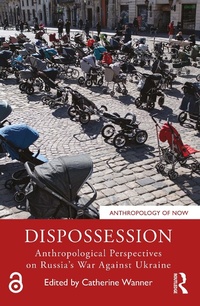
Dispossession
Anthropological Perspectives on Russia's War Against Ukraine
1st Edition
Published on 15. December 2023
270 pages
978-1-003-83574-5 (ISBN)
Description

This volume examines Russia's war on Ukraine. Scholars who have lived through the Russian invasion or who have conducted ethnographic research in the region for decades provide timely analysis of a war that will leave a lasting mark on the twenty-first century.
Using the concept of dispossession, this volume showcases some of the novel ways violence operates in the Russian-Ukrainian war and the multiple means by which civilians, within the conflict zone and beyond, have become active participants in the war effort. Anthropological perspectives on war provide on-the-ground insight, historically informed analysis, and theoretical engagement to depict the experiences of dispossession by war and the motivations that drive the responses of the dispossessed. Such perspectives humanize the victims even as they depict the very inhumanity of war.
Dispossession is geared towards upper-level undergraduate and graduate students, scholars, and the general reader who seeks to have a deeper understanding of the Russian-Ukrainian war as it continues to impact geopolitics more broadly.
The Open Access version of this book, available at http://www.taylorfrancis.com, has been made available under a Creative Commons Attribution-Non Commercial-No Derivatives (CC-BY-NC-ND) 4.0 license.
Using the concept of dispossession, this volume showcases some of the novel ways violence operates in the Russian-Ukrainian war and the multiple means by which civilians, within the conflict zone and beyond, have become active participants in the war effort. Anthropological perspectives on war provide on-the-ground insight, historically informed analysis, and theoretical engagement to depict the experiences of dispossession by war and the motivations that drive the responses of the dispossessed. Such perspectives humanize the victims even as they depict the very inhumanity of war.
Dispossession is geared towards upper-level undergraduate and graduate students, scholars, and the general reader who seeks to have a deeper understanding of the Russian-Ukrainian war as it continues to impact geopolitics more broadly.
The Open Access version of this book, available at http://www.taylorfrancis.com, has been made available under a Creative Commons Attribution-Non Commercial-No Derivatives (CC-BY-NC-ND) 4.0 license.
More details
Series
Edition
1. Auflage
Language
English
Place of publication
London
United Kingdom
Publishing group
Taylor & Francis Ebooks
Target group
College/higher education
Illustrations
5 Tables, black and white; 17 Halftones, black and white; 17 Illustrations, black and white
File size
8,80 MB
ISBN-13
978-1-003-83574-5 (9781003835745)
Copyright in bibliographic data and cover images is held by Nielsen Book Services Limited or by the publishers or by their respective licensors: all rights reserved.
Schweitzer Classification
Other editions
Additional editions
Book
12/2023
1st Edition
Routledge
€206.60
Shipment within 10-20 days
Book
12/2023
1st Edition
Routledge
€63.50
Shipment within 10-20 days
Person
Catherine Wanner is Professor of Anthropology, History, and Religious Studies at The Pennsylvania State University, USA. Using ethnographic and archival methods, her research centers on the politics of religion, conflict mediation, and trauma healing. In 2020, she was awarded the Distinguished Scholar Prize from the Association for the Study of Eastern Christianity. She is the convener of the Working Group on Lived Religion in Eastern Europe and Eurasia. She is the author or editor of six books on Ukraine, most recently Everyday Religiosity and the Politics of Belonging in Ukraine (2022).
Content
Introduction: War and dispossession; Part I: Experiencing loss through dispossession and displacement; 1.The time that was taken from us: Temporal experiences after the full-scale Russian invasion of Ukraine - Natalia Otrishchenko; 2. The emotional and behavioral consequences of the Russian invasion of Ukraine for the civilian population of Ukraine - Valentyna Pavlenko; 3. Population displacement and the Russian occupation of Crimea: "Never again" becomes "Again and again" - Greta Uehling; 4. No longer a citizen: Dispossession in Eastern Ukraine - Oleksandra Tarkhanova; 5. Fragmented lives, fragmented histories in Odesa - Marina Sapritsky-Nahum; 6. Faith and war: Grassroots Ukrainian Protestantism in the context of the Russian invasion - Tatiana Vagramenko; Part II: Radical openness and responding to dispossession; 7. Memes as antibodies: Creativity and resilience in the face of Russia's war - Laada Bilaniuk; 8. "Russian Warship, Go F*ck Yourself": Circulating social media discourses in the Russia-Ukraine war - Bridget Goodman; 9. Responses to dispossession: Self-organization and the state - Emily Channell-Justice; 10. Women and gender equality in the Ukrainian Armed Forces - Tamara Martsenyuk; 11. Meeting the Other: Peacekeeping and religious actors in a time of war - Tetiana Kalenychenko.
