

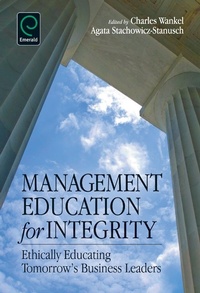
Management Education for Integrity
Ethically Educating Tomorrow's Business Leaders
Published on 2. September 2011
300 pages
978-1-78052-069-8 (ISBN)
Description

Recent examples of corporate, national and international ethical and financial scandals and crises have created a need to bolster the ethical acumen of managers through business education imperatives. This topical book forms an important part of the debate on the development of ethical business leaders and provides empirically grounded, theoretical insights for rethinking business curricula requisite for understanding and meaningfully confronting an ethical vacuum that sometimes exists in business. "Management Education for Integrity" explains how curricula should be streamlined and rejuvenated to ensure a high level of integrity in management education, providing numerous examples of new tools, teaching methods, integrity sensitization and development exercises and ethical management education assessment approaches. Chapters include: fostering integrity in business curricula; a critique of ethics education in management; measuring best practices in management education for integrity capacity; encouraging moral engagement in business ethics courses; management education for behavioral integrity; and scenario-based approach as a teaching tool to promote integrity awareness.
More details
Language
English
Place of publication
Bingley
United Kingdom
Target group
Professional and scholarly
File size
2,47 MB
ISBN-13
978-1-78052-069-8 (9781780520698)
Copyright in bibliographic data and cover images is held by Nielsen Book Services Limited or by the publishers or by their respective licensors: all rights reserved.
Schweitzer Classification
Other editions
Additional editions
Charles Wankel | Agata Stachowicz-Stanusch
Management Education for Integrity
Ethically Educating Tomorrow's Business Leaders
Book
09/2011
Emerald Group Publishing Limited
€126.50
Shipment within 10-20 days
Content
- Front Cover
- Management Education for Integrity: Ethically Educating Tomorrow's Business Leaders
- Copyright Page
- Contents
- List of Contributors
- List of Reviewers
- Acknowledgements
- PART I: INTRODUCTION
- 1. Management Education for Integrity
- Transcending Amoral Business Curricula
- References
- PART II: BUSINESS ETHICS EDUCATION: ACROSS THE CURRICULUM AND BEYOND
- 2. Sensemaking: A Fresh Framework for Ethics Education in Management
- 2.1. Sensemaking as a Framework for Ethics Instruction
- 2.2. Sensemaking and Assessment
- 2.3. Discussion
- Acknowledgments
- References
- 3. Three Pedagogical Tools to Advance Management Integrity Capacity
- 3.1. The Concept of Integrity Capacity
- 3.2. Indicator of Readiness for Management Ethics Inquiry
- 3.3. Process Integrity Capacity Auction
- 3.4. Intra-Organizational Ethics Bowl Event
- 3.5. Conclusion
- References
- Appendix 3.A. Indicator of Readiness for Management Ethics Inquiry (IRMEI) ©
- Appendix 3.B. Process Integrity Capacity Auction (PICA) ©
- 4. Using Literature to Encourage Moral Engagement in Business Ethics Courses
- 4.1. Sources of Failure in Business Ethics
- 4.2. Seeking ''Internalization''
- 4.3. The Imaginative Alternative
- 4.4. Different Kinds of Imagination
- 4.5. Using Imaginative Literature
- 4.6. What the Teacher must bring to the Course
- 4.7. A Course using Imaginative Literature
- 4.8. Conclusion
- Acknowledgments
- References
- Appendix. Some Works used by the Author in His Business Ethics Course
- 5. Fostering Integrity in Business Education: An Analysis of Academic Administrators' Perceptions at Spanish Business Schools
- 5.1. Introduction
- 5.2. Fostering Integrity at Business Schools: Theoretical Review
- 5.3. Implementing Integrity-Based Experiences at Business Schools: Empirical Review
- 5.4. Integrity at Spanish Business Schools: Academic Administrators' Perceptions
- 5.5. Conclusions
- Acknowledgments
- References
- PART III: VALUES AS PATHWAYS TO ETHICAL ACTION
- 6. Teaching ''How'' - Not ''Whether'' - to Manage with Integrity: Undergraduate and MBA Applications of the ''Giving Voice to Values'' Curriculum
- 6.1. GVV with Undergraduates at the Mason School of Business, College of William & Mary
- 6.2. GVV in the Simmons SOM MBA Program
- 6.3. Conclusion
- References
- 7. Four Key Steps in Developing Leader Integrity
- 7.1. Motivate
- 7.2. Equip
- 7.3. Follow-Up
- 7.4. Manage the Larger Organizational Context
- 7.5. Summary
- Acknowledgments
- References
- 8. Scenario-based Approach as a Teaching Tool to Promote Integrity Awareness: A Chinese Perspective
- 8.1. Consistency of Thought, Voice, and Action
- 8.2. Inconsistency of Thought, Voice, and Action
- 8.3. Chinese Integrity-Related Core Values
- 8.4. Scenario Analysis for Promoting Integrity Awareness
- 8.5. TVA Analytical Model for Integrity: An Illustration
- 8.6. Discussion
- 8.7. Conclusion
- Acknowledgment
- References
- Appendix 8.A. Worksheet for ''Indonesia Expatriation'': A Scenario
- Appendix 8.B. MBA Class Feedback Information as the Basis for Group Discussions
- Appendix 8.C. EMBA Class Feedback Information as the Basis for Group Discussions
- PART IV: DEVELOPING CURRICULA BASED ON A LIBERAL APPROACH TO EDUCATION: A WAY TOWARD RESPONSIBLE CITIZENS
- 9. Returning to a Holistic Management Education and the Tradition of Liberal Education
- 9.1. The Call to Transform Management Education
- 9.2. Liberal Education: Rediscovering and Returning to Our Roots
- 9.3. Traditional Undergraduates as a Unique Population
- 9.4. Re-Thinking How to Teach for Integrity
- 9.5. A Model for Integrated, Liberal Management Education Experiences
- 9.6. Conclusions and Recommendations
- Acknowledgments
- References
- 10. Education for Integrity: Business, Elitism, and the Liberal Arts
- 10.1. Introduction
- 10.2. Liberal Arts, Management Education, and the Organization of Business - A Short History
- 10.3. How Can the Liberal Arts Strengthen the Integrity of Undergraduate Management Students?
- 10.4. Conclusions
- References
- 11. Meeting the Objectives of Business Ethics Education: The Marriott School Model and Agenda for Utilizing the Complete Collegiate Educational Experience
- 11.1. Introduction
- 11.2. Level One: Personal Ethical Understanding
- 11.3. Level Two: Application of Ethical Principles to Business Situations
- 11.4. Level Three: Moral Courage and Organizational Savvy
- 11.5. Level Four: Ethical Leadership
- 11.6. Agenda for Utilizing the Complete Collegiate Educational Experience
- Acknowledgment
- References
- About the authors
- Author Index
- Subject Index
