

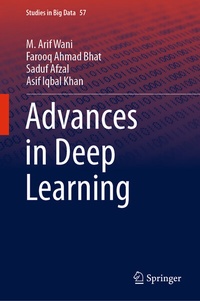
Advances in Deep Learning
Description

This book introduces readers to both basic and advanced concepts in deep network models. It covers state-of-the-art deep architectures that many researchers are currently using to overcome the limitations of the traditional artificial neural networks. Various deep architecture models and their components are discussed in detail, and subsequently illustrated by algorithms and selected applications. In addition, the book explains in detail the transfer learning approach for faster training of deep models; the approach is also demonstrated on large volumes of fingerprint and face image datasets. In closing, it discusses the unique set of problems and challenges associated with these models.
More details
Other editions
Additional editions
Persons
Prof. M. Arif Wani completed his M.Tech. in Computer Technology at the Indian Institute of Technology, Delhi and his PhD in Computer Vision at Cardiff University, UK. Currently, he is a Professor at the University of Kashmir, having previously served as a Professor at California State University Bakersfield. His main research interests are in gene expression datasets, face recognition techniques/algorithms, artificial neural networks and deep architectures. He has published many papers in reputed journals and conferences in these areas. He was honored with The International Technology Institute Award in 2002 by the International Technology Institute, California, USA. He is a member of many academic and professional bodies, e.g. the Indian Society for Technical Education, Computer Society of India, IEEE USA and Optical Society of America.
Dr. Farooq Ahmad Bhat completed his MPhil and PhD in Computer Science at the University of Kashmir. His dissertation focusedon 'Efficient and robust convolutional neural network based models for face recognition'. Currently, his main interests are in artificial intelligence, machine learning and deep learning, areas in which he has published many articles.
Dr. Saduf Afzal teaches at the Islamic University of Science and Technology, Kashmir, India. She completed her BCA, MCA, MPhil and PhD at the Department of Computer Science, University of Kashmir. She has also worked as an academic counselor for the MCA program at IGNOU University. Her main research interests are in machine learning, deep learning and neural networks. She has published many articles in high-impact journals and conference proceedings.
Dr. Asif Iqbal Khan currently works as a Lecturer in the Higher Education Department, Kashmir, India. He completed his MCA, MPhil and PhD at the Department of Computer Science, University of Kashmir. His main research interests are in machine learning, deep learning, and image processing. He is actively publishing in these areas.
