

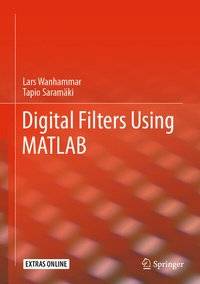
Digital Filters Using MATLAB
Description

This textbook provides comprehensive coverage for courses in the basics of design and implementation of digital filters. The book assumes only basic knowledge in digital signal processing and covers state-of-the-art methods for digital filter design and provides a simple route for the readers to design their own filters. The advanced mathematics that is required for the filter design is minimized by providing an extensive MATLAB toolbox with over 300 files. The book presents over 200 design examples with MATLAB code and over 300 problems to be solved by the reader. The students can design and modify the code for their use. The book and the design examples cover almost all known design methods of frequency-selective digital filters as well as some of the authors' own, unique techniques.
More details
Other editions
Additional editions
Persons
Lars Wanhammar was born in Vansbro, Sweden, on August 19, 1944. He received the Tekn. Mag. degree in 1970, the Civ. Ing. degree in 1980, the Tekn. Dr. degree in 1981, and the Docent degree in 1986, all from Linköping University, Sweden. He is currently Professor emeritus at Department of Electrical Engineering, Linköping University. His research interests include theory and design of communication and digital signal processing systems, particularly analog and digital filters and fast transforms, computational properties of digital signal processing algorithms, computer-aided design tools, and ULSI techniques. He is the author or co-author of several textbooks.
Tapio Saramäki was born in Orivesi, Finland, on June 12, 1953. He has received the Diploma Engineer and Doctor of Technology degrees (both with honors) in electrical engineering from the Tampere University of Technology (TUT), Tampere, Finland, in 1978 and 1981, respectively. Currently, he is at TUT an Emeritus Professor of Signal Processing and a Docent (Adjunct Professor) of Communications. In addition, he is Co-Founder and a System-Level Designer of VLSI Solution specializing of both analog and digital signal processing algorithms for various applications.
The research interests of Tapio Saramäki are in digital signal processing, especially in filter and filter bank design, efficient VLSI implementations of DSP algorithms, and communications application as well as approximation and optimization theories. He has contributed to more than 300 international journals and conference articles and more than ten international book chapters as well as holds three worldwide used patents. He is the Fellow of IEEE and Popov Society and the receipt of the Guillemin-Cauer Award twice. He has been very actively taking part of organizing conferences and workshops related to digital signal processing.
Content
Introduction.- Signals and Transforms.- Discrete-Time and Digital Filters.- Filter Algorithms.- Finite Wordlength Effects.- Synthesis of Fir Filters.- Realization of Fir Filters.- Synthesis of Analog Filters.- Analog Filters with Lumped and Distributed Elements.- Synthesis of IIR Filters.- Wave Digital Filters.- Ladder Wave Digital Filters.- Symmetric Wave Digital Filters.- Frequency-Response Masking Filters.- Sampling Rate Converters.- Multirate Filters.- Implementation of Digital Filters.- References.- Index.
