

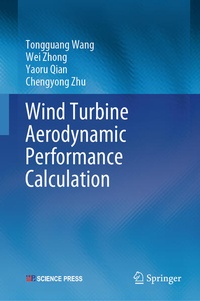
Wind Turbine Aerodynamic Performance Calculation
1st Edition
Published on 13. November 2023
XV, 236 pages
978-981-99-3509-3 (ISBN)
Description

This book deals with horizontal-axis wind turbine aerodynamic performance prediction methods. It focuses on the traditional and newly-developed methods for the wind turbine aerodynamic performance calculation. The fundamental theories of fluid mechanics essential for understanding the other parts of this book are firstly introduced in Part I, followed by the blade element momentum theory in Part II, with special attentions to a systematic review of various correction models. Part III is mainly about the prescribed and free vortex wake methods, while the state-of-art computational fluid dynamics (CFD) methods are detailed in Part IV.
Part III thoroughly describes the prescribed and free vortex wake methods which are still of great importance towards realistic investigation of wind turbine performance. Despite the highly computational cost, the CFD methods in Part IV have received increasing interest from the academic community since they provide more detailed information about the flow field around the wind turbine. This has shed a light in combination with the correction models introduced in Part II on more advanced research for wind turbine.
This book is intended for researchers and students interested in aerodynamics of wind turbine and is particularly suitable for practicing engineers in wind energy. Readers can gain a comprehensive understanding in both classical and up-to-date methods for the study of wind turbine aerodynamics. The authors hope that this book can promote the research and development of wind turbines.
Part III thoroughly describes the prescribed and free vortex wake methods which are still of great importance towards realistic investigation of wind turbine performance. Despite the highly computational cost, the CFD methods in Part IV have received increasing interest from the academic community since they provide more detailed information about the flow field around the wind turbine. This has shed a light in combination with the correction models introduced in Part II on more advanced research for wind turbine.
This book is intended for researchers and students interested in aerodynamics of wind turbine and is particularly suitable for practicing engineers in wind energy. Readers can gain a comprehensive understanding in both classical and up-to-date methods for the study of wind turbine aerodynamics. The authors hope that this book can promote the research and development of wind turbines.
More details
Series
Language
English
Place of publication
Singapore
Singapore
Publishing group
Springer Singapore
Target group
Professional and scholarly
Product notice
Reflowable
Illustrations
XV, 236 p. 102 illus., 32 illus. in color.
File size
6,62 MB
ISBN-13
978-981-99-3509-3 (9789819935093)
DOI
10.1007/978-981-99-3509-3
Schweitzer Classification
Other editions
Additional editions
Tongguang Wang | Wei Zhong | Yaoru Qian
Wind Turbine Aerodynamic Performance Calculation
Book
11/2023
Springer
€139.09
Shipment within 3-4 weeks
Persons
Tongguang Wang
, Professor of Aerodynamics at Nanjing University of Aeronautics and Astronautics (NUAA), is the Chair-Direct of the Chinese Wind Energy Association.
He received his Bachelor's degree and Master's degree in engineering from NUAA in 1983 and 1988, respectively, with his master's dissertation "Calculation of the Horizontal Axis Wind Turbine Aerodynamic Performance in Different Wind Conditions". He joined the University of Glasgow as a visiting scholar in 1995 and then did his PhD there from 1996 to 1999 and obtained his Degree of Doctor of Philosophy with the dissertation "Unsteady Aerodynamic Modelling of Horizontal Axis Wind Turbine Performance". He did postdoctoral research at the University of Glasgow from October 1999 to August 2001 on orthogonal blade/vortex interaction. During this period, he was invited to join in the Wind Turbine Unsteady Aerodynamics Experiment - Blind Comparison. He came back to China and worked for Nanjing University of Aeronautics and Astronautics as Associate Professor in 2001. He became full Professor of aerodynamics in 2002.
Wei Zhong , PhD in fluid mechanics, Lecturer of Nanjing University of Aeronautics and Astronautics, has been engaged in the research of wind turbine aerodynamics since 2008.
Yaoru Qian received her Ph.D. from Nanjing University of Aeronautics and Astronautics, China in 2018, and is currently a lecturer at the Energy Research Institute of Nanjing Institute of Technology, China. Her work mainly focuses on the study of the fluid mechanics problems related to wind energy.
Chengyong Zhu received his Ph.D. in fluid mechanics from Nanjing University of Aeronautics and Astronautics, China in 2020. he is currently a lecturer at the School of New Energy, Nanjing University of Science and Technology, China. He has actively led or participated in research projects onwind turbine aerodynamics with his expertise in computational fluid dynamics, flow control, and aerodynamic design.
He received his Bachelor's degree and Master's degree in engineering from NUAA in 1983 and 1988, respectively, with his master's dissertation "Calculation of the Horizontal Axis Wind Turbine Aerodynamic Performance in Different Wind Conditions". He joined the University of Glasgow as a visiting scholar in 1995 and then did his PhD there from 1996 to 1999 and obtained his Degree of Doctor of Philosophy with the dissertation "Unsteady Aerodynamic Modelling of Horizontal Axis Wind Turbine Performance". He did postdoctoral research at the University of Glasgow from October 1999 to August 2001 on orthogonal blade/vortex interaction. During this period, he was invited to join in the Wind Turbine Unsteady Aerodynamics Experiment - Blind Comparison. He came back to China and worked for Nanjing University of Aeronautics and Astronautics as Associate Professor in 2001. He became full Professor of aerodynamics in 2002.
Wei Zhong , PhD in fluid mechanics, Lecturer of Nanjing University of Aeronautics and Astronautics, has been engaged in the research of wind turbine aerodynamics since 2008.
Yaoru Qian received her Ph.D. from Nanjing University of Aeronautics and Astronautics, China in 2018, and is currently a lecturer at the Energy Research Institute of Nanjing Institute of Technology, China. Her work mainly focuses on the study of the fluid mechanics problems related to wind energy.
Chengyong Zhu received his Ph.D. in fluid mechanics from Nanjing University of Aeronautics and Astronautics, China in 2020. he is currently a lecturer at the School of New Energy, Nanjing University of Science and Technology, China. He has actively led or participated in research projects onwind turbine aerodynamics with his expertise in computational fluid dynamics, flow control, and aerodynamic design.
Content
Part 1: Fundamental aerodynamics of wind turbines.- 1 Physical properties of air.- 2 Fundamental aerodynamics.- 3 Basic knowledge of airfoil.- Part 2: Blade element momentum method.- 4 Classical Blade element momentum method.- 5 Correction models.- 6 Unsteady blade element momentum method.- Part 3: Vortex wake Method.- 7 Fundamental theory of vortex.- 8 Vortex wake model.- 9 Performance of wind turbine.- Part 4: Computational Fluid Dynamics Method.- 10 Foundation of Computational Fluid Dynamics.- 11 Numerical simulation of wind turbine aerodynamic performance.- 12 Large-eddy simulation and detached-eddy simulation of wind turbine aerodynamics.
