

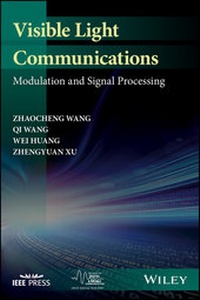
Visible Light Communications
Description

This informative new book on state-of-the-art visible light communication (VLC) provides, for the first time, a systematical and advanced treatment of modulation and signal processing for VLC. Visible Light Communications: Modulation and Signal Processing offers a practical guide to designing VLC, linking academic research with commercial applications.
In recent years, VLC has attracted attention from academia and industry since it has many advantages over the traditional radio frequency, including wide unregulated bandwidth, high security, and low cost. It is a promising complementary technique in 5G and beyond wireless communications, especially in indoor applications. However, lighting constraints have not been fully considered in the open literature when considering VLC system design, and its importance has been underestimated. That's why this book--written by a team of experts with both academic research experience and industrial development experience in the field--is so welcome. To help readers understand the theory and design of VLC systems, the book:
* Details many modern techniques on both modulation and signal processing aspects
* Links academic research with commercial applications in visible light communications as well as other wireless communication systems
* Combines theoretical rigor with practical examples in presenting optical camera communication systems
Visible Light Communications: Modulation and Signal Processing serves as a useful tool and reference book for visible light communication professionals, as well as wireless communication system professionals and project managers. It is also an important guide for undergraduates and graduates who want to conduct research in areas of wireless communications.
More details
Other editions
Additional editions
Persons
ZHAOCHENG WANG, PhD, is a Professor at the Department of Electronic Engineering at Tsinghua University, China. Dr. Wang previously published Millimeter Wave Communication Systems with Wiley-IEEE Press.
QI WANG, PhD, is a Research Fellow at the School of Electronics and Computer Science at University of Southampton, United Kingdom.
WEI HUANG, PhD, is an academic member of the School of Information Science and Technology, University of Science and Technology of China.
ZHENGYUAN XU, PhD, is a Professor at the School of Information Science and Technology, University of Science and Technology of China.
Content
Preface ix
1 Introduction to Visible Light Communications 1
1.1 History 1
1.2 Advantages and applications 4
1.3 Overview of modulation and signal processing 6
1.4 Standards 10
2 Visible Light Communications: Channel and Capacity 17
2.1 LED characteristics 17
2.1.1 Operation principles 19
2.1.2 LED nonlinearity 21
2.2 LED lighting constraints 23
2.2.1 Dimming control 23
2.2.2 Chromaticity control 25
2.2.3 Flicker-free communication 26
2.3 Photodiode characteristics 27
2.4 Propagation links 29
2.4.1 LOS link 31
2.4.2 NLOS link 32
2.5 Noise in VLC systems 33
2.6 Channel capacity 35
2.6.1 Channel models 36
2.6.2 Capacity bounds for free-space optical intensity channel 38
2.6.3 Capacity bounds for discrete-time Poisson channel 47
2.6.4 Capacity bounds for improved free-space intensity channel 50
2.7 Conclusion 53
3 Single Carrier/Carrierless Modulation and Coding 57
3.1 Pulse amplitude modulation 57
3.2 Pulse position modulation 62
3.3 Carrierless amplitude phase modulation 68
3.3.1 Principles of CAP 69
3.3.2 Multidimensional CAP 73
3.4 Modulation and coding schemes for dimmable VLC 77
3.4.1 Modulation schemes for dimmable VLC 78
3.4.2 Coding schemes for dimmable VLC 80
3.5 Conclusion 82
4 Multicarrier Modulation 89
4.1 Optical OFDM for visible light communications 90
4.1.1 DC-biased optical OFDM 90
4.1.2 ACO-OFDM and PAM-DMT 93
4.1.3 Unipolar OFDM 97
4.1.4 Performance comparison 98
4.2 Performance enhancement for optical OFDM 99
4.2.1 DC bias and scaling optimization 100
4.2.2 LED nonlinearity mitigation 103
4.2.3 PAPR reduction 107
4.3 Spectrum- and power-efficient optical OFDM 111
4.3.1 Hybrid optical OFDM 111
4.3.2 Enhanced U-OFDM 118
4.3.3 Layered ACO-OFDM 121
4.4 Optical OFDM under lighting constraints 131
4.4.1 Pulse width modulation 133
4.4.2 Reverse polarity optical OFDM 136
4.4.3 Asymmetrical hybrid optical OFDM 137
4.5 Conclusion 142
5 Multicolor Modulation 147
5.1 Color shift keying 147
5.1.1 Constellation 148
5.1.2 Color calibration 151
5.1.3 Constellation optimization 152
5.1.4 CSK with Quad-LED 155
5.2 CSK with coded modulation 156
5.3 Wavelength division multiplexing with predistorion 159
5.3.1 System model 160
5.3.2 Receiver-side predistortion 161
5.3.3 Performance evaluation 164
5.4 Conclusion 166
6 Optical MIMO 169
6.1 Non-imaging optical MIMO techniques 170
6.1.1 Channel response 170
6.1.2 Optical MIMO techniques 171
6.1.3 Performance comparison 175
6.2 Imaging optical MIMO techniques 178
6.3 Multiuser precoding techniques 180
6.4 Optical MIMO-OFDM 190
6.4.1 DCO-OFDM-based MU-MIMO VLC 193
6.4.2 ACO-OFDM-based MU-MIMO VLC 194
6.4.3 Performance evaluation 195
6.5 Conclusion 197
7 Signal Processing and Optimization 201
7.1 Sum-rate maximization for the multi-chip-based VLC system 201
7.1.1 System model 202
7.1.2 Constraints on illumination and communication 203
7.1.3 Sum-rate maximization 205
7.1.4 Performance evaluation 208
7.2 Heterogeneous VLC-WiFi optimization 212
7.2.1 System model 213
7.2.2 Efficient VHO scheme 214
7.2.3 Performance evaluation 219
7.3 Signal estimation and modulation design for VLC with SDGN 223
7.3.1 Signal estimation for VLC with SDGN 223
7.3.2 Suboptimal estimation for VLC with SDGN 228
7.3.3 Efficient signal design for VLC with SDGN 230
7.4 Conclusion 236
8 Optical Camera Communication: Fundamentals 239
8.1 Why OCC 239
8.1.1 Wide spectrum 240
8.1.2 Image-sensor-based receiver 240
8.1.3 Advantages of image sensor receiver 241
8.1.4 Challenges for OCC implementation 244
8.2 OCC applications: beyond imaging 246
8.2.1 Indoor localization 246
8.2.2 Intelligent transportation 249
8.2.3 Screen-camera communication 250
8.2.4 Privacy protection 251
8.3 Fundamentals of OCC 252
8.3.1 Optical imaging system 252
8.3.2 Image sensor architecture 253
8.3.3 Noise characteristics in the image-sensor-based receiver 261
8.3.4 Channel model for OCC 270
8.4 Capacity bounds for OCC 275
8.4.1 SISO-OCC channel capacity with M-SDGN 275
8.4.2 Capacity-achieving probability measurement with M-SDGN 276
8.4.3 Capacity of imaging optical MIMO systems with bounded inputs 280
8.5 Outage capacity for OCC with misalignment 284
8.6 Conclusion 285
9 Optical Camera Communication: Modulation and System Design 291
9.1 Coding and decoding 292
9.1.1 Multilevel coding and multi-stage decoding 293
9.1.2 Single-level coding and joint decoding 295
9.2 Modulation schemes 297
9.2.1 Undersampling-based modulation 298
9.2.2 Rolling shutter effect-based modulation 301
9.2.3 Spatial OFDM 304
9.2.4 Spatial WPDM 307
9.3 System impairment factors 309
9.3.1 Impairment factors in spatial OFDM 309
9.3.2 Impairment mitigation techniques 322
9.4 Synchronization in OCC 329
9.4.1 Synchronization challenges 329
9.4.2 Per-line tracking and inter-frame coding 331
9.4.3 Rateless coding 333
9.5 OCC system experimental platform 336
9.5.1 Design and implementation of a real-time OCC system 336
9.6 Conclusion 347
10 Index 353
1
Introduction to Visible Light Communications
1.1 History
Visible light communication (VLC) is an age-old technique which uses visible light to transmit messages from one place to another. In ancient China, communication by flames was an effective way to relay signals from border sentry stations to distant command offices on the Great Wall. Similarly, lighthouses were distributed along seashore or on islands to navigate the cargo ships on oceans. Nowadays, visible lights are also mounted on modern skyscrapers to not only indicate its presence at particular locations, but also provide reference signals to pilots flying a plane.
Along with the evolution of telecommunication science and technology, using visible lights instead of other electromagnetic waves to transmit information started to attract attentions from scientists, tracing back to the famous photophone experiment by Alexander Graham Bell in 1880 [1]. In his experiment, the voice signal was modulated onto the sunlight and the information was transmitted over a distance of about 200 m. Efforts to explore natural lights and artificial lights for communication continued for decades. In 1979, F. R. Gfeller and G. Bapst demonstrated the technical feasibility of indoor optical wireless communication using infrared light emitting diodes (LEDs) [2]. Built upon fluorescent lamps, VLC at low data rates was investigated in [3]. As LED illumination industry advanced, the fast switching characteristic of visible light LEDs prompted active researches on high-speed VLC. A concept was first proposed by Pang et al. in 1999 [4], using the traffic light LED as the optical signal transmitter. Later on, a series of fundamental studies were carried out by S. Haruyama and M. Nakagawa at Keio University in Japan. They investigated the possibility of providing concurrent illumination and communication using white LEDs for VLC systems [5, 6]. Meanwhile, they not only discussed and analyzed effects of light reflection and shadowing on the system performance, but also explored VLC applications at relatively low rates [7, 8]. Using LED traffic lights to transmit traffic information was experimented based on avalanche photodiode (APD) and two-dimensional image sensor receiver, respectively [9, 10]. VLC and powerline communication (PLC) were coherently integrated to provide a network capability [11], where the performance of an advanced orthogonal frequency division multiplexing (OFDM) modulation format was evaluated [12]. Applications were extended to brightness control [13] and high-accuracy positioning [14] in addition to communications.
As mobile broadband grows rapidly, the demand for high-speed data services also increases dramatically. VLC emerges as an alternative to alleviate radio spectrum crunch. Higher rate VLC has attracted global research attentions, in particular, from European researchers at the beginning, by maximally exploring the LED capabilities and increasing the spectral efficiency. Using a simple first-order analogue equalizer, a data rate of 100 Mbps was realized with on-off keying non-return-to-zero (OOK-NRZ) modulation in 2009 [15]. Meanwhile, 125 Mbps over 5 m using OOK and 200 Mbps over 0.7 m using OFDM were reported by Vucic et al. [16, 17], where photodiodes (PDs) were used in those VLC systems to detect optical signals. By adopting a 2 × 1 array of white LEDs and an imaging receiver consisting of a 3 × 3 photodetector array, a multiple-input multiple-output OFDM (MIMO-OFDM) system could deliver a total transmission rate of 220 Mbps over a range of 1 m [18]. The data rate can be further increased if APD is adopted. In 2010, the data rate of the OOK-based system reached 230 Mbps [19] and the data rate of the OFDM-based system approached 513 Mbps with bit- and power-loading [20]. In 2012, the highest data rate of a single LED-based VLC system achieved 1 Gbps with OFDM [21]. Additionally, carrierless amplitude and phase modulation (CAP) was introduced into VLC systems, and a data rate of 1.1 Gbps was achieved [22]. Using an MIMO structure, a 4 × 9 VLC system achieving 1.1 Gbps was presented, where the parallel streams were transmitted by 4 individual LEDs and detected by a 3 × 3 receiver array [23].
In the previous studies, a phosphor-converted LED (pc-LED) was adopted as optical signal transmitter. The bandwidth of a pc-LED is however limited by slow response of the phosphorescent component. In 2014, a post-equalization circuit consisting of two passive equalizers and one active equalizer was proposed to extend the bandwidth from tens of MHz to around 150 MHz [24]. If other types of LEDs having higher bandwidth are employed, it has potential to increase the throughput significantly. For example, using micro LEDs as transmitters in VLC systems could be firstly attributed to McKendry et al. and a data rate of 1 Gbps was reported at a price of low luminous efficiency [25]. Multicolor LEDs, radiating particularly red, green, and blue lights, can provide high-rate transmission by wavelength division multiplexing (WDM). Data were simultaneously conveyed in parallel by different colors such as red, green, and blue lights. In principle, the data rate could be tripled in the absence of color crosstalk. An OFDM-based VLC system using a multicolor LED was realized supporting a data rate of 803 Mbps over 0.12 m [26]. Using multicolor LED as the transmitter and APD as the receiver, the data rate of OFDM-based VLC systems was increased from 780 Mbps over 2.5 m to 3.4 Gbps over 0.3 m, where WDM and bit- and power-loading techniques were jointly applied [27-29]. In another study [30], the bandwidths of multicolor LED chips were extended to 125 MHz and modulated by 512 quadrature amplitude modulation (QAM) and 256WDM, respectively, and the frequency domain equalization based VLC system finally reached a data rate of 3.25 Gbps. The data rate of CAP-based VLC systems using multicolor LEDs was increased up to 3.22 Gbps, also benefiting from WDM technology [31].
It is well known that lighting LEDs typically serve as transmitters for downlink information transmission to mobile devices. In 2013, an asynchronous bidirectional VLC system was demonstrated in [32] where a 575 Mbps downlink transmission was realized by red and green LEDs, and a 225 Mbps uplink transmission by a single blue LED. From a network perspective, a spectrum reuse scheme based on different colors was proposed for different cells in an indoor optical femtocell, where multiple users can share the spectrum and access the network simultaneously [33]. User-centric cluster formation methods were proposed for interference-mitigation in [34]. A VLC system can also be combined with a wireless fidelity (WiFi) system to provide seamless coverage after a judicious handover scheme was designed and applied [35].
In multicolor LED-based VLC systems, signals from three color light sources were transmitted independently in most experiments, leaving room for capacity increase. In 2015, Manousiadis et al. used a polymer-based color converter to generate red, green, and blue lights emitted by blue micro LEDs [36]. Three color lights were modulated and mixed for white light illumination. The aggregate data rate from three colors was 2.3 Gbps. Techniques to explore spatial and temporal capabilities of devices were also investigated. A MIMO VLC system employing different field of view (FOV) detectors in order to improve signal-to-noise ratio (SNR) was analyzed in [37]. An optical diversity scheme was proposed, where the original data and its delayed versions were simultaneously transmitted over orthogonal frequencies [38]. Data rate can be significantly enhanced by employing different degrees of freedom. Combining with WDM, high-order CAP, and post-equalization techniques, Chi et al. showed that a multicolor LED-based VLC system could provide a data rate of 8 Gbps [39]. A novel layered asymmetrically clipped optical OFDM scheme was proposed to make a tradeoff between complexity and performance of an intensity-modulated direct-detection (IM/DD) VLC system [40]. Under lighting constraints, DC-informative modulation and system optimization techniques were proposed [41-43]. Some receiver design issues were particularly addressed in weak illuminance environments and several bidirectional real-time VLC systems with low complexity were reported [44, 45].
Besides individual research groups, there are also many large scale organizations and research teams worldwide that have contributed to the development and standardization of VLC technology. In Europe, the HOME Gigabit Access (OMEGA) project was launched in 2008 to develop a novel indoor wireless access network, providing gigabit data rates for home users [46]. The project members included France Telecom, Siemens, University of Oxford, University of Cambridge, and many other companies and universities. This project finally demonstrated a real-time VLC system using 16 white LEDs on the ceiling to transfer HD video streams at 100 Mbps. Another organization called OPTICWISE was funded by the European Science Foundation under an action of the COST European Cooperation in Science and Technology (COST), which allowed coordination of nationally funded VLC researches across European countries. Significant research results and professional activities were reported from its various groups [47].
In Japan, Visible Light Communication Consortium (VLCC) consisting of many Hi-tech enterprises and manufacturers in...
