

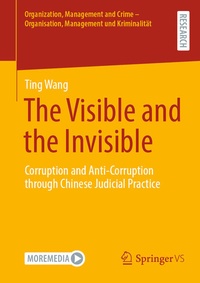
The Visible and the Invisible
Description

Corruption and anti-corruption have long been central public concerns in China, yet the organizational mechanisms through which corruption and anti-corruption operate remain poorly understood. This book takes bribery-offering by unit as its analytical entry point and combines a systematic analysis of 3,886 publicly released court records with in-depth interviews with judges, prosecutors, disciplinary and supervisory officials, and lawyers.
Focusing on visible court records, the book shows how corruption is produced and normalized at the organizational level, moving beyond explanations that reduce bribery to individual moral failure or market exchange. It introduces the perspective of "invisible corruption" to explore why certain bribery practices never enter judicial proceedings. By reconstructing the cognitive frameworks and professional reasoning of legal practitioners, it analyzes how organizational bribery is understood, categorized, and processed in judicial practice, and how legal decision-making is shaped by institutional constraints, political pressures, and organizational contexts. Situated at the intersection of sociology of law, organizational studies, and corruption research, this book offers new empirical and theoretical insights into China's anti-corruption system.
More details
Other editions
Additional editions
Person
Ting Wang received her PhD from Heidelberg University. Her research interests include corruption and anti-corruption, organizational crime, compliance and governance, and the relationship between law and society.
Content
Introduction.- Systemic corruption and the anti- corruption campaign in China.- Organizational crime.- Research design.- How do organizations decide to give bribes?.- Anti-corruption in China from court records.- Tensions in anti-corruption systems.- Discussion.- Conclusion.- References.
