

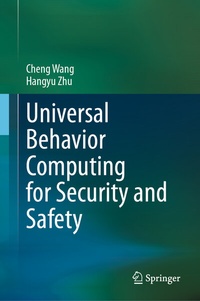
Universal Behavior Computing for Security and Safety
Description

This book presents advanced solutions for integrated security and safety based on universal behavior computing. It provides a comprehensive survey of recent representative research in the field of universal behavior computing, including a review of traditional behavior analysis methods, an introduction to emerging key technologies and frameworks for building behavior models, and a discussion on further opportunities for utilizing behavior simulation in future research.
This book aims to provide a comprehensive and promising perspective for behavior computing-based security and safety solutions. By examining common weaknesses in typical real-world cases, it offers representative examples for a wide range of practical applications. It can provide valuable insights for both researchers and professionals in the field.
More details
Other editions
Additional editions
Persons
Cheng Wang received the Ph.D. degree from the Department of Computer Science, Tongji University, in 2011. He is currently a professor with the Department of Computer Science and Technology, Tongji University. He has conducted extensive research in behavior computing. His achievements have been recognized with the National Science and Technology Progress Award and the Outstanding Ph.D. Dissertation Award from the China Computer Federation (CCF). His research interests include cyberspace security and intelligent information services.
Hangyu Zhu is a Ph.D. candidate in the Department of Computer Science and Technology at Tongji University. His research interests include behavioral anomaly detection and network representation learning.
Content
Chapter 1. Overview of Universal Behavior Computing.- Chapter 2. Enhancing Data for Hard Anomaly Detection.- Chapter 3. Addressing Imbalance Data for Online Fraud Detection.- Chapter 4. Vectoring Applicant Information for Ex-ante Fraud Prediction.- Chapter 5. Detecting Behavioral Anomalies for Cyber Security.- Chapter 6. Layered Behavior Modeling for Recommendations.- Chapter 7. Collaborative Behavioral Protection in Anti-Fraud Systems.- Chapter 8. Behavioral Authentication for Security and Safety.- Chapter 9. Sophisticated Behavioral Simulation.
