

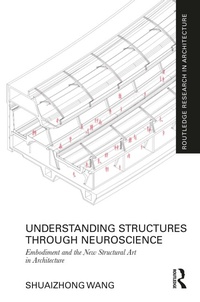
Understanding Structures through Neuroscience
Embodiment and the New Structural Art in Architecture
Published on 8. June 2026
186 pages
978-1-040-75868-7 (ISBN)
Description

Drawing on the recent findings of neuroscience, this book invites readers to rethink the issue of structural expression through the lens of embodiment.
This book begins by exploring an ambiguous and often-overlooked perspective on structural expression in architectural design. It reveals how structural expressiveness is profoundly shaped by evolving conceptions of the body and analogies between the body and structure. Going beyond the mechanical analogy, it argues that perceptions of structure are embodied, and, conversely, structures should be designed to evoke embodied perceptions. Incorporating the neuroscientific theories of embodied simulation, affordance, and enactivism, this book builds a theoretical framework that informs structural design through sense of force, sense of interaction, and sense of dynamics. Each sense is illustrated through a series of global case studies, which are then located in a comprehensive mapping of relevant figures related to structural expression. Overall, this framework redefines the relationship between physical and mental aspects of structural design, offering a novel perspective on the artistry of structural expression.
This book will be of interest to scholars, practitioners, students, and researchers in architecture, structural engineering, and cognitive neuroscience, particularly those interested in perception and livability.
This book begins by exploring an ambiguous and often-overlooked perspective on structural expression in architectural design. It reveals how structural expressiveness is profoundly shaped by evolving conceptions of the body and analogies between the body and structure. Going beyond the mechanical analogy, it argues that perceptions of structure are embodied, and, conversely, structures should be designed to evoke embodied perceptions. Incorporating the neuroscientific theories of embodied simulation, affordance, and enactivism, this book builds a theoretical framework that informs structural design through sense of force, sense of interaction, and sense of dynamics. Each sense is illustrated through a series of global case studies, which are then located in a comprehensive mapping of relevant figures related to structural expression. Overall, this framework redefines the relationship between physical and mental aspects of structural design, offering a novel perspective on the artistry of structural expression.
This book will be of interest to scholars, practitioners, students, and researchers in architecture, structural engineering, and cognitive neuroscience, particularly those interested in perception and livability.
More details
Series
Language
English
Place of publication
London
United Kingdom
Publishing group
Taylor & Francis Ltd
Target group
College/higher education
Professional and scholarly
Product notice
Reflowable
Illustrations
14 Line drawings, black and white; 4 Halftones, black and white; 18 Illustrations, black and white
File size
4,42 MB
ISBN-13
978-1-040-75868-7 (9781040758687)
Copyright in bibliographic data and cover images is held by Nielsen Book Services Limited or by the publishers or by their respective licensors: all rights reserved.
Schweitzer Classification
Other editions
Additional editions
Shuaizhong Wang
Understanding Structures through Neuroscience
Embodiment and the New Structural Art in Architecture
Book
approx. 06/2026
1st Edition
Routledge
€191.50
Not yet published
Person
Shuaizhong Wang (PhD) is Assistant Professor at the School of Architecture, The Chinese University of Hong Kong. His research explores architecture and structural-integrated design, structural reuse, and neuroarchitecture.
He received his PhD from the Chair of Structural Design at ETH Zurich and a Master's degree with distinction from Aalto University. His work has been widely published in leading international journals and conferences, and he has guest-edited special issues for journals including Architectural Journal and The Architect.
He has conducted research at the Tokyo Institute of Technology (Atelier Bow-Wow) and collaborated with B&M and JKMM Architects in Finland. His projects have received numerous national and international competition awards. His work Concrete Spolia was exhibited in the China Pavilion at the 19th Venice Biennale International Architecture Exhibition.
He received his PhD from the Chair of Structural Design at ETH Zurich and a Master's degree with distinction from Aalto University. His work has been widely published in leading international journals and conferences, and he has guest-edited special issues for journals including Architectural Journal and The Architect.
He has conducted research at the Tokyo Institute of Technology (Atelier Bow-Wow) and collaborated with B&M and JKMM Architects in Finland. His projects have received numerous national and international competition awards. His work Concrete Spolia was exhibited in the China Pavilion at the 19th Venice Biennale International Architecture Exhibition.
Content
1 Introduction: the question of structural expression 2 The analogical body in structure 3 The embodied structure 4 Equilibrium as the common ground 5 Empathy and the sense of force 6 Affordance and the sense of interaction 7 Enactivism and the sense of dynamic 8 Conclusion: reflections on structural design
