

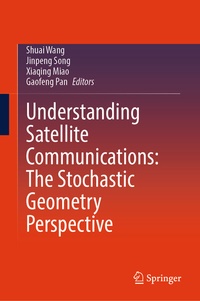
Understanding Satellite Communications: The Stochastic Geometry Perspective
Description

This book aims to analyze and model satellite communication systems while taking into account the variable transmission performance that occurs due to randomness in space, aerial, and terrestrial terminals. The book covers both conceptual principles and practical engineering applications, with an emphasis on the latter. Readers will gain a deep understanding of several major topics, including satellite-terrestrial communications, satellite-aerial communications, satellite-aerial-terrestrial communications, and terrestrial-satellite-terrestrial communications. A key feature of this book is its comprehensive and systematic treatment of satellite communication issues, making it an ideal resource for anyone interested in learning about various application scenarios in this field. Researchers, engineers, and graduate students in wireless communications, signal processing, and related areas will find this book highly valuable.
More details
Other editions
Additional editions
Persons
Shuai Wang received the Ph.D. degree in communications systems from the Beijing Institute of Technology (BIT), China, in 2012. Upon his graduation, he joined the Faculty of the School of Information and Electronics, BIT. In 2021, he transferred to the new-founded School of Cyberspace Science and Technology, where he has been appointed as the Chair Professor of the Department of Information Security and Countermeasures. He has contributed more than 40 peer-reviewed articles, mainly in leading IEEE journals or conferences and holds more than 60 patents. His research interests include satellite communications, anti-interference communications, and datalink technologies for space platforms. He is a co-recipient of the Second Class National Technical Invention Award of China in 2019. He has served as an Editor for IEEE Wireless Communications Letters. He is serving as an Editor for IEEE Communications Letters and China Communications.
Jinpeng Song received the B.S. and Ph.D. degrees from the University of Electronic Science and Technology of China, Chengdu, China, in 2013 and 2019, respectively. From 2016 to 2018, he was a Visiting Researcher with the University of Wisconsin, Madison, WI, USA. From 2019 to 2021, he was a Postdoctoral Research Fellow with the Beijing Institute of Technology, Beijing, China, where he is currently an Assistant Professor.,He has authored several journal papers in the IEEE Transactions on Signal Processing, IEEE Transactions on Instrumentation and Measurement, IEEE Transactions on Circuits and Systems-I: Regular Papers, and IEEE Transactions on Circuits and Systems-II: Express Briefs. His research interests include the theory, design, and implementation of digital, analog, and mixed-signal processing systems with special emphasis on wireless communication systems and digital enhancement techniques for analog signal processing systems.
Xiaqing Miao assistant professor , received the Ph.D. degree at the Beijing Institute of Technology, Beijing, P.R. China in 2020. His research interests include wireless communication, channel coding and signal processing.
Gaofeng Pan received the B.Sc. degree in communication engineering from Zhengzhou University, Zhengzhou, China, in 2005, and the Ph.D. degree in communication and information systems from Southwest Jiaotong University, Chengdu, China, in 2011. He is currently with the School of Cyberspace Science and Technology, Beijing Institute of Technology, China, as a Professor. His research interests span special topics in communications theory, signal processing, and protocol design. He is serving as an Editor for IEEE Transactions on Communications, IEEE Transactions on Green Communications and Networks, etc.
Content
Introduction to satellite communications.- Satellite to terrestrial communications.- Satellite aerial communications.- Satellite aerial terrestrial communications.- End to end terrestrial satellite terrestrial communications.- Summary.
