

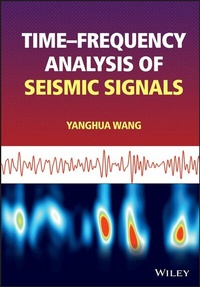
Time-frequency Analysis of Seismic Signals
Description

A practical and insightful discussion of time-frequency analysis methods and technologies
Time–frequency analysis of seismic signals aims to reveal the local properties of nonstationary signals. The local properties, such as time-period, frequency, and spectral content, vary with time, and the time of a seismic signal is a proxy of geologic depth. Therefore, the time–frequency spectrum is composed of the frequency spectra that are generated by using the classic Fourier transform at different time positions.
Different time–frequency analysis methods are distinguished in the construction of the local kernel prior to using the Fourier transform. Based on the difference in constructing the Fourier transform kernel, this book categorises time–frequency analysis methods into two groups: Gabor transform-type methods and energy density distribution methods.
This book systematically presents time–frequency analysis methods, including technologies which have not been previously discussed in print or in which the author has been instrumental in developing. In the presentation of each method, the fundamental theory and mathematical concepts are summarised, with an emphasis on the engineering aspects.
This book also provides a practical guide to geophysicists who attempt to generate geophysically meaningful time–frequency spectra, who attempt to process seismic data with time-dependent operations for the fidelity of nonstationary signals, and who attempt to exploit the time–frequency space seismic attributes for quantitative characterisation of hydrocarbon reservoirs.
Yanghua Wang is a Professor of Geophysics at Imperial College London and the Director of the Resource Geophysics Academy. He is a Fellow of the Royal Academy of Engineering (FREng). He has received the Conrad Schlumberger Award (2021) from the European Association of Geo-scientists & Engineers for his scientific contribution to geophysics.
More details
Other editions
Additional editions
Person
Yanghua Wang is a Professor of Geophysics at Imperial College London and the Director of the Resource Geophysics Academy. He is a Fellow of the Royal Academy of Engineering (FREng). He has received the Conrad Schlumberger Award (2021) from the European Association of Geo-scientists & Engineers for his scientific contribution to geophysics.
Content
Preface viii
1 Nonstationary signals and spectral properties 1
1.1 Stationary signals 1
1.2 Nonstationary signals 5
1.3 The Fourier transform and the average properties 7
1.4 The analytic signal and the instantaneous properties 10
1.5 Computation of the instantaneous frequency 13
1.6 Two groups of time-frequency analysis methods 17
2 The Gabor transform 19
2.1 Short-time Fourier transform 19
2.2 The Gabor transform 23
2.3 The cosine function windows 26
2.4 Spectral leakage 31
2.5 The Gabor limit of time-frequency resolution 33
2.6 Implementation of the Gabor transform 36
2.7 The inverse Gabor transform 40
2.8 Application in inverse Q Filtering 42
3 The continuous wavelet transform 47
3.1 Basics of the continuous wavelet transform 47
3.2 The complex Morlet wavelet 51
3.3 The Morse wavelet 54
3.4 The generalised seismic wavelet 58
3.5 The frequency representation 62
3.6 The inverse wavelet transform 64
3.7 Implementation of the continuous wavelet transform 66
3.8 Hydrocarbon reservoir characterisation 68
4 The S transform 73
4.1 Basics of the S transform 74
4.2 The generalised S transform 77
Time-Frequency vi Analysis of Seismic Signals
4.3 The fractional Fourier transform 79
4.4 The fractional S transform 83
4.5 Implementation of the S transform 86
4.6 The inverse S transform 88
4.7 Application to clastic and carbonate reservoirs 93
5 The W transform 95
5.1 Basics of the W transform 95
5.2 The generalised W transform 99
5.3 Implementation of nonstationary convolution 106
5.4 The inverse W transform 108
5.5 Application to detect hydrocarbon reservoirs 109
5.6 Application to detect karst voids 112
6 The Wigner-Ville distribution 117
6.1 Basics of the Wigner-Ville distribution (WVD) 117
6.2 Defining the WVD with the analytic signal 120
6.3 Properties of the WVD 123
6.4 The smoothed WVD 126
6.5 The generalised class of time-frequency representations 132
6.6 The ambiguity function and the generalised WVD 134
6.7 Implementation of the standard and smoothed WVDs 140
6.8 Implementation of the ambiguity function and the
generalised WVD 147
7 Matching pursuit 151
7.1 Basics of matching pursuit 151
7.2 Three-stage matching pursuit 153
7.3 Matching pursuit with the Morlet wavelet 157
7.4 The sigma filter 159
7.5 Multichannel matching pursuit 163
7.6 Structure-adaptive matching pursuit 168
7.7 Three applications 170
8 Local power spectra with multiple windows 175
8.1 Multiple orthogonal windows 176
8.2 Multiple windows defined by the prolate spheroidal
wave functions 178
8.3 Multiple windows constructed by solving a discretised
eigenvalue problem 180
8.4 Multiple windows constructed by Gaussian functions 184
8.5 The Gabor transform with multiple windows 187
8.6 The WVD with multiple windows 190
Contents vii
Appendices 195
A The Gaussian integrals, the Gamma function, and the
Gauss error functions 195
B The Fourier transform of the tapered boxcar window,
the truncated Gaussian window, and the Blackman
window 198
C The generalised seismic wavelet 201
D The fractional Fourier transform 203
E Marginal conditions and the analytic signal in the WVD
definition 204
F Prolate spheroidal wave functions and the associated
Legendre polynomials 209
References 215
Author index 223
Subject index 225
1
Nonstationary Signals and Spectral Properties
Stationary signals are any idealised signals that have time-independent properties, such as time period, frequency, and spectral content. Seismic signals, however, are nonstationary signals that violate the stationary rule described above. When seismic waves propagate through the anelastic media in the Earth's subsurface, seismic signals have variable properties that vary with the propagation path and travel time.
A stationary signal can be represented mathematically by a stack of sinusoids, using the Fourier transform. In contrast, a nonstationary signal cannot be properly represented by the Fourier transform because the amplitude and frequency of a sinusoidal representation can change dynamically as a function of travel time. To investigate the local properties of a nonstationary signal, an analytic signal-based analysis method can be used instead.
1.1 Stationary Signals
For seismic signals, an idealised stationary model is a stationary convolution process. The physical meaning of the convolution process is 'superposition', which is a fundamental principle in the analysis of seismic signals.
Consider an earth model with a layered structure (Figure 1.1). Each layer has a different acoustic impedance, which is the product of velocity and density. The contrast of this physical property between two layers causes seismic reflections at the interface.
Figure 1.1 The principle of 'superposition'. Each wavelet is scaled by the reflectivity, which is the contrast in the acoustic impedance between two layers. A seismic trace is formed by summing all scaled wavelets, which are reflected from various interfaces.
The contrast of acoustic impedance is called reflectivity, or reflection coefficient. The seismic reflectivity includes primary and multiple , where is the travel time. The reflectivity series in time consists of both types, . Each reflectivity serves as a scaling factor to scale a particular wavelet . A recorded seismic trace is formed by summing all scaled wavelets reflected from different interfaces.
This physical process is the 'superposition' and can be written as
(1.1)where is the vector of the reflectivity series, is the vector of the seismic wavelet, and is the vector of the seismic trace. If the length of the reflectivity series is , and the length of the seismic wavelet is , the length of the resulting seismic trace is .
In the superposition process of Eq. (1.1), the wavelet is time shifted and scaled by the reflectivity. Combining all the time-shifted wavelets to form a wavelet matrix, , the superposition process can be expressed in a matrix-vector form, , and written explicitly as
(1.2)in which the size of the wavelet matrix is .
In the matrix-vector form of Eq. (1.2), the wavelet matrix is a Toeplitz matrix, because each diagonal of is a constant, . Then, if we look at the wavelet matrix row by row, we can see that each row of the matrix consists of the discretised wavelet samples in time-reversed order:
(1.3)Therefore, the matrix-vector form of superposition, , is the discretised form of 'convolution'. The corresponding continuous form for the convolution process can be expressed as
(1.4)where is the seismic wavelet, is the subsurface reflectivity series, is the convolution operator, and is the seismic trace. In this convolution process, the convolution kernel is the stationary wavelet , which has a constant time period, frequency, and spectral content, with respect to time variation.
A wavelet is a 'small wave', for which the time period is relatively short compared to the time duration of the reflectivity series and the resulting seismic trace. With the stationary wavelet , the stationary convolution process of Eq. (1.4) can be depicted as in Figure 1.2.
The stationary wavelet, that is used in Figure 1.2 for the demonstration, is the Ricker wavelet defined as (Ricker, 1953)
(1.5)where is the dominant frequency (in ), and is the central position of the wavelet. The Ricker wavelet is symmetrical with respect to time and has a zero mean, . Therefore, it is often known as Mexican hat wavelet in the Americas for its sombrero shape.
Figure 1.2 A stationary convolution process, in which a vector of seismic trace is generated by the multiplication of a wavelet matrix and a vector of reflectivity series . Each column vector of the wavelet matrix is formed by a stationary seismic wavelet .
1.2 Nonstationary Signals
The stationary convolution process from the previous section is an idealised model for seismic signals. In reality, however, seismic signals are nonstationary due to the dissipation effect when seismic waves propagate through the subsurface anelastic media.
The nonstationary convolution process can be expressed as follows,
(1.6)where is a nonstationary seismic wavelet, in place of the stationary wavelet . The nonstationary seismic wavelet evolves continually according to a dissipation model:
(1.7)where is the dissipation coefficient, and acts on the idealised stationary wavelet .
In the convolution expression of Eq. (1.7) for the nonstationary wavelet , the dissipation coefficient , within which indicates the time dependency, is nonstationary. At any given time position , the dissipation coefficient can be defined by
(1.8)where f is the frequency, is the frequency-dependent attenuation coefficient, and is the associated dispersion, i.e. the phase delay of different frequency components (Futterman, 1962).
The attenuation coefficient of seismic waves propagating through the subsurface anelastic media is (Wang & Guo, 2004)
(1.9)and the associated dispersion is
(1.10)where is a reference frequency,
(1.11)and is the quality factor of the subsurface anelastic media (Kolsky, 1956; Futterman, 1962; Wang, 2008). Because seismic signals have a relatively narrow frequency band, it is reasonable to assume to be frequency independent. But is time dependent, and the time here is a proxy for geologic depth.
For numerical calculation, the nonstationary convolution process of Eq. (1.6) may also be expressed in a matrix-vector form as
(1.12)where is the nonstationary wavelet matrix. Figure 1.3 depicts this matrix-vector form of the nonstationary convolution process.
Figure 1.3 The nonstationary convolution process. The wavelet matrix is formed by column vectors, each of which is a nonstationary seismic wavelet , and thus the seismic trace is a nonstationary signal.
The essential distinction between stationary and nonstationary convolution models is the nonstationary wavelet matrix . While the example symmetrical wavelet in Figure 1.2 is a zero-phase wavelet, the form of the wavelet in Figure 1.3 changes continuously. The amplitude decreases and the phase varies with the travel time. The form of the wavelet gradually changes from symmetrical to asymmetrical.
In general, the differences between stationary and nonstationary signals can be captured in three characteristics.
- Time period: The time period for a stationary signal always remains constant, whereas the time period for a nonstationary signal is not constant and varies with time.
- Frequency: The frequency of a stationary signal remains constant throughout the process, while the frequency of a nonstationary signal changes continuously during the process.
- Spectral content: The spectral content of a stationary signal is constant, while the spectral content of a nonstationary signal varies continuously with respect to time.
For seismic signals, there would be several sets of frequency contents within a given time interval, and these frequency contents are likely to change dynamically with respect to travel time. Therefore, the statistical properties of nonstationary seismic signals also change with time. These statistical properties include the mean, variance, and covariance.
1.3 The Fourier Transform and the Average Properties
The Fourier transform represents a stationary signal as a stack of sinusoids, each of which has a constant frequency and a constant amplitude. Therefore, the Fourier transform is a static spectral analysis that provides only the average characteristics of a nonstationary seismic signal.
For a seismic trace , the Fourier transform is defined as (Bracewell, 1965)
(1.13)where is the frequency spectrum of .
The physical meaning of the Fourier transform can be understood by expressing the transform kernel in Euler's formula,
(1.14)and rewriting the Fourier transform as follows,
(1.15)The first integral is a cross-correlation between the seismic signal and a cosine function, , and the second integral is a cross-correlation...
