

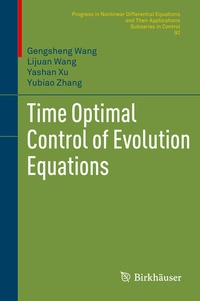
Time Optimal Control of Evolution Equations
Description

This monograph develops a framework for time-optimal control problems, focusing on minimal and maximal time-optimal controls for linear-controlled evolution equations. Its use in optimal control provides a welcome update to Fattorini's work on time-optimal and norm-optimal control problems. By discussing the best way of representing various control problems and equivalence among them, this systematic study gives readers the tools they need to solve practical problems in control.
After introducing preliminaries in functional analysis, evolution equations, and controllability and observability estimates, the authors present their time-optimal control framework, which consists of four elements: a controlled system, a control constraint set, a starting set, and an ending set. From there, they use their framework to address areas of recent development in time-optimal control, including the existence of admissible controls and optimal controls, Pontryagin's maximum principlefor optimal controls, the equivalence of different optimal control problems, and bang-bang properties.This monograph will appeal to researchers and graduate students in time-optimal control theory, as well as related areas of controllability and dynamic programming. For ease of reference, the text itself is self-contained on the topic of time-optimal control. Frequent examples throughout clarify the applications of theorems and definitions, although experience with functional analysis and differential equations will be useful.
Reviews / Votes
"The book under review is a welcome addition to the increasing number of monographs in the theory of linear-controlled dynamical systems in Hilbert spaces and provides an inspired presentation of the tools of optimal control theory in solving time-optimal problems. . this book contains many ideas, methods and recent advances in the field, is quite well-written and well-organized and suits best to researchers and graduate-level treatment." (Shokhrukh Kholmatov, zbMATH 1406.49002, 2019)More details
Other editions
Additional editions
Persons
Lijuan Wang is a professor at Wuhan University's School of Matheamtics and Statistics.
Yashan Xu is a professor at the School of Mathematical University at Fudan University.
Yubiao Zhang is a professor at the Center for Applied Mathematics at Tianjin University.
