

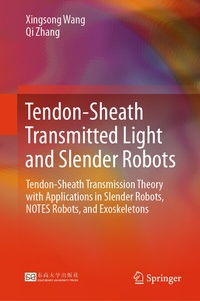
Tendon-Sheath Transmitted Light and Slender Robots
Description

This book focuses on mechanical and electric designing, body shape sensing and tip motion control of various types of light slender robots based on tendon-sheath transmission. From the theoretical concise figures and practical examples of tendon-sheath transmitted mechanisms illustrated succinctly and clearly with 3D color drawings in this book, the proposed readers, including the researchers and students, might get inspirations in their own robotic system design or just following this book to build their own tendon-sheath actuated light slender robotic systems.
More details
Other editions
Additional editions
Persons
Xingsong Wang received the B.S. degree and M.S. degree from Zhejiang University, Hangzhou, China, in 1988 and 1991, respectively, and the Ph.D. degree from Southeast University, Nanjing, China, in 2000, all in mechanical engineering. He was a visiting scientist at Concordia University, Canada (2000.6-2000.12, 2001.9-2002.3) and at Purdue University, USA (2007.9-2008.3), both at the School of Mechanical Engineering. Currently, he is a full professor in the Department of Mechanical Engineering at Southeast University. He has published over 300 technical papers and over 70 Chinese and US patents in these areas.
Qi Zhang received the B.S. degree in mechanical engineering and automation from Nanjing University of Science and Technology, Nanjing, China, in 2015, and the Ph.D. degree in mechatronics engineering from the School of Mechanical Engineering, Southeast University, Nanjing, China, in 2021. She was a visiting scholar in the Advanced Medical Technologies Laboratory (AMTL) at the University of Colorado Boulder (from January 2019 to December 2019). Currently, she is an assistant professor in School of Automation at Nanjing University of Information Science and Technology. Her major research interests include the tendon-sheath transmission theory, the artificial muscle actuator, and the application of limb rehabilitation exoskeleton.
Content
Introduction.- Tendon-Sheath Transmission System.- Transmission Characteristics of Tendon-sheath System.- Transmission Model of Tendon-sheath System.- Control of Tendon-sheath Transmission Mechanism.- Mechanism of Tendon-Sheath Transmitted Slender Robots.- Geometry Estimation of Tendon-Sheath Transmitted Slender Robots.- Tendon-Sheath Transmitted Slender Robots for Detection and Rescue.- Tendon-Sheath Transmitted NOTES Robots.- Tendon-Sheath Transmitted Soft Light Exoskeletons.- Current Issues & Future Perspective.
