

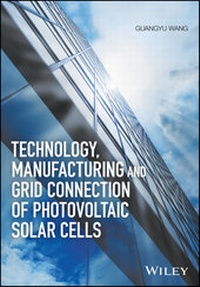
Technology, Manufacturing and Grid Connection of Photovoltaic Solar Cells
Description

* Unique from other books in the area in that it explains profound theories in simple language, introduces widely used production equipment and processes for industry professionals, and explains the complete PV industry chain from material to power generation
* Has originated from the author's practical industry experience, enabling the use of up-to-date information during this time of new development in the Chinese PV industry
* Content includes approximately 255 illustrations and 46 tables to help clarify complex theories.
More details
Other editions
Additional editions
Person
GUANGYU WANG, Shanghai Institute of Microsystem and Information Technology, Chinese Academy of Sciences, China
Content
About the Author xv
Preface xvii
1 Basic Physics of Solar Cells 1
1.1 Development of Solar Cells 1
1.1.1 Solar Energy Is the Most Promising Renewable Energy Source in the World 1
1.1.2 Development of Solar Cells 4
1.2 Solar Radiation and Air Mass 6
1.2.1 Conversion of Sunlight Into Electricity Using Photoelectric Effect Is an ImportantWay to Make Use of Solar Energy 6
1.2.2 Basics of Solar Radiation and Definition of Air Mass 6
1.2.3 Wavelength of Solar Radiation 7
1.3 Basics of Semiconductors 8
1.3.1 Communisation Motion of Electrons in a Crystalline and Formation of Energy Bands 9
1.3.2 Atomic Structures of Conductors, Insulators and Semiconductors and Energy Bands Image 9
1.3.3 Energy Band Structure of Dope Semiconductor 10
1.3.4 Fermi Level 11
1.3.5 DirectionalMovement of Electrons and Holes 12
1.3.6 Generation and Recombination of Carriers 13
1.4 Light Absorption of Semiconductor Materials 14
1.4.1 Light Absorption of Semiconductor 14
1.4.2 Intrinsic and Non-Intrinsic Absorptions of Semiconductor Materials 15
1.4.3 Light Absorption Coefficient and Semiconductor Materials of Direct/Indirect Transition 16
1.5 P-N Junctions and PV Effect of Solar Cells 18
1.5.1 Bending of a P-N Junction Band and Formation of a Built-In Field 18
1.5.2 Effect of an External Voltage on the P-N Junction Band Structure 20
1.5.3 Effect of Solar Radiation on a P-N Junction's Band Structure and the PV Effect 20
1.5.4 Composition of the Photo-Generated Current in the Solar Cell 22
1.5.5 Key Parameters of the Solar Cell 24
1.5.5.1 I-V Characteristic Curve of a Solar Cell 24
1.5.5.2 Relations of the Open-Circuit Voltage and the Height of the P-N Junction Potential Barrier in a Solar Cell 24
1.5.5.3 Short-Circuit Current of a Solar Cell Isc 24
1.5.5.4 The Optimum Operation Point of Solar Cells, the Optimum Operation Voltage and Current 25
1.5.5.5 Filling Factor (FF) 26
1.5.5.6 Power Conversion Efficiency of a Solar Cell ¿ 26
1.5.5.7 Temperature Characteristics of a Solar Cell 27
1.5.6 Application of a Concentration Junction in a PV Cell for Back Surface Field (BSF) 27
1.5.7 Basic Structure of Homogeneous P-N Junction Crystalline Silicon Solar Cells and Analysis on the Cell's Efficiency 29
1.6 Solar Cells of Heterojunctions 32
1.6.1 Composition of Heterojunctions 32 1.6.2 Construction andWorking Principle of the Solar Cell with Heterojunctions 32
2 Materials of Solar Cells 35
2.1 Low-Cost Solar-Grade Polycrystalline Silicon 35
2.1.1 Polycrystalline Silicon-The Most Important Raw Material of the PV Industry 35
2.1.2 Meaning of Solar-Grade Polycrystalline Silicon 38
2.1.3 Preparation of Solar-Grade Polycrystalline Silicon (UMG Silicon) by MetallurgicalMethod 41
2.1.4 Preparation of Solar-Grade Polycrystalline Silicon by FBR Method 45
2.1.5 Preparation of Solar-Grade Polycrystalline Silicon by SiCl4 Zinc Reduction Method 45
2.1.6 Preparation of Solar-Grade Granular Polycrystalline Silicon by VLD Method 47
2.1.7 Hydrogenation of the Main By-Product SiCl4 Produced in the Production Process of Polycrystalline Silicon by the SiemensMethod 48
2.2 Casting Polycrystalline Silicon 49
2.2.1 General 49
2.2.2 Preparation Process of Casting Crystalline Silicon 50
2.2.3 Impurities and Defects in Casting Crystalline Silicon 54
2.2.3.1 Non-Metal Impurities in Casting Crystalline Silicon 54
2.2.3.2 Metal Impurities and Gettering in Casting Crystalline Silicon 56
2.2.3.3 Crystal Boundaries and Dislocations in Casting Crystalline Silicon 57
2.2.4 Latest Development of Casting Crystalline Silicon andWafers 58
2.2.4.1 Casting of Pseudo-Single Crystal 58
2.2.4.2 Continuous Output Improvement of Casting Crystalline Silicon Furnaces 59
2.3 CZ Monocrystalline Silicon 60
2.3.1 Heat Flow Continuity Equation of Grain Growth Interface and its Application 60
2.3.2 Heat Conduction in the Melt 62
2.3.3 Temperature Distribution in the Crystal 63
2.3.4 Impurity Segregation Between Solid and Liquid 64
2.4 Nature of a-Si/µC-SiThin Film 66
2.4.1 Nature of a-SiThin Film 66
2.4.1.1 Basic Nature of a-Si Thin Film and its Application to PV Sector 67
2.4.1.2 Fermi Level Pinning and Efficiency DegradationMechanism for a-Si Thin-film Cells 69
2.4.2 Nature of µC-SiThin Film 70
2.5 PreparationMethods of a-Si/µC-Si Film 72
2.5.1 A Main Raw Material for Silicon Film Preparation-Silane 72
2.5.2 Introduction to Silicon Thin-film Growth Methods 74
2.5.3 Preparation of a-Si/µC-SiThin Film by PECVD Method 74
2.5.4 Preparation of a-Si/µC-SiThin Film by HWCVD Method 75
2.5.5 Growing SiliconThin Film by Other Methods 76
2.5.5.1 Direct Preparation of µC-SiThin Film by LPCVD Technique 76
2.5.5.2 a-Si Crystallised to Polycrystalline SiliconThin Film by SPC Technique 77
2.5.5.3 a-Si Crystallised to Polycrystalline SiliconThin Film by Metal-Induced Method 77
2.5.5.4 a-Si Crystallised to Polycrystalline SiliconThin Film by RTP Technique 77
2.5.5.5 a-Si Crystallised to Polycrystalline SiliconThin Film by Linear Laser Technique 78
2.5.6 Comparisons of Various Silicon Film Growth Methods 78
2.6 Compound Semiconductor Materials 79
2.6.1 GaAs and Other Semiconductor Materials 79
2.6.2 CdTe and CdSThin Film Materials 80
2.6.3 CuInSe2 and CuInS2 Thin Film Materials 80
2.7 Analysis on Impurities in Semiconductor Materials 81
2.7.1 Glow Discharge Mass Spectrometry (GDMS) Analysis 81
2.7.2 Secondary Ion Mass Spectrometry (SIMS) Analysis 82
2.7.3 Infrared Spectroscopy to Detect the Carbon and Oxygen Contents in SiliconWafer 84
3 Preparation Methods of Crystalline Silicon Solar Cells 85
3.1 Preparation Process Flow of CSSCs 85
3.1.1 Basic Structure of CSSCs 85
3.1.2 Production Flow of CSSCs 87
3.2 Performance Detection and Sorting of Raw SiliconWafer 88
3.2.1 Measurement of SiliconWafer Conduction Type 88
3.2.2 Measurement of SiliconWafer Resistivity and Thin Layer Square Resistance 89
3.2.3 Measurement of the Minority Carrier Lifetime 90
3.2.4 Measurement of SiliconWafer Thickness 92
3.2.5 High-Speed Multi-Purpose SiliconWafer Testers 92
3.3 SiliconWafer Surface Cleaning and Texturing 93
3.3.1 Principles of Chemical Cleaning and Texturing 93
3.3.2 Production Equipment and Process of Chemical Corrosion Texturing 94
3.3.3 Laser Texturing and Reactive Ion Etching (RIE) Techniques 95
3.3.3.1 Laser Texturing 97
3.3.3.2 RIE 98
3.4 Junction Preparation by Diffusion 99
3.4.1 Principles 99
3.4.2 Process and Equipment 100
3.4.2.1 Gaseous Diffusion of POCl3 in Tubular Furnace 100
3.4.2.2 Dilute Phosphoric Acid Doper and Chain-Type Diffusion Furnace 102
3.4.3 Measurement of Diffusion LayerThickness (Junction Depth) 103
3.4.3.1 Measurement of the Longitudinal Distribution of the Phosphorus Concentration on the Diffusion Layer by SIMS Method 103
3.4.3.2 Measurement of PN Junction Depth by SRP 103
3.4.4 CSSC Phosphorus Impurity Gettering 104
3.5 Plasma Corrosion and Laser Edging Isolation 106
3.5.1 Objectives and Means of Edging Isolation 106
3.5.2 Principles and Equipment of Plasma Etching 107
3.5.3 Laser Edging Isolation 109
3.6 Removal of PSG 110
3.6.1 Principles and Processes of PSG Removal 110
3.6.2 Equipment and Production Line for PSG Removal 111
3.6.2.1 Bath-Type PSG-Removal Integrated Production System 111
3.6.2.2 Chain-Type PSG-Removal Production System 112
3.7 Preparation of Anti-Reflection Coating by PECVD and PVD Methods 112
3.7.1 Objectives and Principles for Anti-Reflection Coating Preparation 112
3.7.2 Principles of Silicon Nitride Coating Prepared by PECVD 113
3.7.3 Direct (Tubular) PECVD and Indirect (Plate-Type) PECVD 115
3.7.4 Typical PECVD Systems 117
3.7.4.1 Tubular Direct PECVD System 117
3.7.4.2 Plate-Type Direct PECVD System 117
3.7.4.3 Plate-Type Indirect PECVD System 118
3.7.5 Preparation of Silicon Nitride Coating by Physical Vapour Deposition (PVD) 119
3.7.5.1 Principles of Silicon Nitride Coating Prepared by PVD 119
3.7.5.2 Comparisons of Silicon Nitride Coating Deposited by PVD and PECVD 121
3.7.5.3 ATON Sputtering System Produced by Applied Materials, USA 122
3.7.6 Measurement of theThickness and Refractive Index of the Anti-Reflection Coating by Ellipsometer 122
3.8 Preparation of Top/Bottom Electrodes (Surface Metallisation) 123
3.8.1 Technical Requirements and Production Flow for Top/Bottom Electrode Preparation 123
3.8.2 Electrode Printing, Drying, Testing and Cell sorting 125
3.8.3 Fast Sintering Furnace System 126
3.8.4 Electrode Slurry 128
3.8.5 Aluminum Impurity Gettering 130
3.9 Cell Testing and Sorting 130
3.9.1 Objectives of Solar Cell Testing and Sorting 130
3.9.2 Cell-sorting Equipment 130
3.10 Automation of CSSC Production Techniques 133
3.10.1 Promotion of Cascading/Chain-Type Production Lines 133
3.10.2 Mounting/Dismounting the SiliconWafer by Robots Instead of Manual Operation 133
3.11 ParameterMeasurement in CSSC Production Process 136
3.11.1 Solar Simulator 136
3.11.2 Measurement of V-I Characteristics and PV Conversion Efficiency for Solar Cells 136
3.11.3 Measurement of Spectral Response for Solar Cells 139
3.12 Product Quality Control and Cost Analysis for Solar Cell Production Lines 140
3.12.1 On-line Inspection of Solar Cell Production 140
3.12.2 Traditional Process Quality Control on the Solar Cell Production Line 140
3.12.2.1 Working Environment 140
3.12.2.2 Quality Control of the Cleaning and Texturing Process 140
3.12.2.3 Quality Control of Diffusion Process 141
3.12.2.4 Quality Control inWafer Edging Isolation and PSG Removal Procedures 141
3.12.2.5 Quality Control in PECVD Procedure 141
3.12.2.6 Quality Control in Print and Sintering Procedures 141
3.12.3 Cost Analysis for CSSCs 142
4 Preparation Methods of Thin Film Silicon Solar Cells 143
4.1 Advantages and Prospects of TFSSCs 143
4.1.1 Advantages of TFSSCs 143
4.1.2 History and Prospects of TFSSCs 144
4.2 Structures and Power Generation Principles of TFSSCs 146
4.2.1 Structures of a-Si:H and µC-Si THSCs 146
4.2.2 Power Generation Principle of TFSSCs 147
4.2.3 Light Absorption of a-SiC:H/µC-Si and a-Si:H/a-SiGe:H Stacked Solar Cells 150
4.3 Preparation Techniques of TFSSCs 151
4.3.1 TCO Sputtered on Glass Substrate 151
4.3.2 P-Type (a-SiC:H) Film Deposited by PECVD Method 152
4.3.3 I (a-Si:H) Intrinsic Zone Deposited by PECVD Method 152
4.3.4 N-Type (a-Si:H) Layer Thin Film Deposited by PECVD Method 154
4.3.5 Al(Ag) Back Electrodes Sputtered by PVD Method 154
4.3.6 Integration of TFSCs and Modules 154
4.4 Main Production Equipment for TFSSCs 155
4.4.1 Production System of TFSSCs 155
4.4.2 Glass Cleaning and Surface Texturing Equipment 158
4.4.3 TCO Sputtering Equipment and ZAO Target 158
4.4.4 PECVD System forThin Film Silicon Deposition 160
4.4.5 Back Contact Sputtering Equipment 163
4.4.6 Laser Scriber 164
4.4.7 Testing Equipment 165
4.5 Discussion on Some Issues Concerning TFSSC Preparation 166
4.5.1 Performance, Preparation and Testing of TCO 166
4.5.2 Influence of PECVD Process Parameters on Deposition and Crystallisation Rates of Silicon Thin Film 167
4.5.2.1 Hydrogen Dilution 167
4.5.2.2 Gas Pressure 167
4.5.2.3 Deposition Temperature 168
4.5.2.4 Distance Between the Electrode and the Substrate 168
4.5.2.5 Power Excited by Plasma 169
4.5.2.6 Frequency Excited by Plasma 169
4.5.3 VHF-PECVD Method to Deposit Silicon Film 169
4.5.4 HWCVD Method to Deposit Silicon Film 170
4.6 Adjustment of TFSSC Energy Band Structure 171
4.6.1 Methods to Adjust the Band Gap of Thin Film Silicon 171
4.6.1.1 Significance of Energy Band Structure Adjustment for TFSSCs 171
4.6.1.2 Gap Adjustment by a-Si Hydrogen Content and Deposition Temperature 172
4.6.1.3 a-SiC Carbon Material toWiden the Gap 172
4.6.1.4 a-Si Ge Material to Narrow Down the Gap 172
4.6.2 a-SiGe TFSCs 172
4.6.3 Boron, Phosphorous and Hydrogen in a-Si Film 175
4.7 Physical Principle of PECVD and Deposition of SiliconThin Film 175
4.7.1 Glow Discharge and Plasma Generation 175
4.7.2 Mechanism on a-Si Thin Film Grown by PECVD Method 177
4.7.2.1 Basic Principles of PECVD 177
4.7.2.2 a-Si:H (a-Si-Containing Hydrogen) Deposited by PECVD Method 178
4.7.2.3 Growth Mechanism 179
4.8 Physical Sputtering Principles and TCO and Back Metal Preparation System 179
4.8.1 Overview on TCO and Back Metal Deposited by Physical Sputtering 179
4.8.2 A Simple Parallel Metal DC Diode Sputtering System 182
4.8.3 RF and MC Sputtering Systems 183
5 High-Efficiency Silicon Solar Cells and Non-Silicon-Based New Solar Cells 187
5.1 High-Efficiency Crystalline Silicon Solar Cells (CSSCs) 187
5.1.1 Selective Emitters and Buried Contact Silicon Solar Cells 188
5.1.2 Passivation Emitter Silicon Solar Cells 190
5.1.3 Back Finger Electrodes and Boron Diffusion N-Type Crystalline Silicon (IBC) Solar Cells 192
5.1.4 MetallisationWrap-Through (MWT) Silicon Solar Cells 193
5.2 Production Techniques of HIT High-Efficiency Solar Cells 196
5.2.1 a-Si/Monocrystalline Silicon Heterojunctions with Intrinsic Layer 196
5.2.2 Structure and Techniques of Double-Surface HIT Cells 196
5.2.3 Characteristics of HIT Cells 197
5.3 Compound Semiconductor Solar Cells 197
5.3.1 Fabrication Methods of Compound Solar Cells 197
5.3.1.1 Vacuum Evaporation Technique 197
5.3.1.2 Liquid Phase Epitaxy (LPE) Technique 198
5.3.1.3 Metal Organic Chemical Vapour Deposition (MOCVD) Technique 198
5.3.1.4 Molecular Beam Epitaxy (MBE) 198
5.3.2 III-V Compound Multi-Junction Crystalline Solar Cells 199
5.3.3 Cadmium Telluride (CdTe) TFSCs 201
5.3.4 CIGS TFSCs 204
5.3.4.1 Vacuum Co-Evaporation and Vacuum-Sputtering Methods 205
5.3.4.2 Non-Vacuum Method 207
5.3.4.3 Roll to Roll Method 209
5.4 Next-Generation Solar Cells 210
5.4.1 Organic Solar Cells 210
5.4.2 Dye-Sensitised Solar Cells 213
5.4.3 Perovskite Solar Cells 215
5.4.4 Concentrator Solar Cells 217
5.4.5 Multiple QuantumWell (MQW) Solar Cells 219
6 Modules and Arrays of Solar Cells 223
6.1 General 223
6.1.1 Modules and Arrays of Solar Cells 223
6.1.2 Packaging Techniques of Several Solar Cell Modules 224
6.1.3 Packaging Structure of Flat Plate Solar Cell Modules 224
6.1.4 Solar Cell Modules for Building Integrated PV (BIPV) 225
6.1.5 Double-Sided Cells and Modules 228
6.2 Module Packaging Materials 229
6.2.1 Inspection and Sorting of CellWafers 230
6.2.2 Upper Cover Glass 231
6.2.3 Adhesives and Modified EVA Film 232
6.2.4 Back Plate and Localisation 233
6.2.5 Frameworks and Junction Boxes and Other Materials 235
6.3 Module Packaging Techniques 237
6.4 Module Packaging System 239
6.4.1 Main Equipment in the Production Line of Solar Cell Modules 239
6.4.2 Laser Scribers 240
6.4.3 CellWelders 240
6.4.4 Solar Cell Module Laminators 242
6.4.5 Solar Simulators, Turnover Trolleys and Frame Machines 242
6.5 Reliability of Solar Cell Modules and Inspection After Packaging 242
6.5.1 Module Packaging and PV System Reliability 242
6.5.2 Objectives and Descriptions of Solar Cell and Module Tests 244
6.5.2.1 Indoor Tests of PV Cells 245
6.5.2.2 Indoor Tests of PV Modules 245
6.5.2.3 Outdoor Tests of PV Modules 245
6.5.3 Testing Methods and Verification Standards of Solar Cell Modules 246
6.5.4 Tests of PV Performance and Macro Defects of Solar Cell Modules 247
6.5.4.1 Tests of PV Performance of Solar Cell Modules 247
6.5.4.2 Tests of Macro Defects of Solar Cells and the Modules 247
6.5.4.3 Testing Principles of Electroluminescence 249
6.6 Efficiency, Common Specifications and Market Development Trend of Solar Cell Modules 250
6.6.1 Estimates of Solar Cell Module Power and Efficiency 250
6.6.2 Common Specifications in the Solar Cell Module Market 252
6.6.3 Attenuation of Solar Cell Module Power During Usage 253
6.6.4 Development Trend of Solar Cell Modules in China 253
6.7 Solar Cell Arrays 254
6.7.1 Design of Solar Cell Arrays 254
6.7.2 Array Electrical Connections and Hot Spot Effect 255
6.7.3 Installation and Measurement of Arrays 256
7 PV Systems and Grid-Connected Technologies 259
7.1 Overview on the PV System 259
7.1.1 Characteristics, Classifications and Compositions of the PV System 259
7.1.2 Composition and SimpleWorking Principles of the PV System 263
7.2 Energy Storage Batteries 265
7.2.1 Energy Storage Batteries andTheir Application to PV System 265
7.2.2 Lead-Acid Batteries 266
7.2.3 Lithium Ion Batteries 268
7.2.4 Liquid Flow Energy Storage Batteries 269
7.2.4.1 Sodium-Sulphur Batteries 269
7.2.4.2 Vanadium Redox Batteries 270
7.2.4.3 Zinc-Bromine Flow Batteries 270
7.2.5 Super Capacitors 271
7.2.6 Fuel Cells 272
7.2.6.1 General 272
7.2.7 Capacity Design of Battery Packs 274
7.3 Core of the Inverter-Power-Switching Devices 275
7.3.1 MOSFET and IGBT and Other Power Electronic Power-Switching Devices 275
7.3.2 Structure andWorking Principles of IGBT 275
7.3.3 Development History of IGBT 278
7.3.3.1 Trench Gate Technology 278
7.3.3.2 Non-Punch-Through (NPT) Technique 278
7.3.3.3 Filed Stop (FS) Technology 279
7.4 Inverters 281
7.4.1 Role of the Inverter in the PV System 281
7.4.2 Working Principles of the Inverter 282
7.4.3 Control of the Inverter 285
7.4.4 Inverter Circuit and Inverter Types 285
7.4.5 Selection and Requirements of Inverters for PV Applications 286
7.5 Controllers: Module Power Optimisation and IntelligentMonitoring 287
7.5.1 Functions of the PV System Controllers 287
7.5.2 Maximum Power Point Tracking Technology (MPPT) of Solar Cell Controllers 289
7.5.3 Installation Angle and Position Regulation of Solar Cell Arrays by the Controller 291
7.5.4 Other Functions of the Controller 293
7.6 Applications of PV Systems 294
7.6.1 Classifications of PV Systems 294
7.6.2 Application Type, Size and Load Types of the PV System 294
7.6.2.1 Small-Power DC PV Systems 294
7.6.2.2 DC Power Supply Systems Required of Controllers 295
7.6.2.3 AC/DC Power Supply Systems Required of Inverters 295
7.6.2.4 Small-/Medium-Sized Distributed PV Systems with the Grid-Connected Inverter 296
7.6.2.5 Large-Sized Centralised Grid-Connected PV Stations 296
7.6.2.6 Hybrid Power System 297
7.6.3 Energy Storage Device Charging/Discharging by Small-/Medium-Sized PV Systems 298
7.7 BIPV and Distributed PV Stations 299
7.7.1 BIPV 299
7.7.2 Design Principles of BIPV Grid-Connected Power Systems 301
7.7.3 National Policies and Certification of BIPV in China 301
7.7.4 Encouragement of Distributed PV Stations by the Chinese Government 301
7.8 Grid-Connected PV Systems and Intelligent Grids 302
7.8.1 Grid-Connected PV Systems 302
7.8.2 Technical Specifications of the Grid on the Grid-Connected PV System 303
7.8.3 Significance of the Intelligent Grid on PV Power and Other New Energy Utilisation 305
7.8.4 Development of China's PV Industry in the Past 10 Years and Its Outlook 307
7.9 Codes and Test Verifications of the PV System 309
7.9.1 Necessity and Main Contents of PV Product Certification 309
7.9.2 TUV Certification Oriented to the European Market 311
7.9.3 UL Certification Oriented to the U.S. and Canadian Market 311
7.9.4 Certification of PV Products in China 313
Bibliography 319
Index 321
Chapter 1
Basic Physics of Solar Cells
1.1 Development of Solar Cells
1.1.1 Solar Energy Is the Most Promising Renewable Energy Source in the World
The amount of solar radiation striking the earth per second is equivalent to the energy obtained by burning 500 tons of coal. The thermonuclear reactions inside the sun can last 6 × 10¹⁰ years and generate 'inexhaustible' energy. Many energy sources on the earth including wind energy, hydro energy, ocean thermal energy, tidal energy and biomass energy derive their energy from the sun. The currently most widely used fossil fuels such as oil, natural gas and coal are also the forms of the stored energy originally obtained from the sun. As shown in Figure 1.1, based on the existing proved reserves and the current consumption rate of the conventional fossil energy, the world's primary energy source from fossil fuels will be exhausted soon, and China in particular will face a severe shortage of fossil energy sources. In addition, the excessive use of fossil fuels has led to environmental problems and climate change, which has attracted growing attention from governments all around the world. With the outbreak of the energy crisis and the impending depletion of fossil energy resources on the earth, people are increasingly aware of the urgent need to develop solar energy and other renewable energy sources. Both the signing of the Kyoto Protocol in 1997 and the holding of the 2009 UN Climate Change Conference in Copenhagen indicate most governments in the world have regarded the renewable energy use as their national energy strategy. Particularly solar energy is of the greatest strategic significance as it is the ideal renewable and sustainable energy source.
Figure 1.1 Timescale for depletion of conventional fossil energy resources in China and across the world (based on the proved reserves and current consumption rate).
According to statistics, in 2006, the world population already exceeded 6.5 billion and the world energy demand converted into the installed capacity was 14.5 terrawatt (TW); by 2050, the world population will reach 90 to 10 billion and the world energy demand converted into the installed capacity will approximate 60 TW. By that time the world will have almost used up the primary energy resources and have to rely on renewable energy sources. It's reported that the world has a potential hydropower capacity of 4.6 TW only 0.9 TW of which can be actually exploited; the world has 2 TW of actually exploitable wind energy and 3 TW of biomass energy. It means that with a potential capacity of 120,000 TW and the actual available capacity of 600 TW, solar energy will remain the only energy source that can meet the future world energy demand. In this sense, photovoltaic (PV) power will be a key part of the future world energy consumption structure.
The U.S. Department of Energy also released a similar report in 2005. Although the long-term world energy consumption forecasting varies from country to country, the prediction of the future world energy consumption trend remains identical (see Table 1.1 for detailed information).
Table 1.1 Future world dnergy demand and renewable resources
Actual World Energy Consumption in 2004 13 TW Estimated World Energy Consumption in 2050 30 TW Estimated World Energy Consumption in 2100 46 TW Undeveloped Hydropower <0.5 TW Ocean energy (tides, waves, currents) <2 TW Terrain Energy 12 TW Available Wind Energy 2~4 TW Total World Solar Energy 120,000 TWThe Joint Research Centre made a similar forecast according to which PV power will become the most important part in the world energy consumption. By 2030, renewable energy will account for more than 30% of the total world energy consumption while over 10% of the world power supply will come from PV power. By 2040, renewable energy will account for more than 50% of the total world energy consumption while over 20% of the world power supply will come from PV power. By the end of this century, renewable energy will account for more than 80% of the total world energy consumption while over 60% of the world power supply will come from PV power. Judging from the development in the past 20 years, PV power development will be further accelerated.
With the gradual depletion of the fossil energy resources, human beings must accelerate developing renewable energy resources to achieve sustainable energy resource development. It's predicted that by 2050 PV power and solar thermal power will account for a higher proportion than fossil energy resources and other renewable energy resources in the world energy consumption structure. Figure 1.2 indicates the forecast of the development trend of world energy consumption structure in the twenty-first century.
Figure 1.2 Forecast of world energy consumption structure in the twenty-first century.
PV power generation technologies were first applied in space. At present it has been widely used on the earth. Governments all around the world have given support in policy to the development of PV power generation technologies and the application of these technologies in architecture. Grid-connected PV power generation and PV power stations will become the inevitable trend of PV power development. A lot of countries are competing with each other to develop various PV materials and high-efficiency PV power generation technologies to expand the application fields of solar energy.
The rapid development of the solar cell industry is quite unique in the modern industry and unmatched by even the semiconductor industry. In the last 15 years the compound annual growth rate of the world solar cell output has exceeded 30%. At present, Germany and other European countries remains the largest PV market in the world and in these countries, PV power accounts for about 4% of the national electricity consumption. On the other hand, PV markets in Asia, America, Africa and Australia are rapidly rising. Since 2009, China's solar cell and module production has been ranked the first in the whole world. However, grid-connected PV power generation has just started in China. Since 2013 the Chinese government has issued a series of policies to encourage the development of domestic PV applications. In 2013, China's new installed PV capacity was ranked the first in the world. According to the latest data of China's electric power sector, in 2013, total power generation in the Chinese mainland reached 5347.4 terrawatt hours (TWH) while PV power generation only accounted for 0.16% of it, namely, 8.7 TWH. There is a great gap between it and the proportion of PV power in the world energy consumption in the twenty-first century predicted by the intelligence department (see Figure 1.2). As a result, the PV industry has tremendous potential markets and still has a long way to go.
It should be pointed out that due to the currently quite high PV power generation cost, it will be very difficult for PV power generation to compete with conventional power generation through the business accumulation and technological progress of the PV industry. The governments should give some policy support. Take China as an example. In 2013 China's coal-fired power price was RMB 0.42/kilowatt hours (kWh) while the PV power price was RMB 1.00/kWh. If the coal-fired power price rises by 2% annually and the PV power price reduces by 5% annually, then by 2023, PV power will reach grid parity on the generation side in some regions rich in energy resources in China.
Shown in Figure 1.3 is China Roadmap of Photovoltaics Development-A Pathway to Grid Parity released in 2013.
Figure 1.3 China's PV parity price development roadmap, issued by China's relevant department.
1.1.2 Development of Solar Cells
Nowadays the solar cell industry has become one of the world's fastest-growing high-tech industries. In the long run, the research and development of solar cells will go through three stages: crystalline solar cells, thin-film solar cells and quantum devices. Through in-depth R&D the production of crystalline and thin-film solar cells has been characterised by industrialisation, large scale and commercialisation. Categories of crystalline and thin-film solar cells are shown in Table 1.2.
Table 1.2 Solar cell development stages
Solar cells Composition Conversion efficiency Commercialisation Characteristics Monocrystalline silicon * 18-20% Commerciallised Longest application Crystalline cells Polycrystalline silicon 16-18% Commerciallised Largest output Compound semiconductor (GaAs) 28-35% (GaAs) Space application High efficiency, high cost Amorphous silicon thin film 8-10% Industrialisable Promising but unstable Amorphous/microcrystalline silicon thin...