

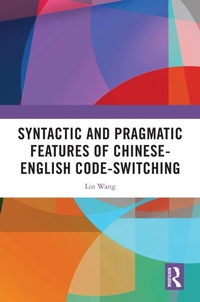
Syntactic and Pragmatic Features of Chinese-English Code-switching
Published on 8. June 2026
328 pages
978-1-040-92454-9 (ISBN)
Description

This book uses corpus analysis and experimental methods to examine the structural characteristics and cognitive mechanisms of Chinese-English code-switching. It also compares the syntactic and pragmatic features of code-switching in children and adults.
The title unveils the fascinating mechanics behind Chinese-English code-switching. Drawing on real language examples and cognitive experiments, it explores the hidden rules that govern mixed speech and shows how bilinguals navigate two languages at once. By comparing the different ways in which children and adults switch code, the author sheds new light on bilingual development and the social functions of Chinese-English code-switching. Bridging the gap between cutting-edge research and practical application, the book offers valuable insights into bilingual education, natural language processing, and cross-cultural communication.
It will be invaluable for researchers and professionals in linguistics, bilingual education, and language technology.
The title unveils the fascinating mechanics behind Chinese-English code-switching. Drawing on real language examples and cognitive experiments, it explores the hidden rules that govern mixed speech and shows how bilinguals navigate two languages at once. By comparing the different ways in which children and adults switch code, the author sheds new light on bilingual development and the social functions of Chinese-English code-switching. Bridging the gap between cutting-edge research and practical application, the book offers valuable insights into bilingual education, natural language processing, and cross-cultural communication.
It will be invaluable for researchers and professionals in linguistics, bilingual education, and language technology.
More details
Language
English
Place of publication
London
United Kingdom
Publishing group
Taylor & Francis Ltd
Target group
College/higher education
Product notice
Reflowable
Illustrations
70 Tables, black and white; 61 Line drawings, black and white; 61 Illustrations, black and white
File size
3,29 MB
ISBN-13
978-1-040-92454-9 (9781040924549)
Copyright in bibliographic data and cover images is held by Nielsen Book Services Limited or by the publishers or by their respective licensors: all rights reserved.
Schweitzer Classification
Other editions
Additional editions
Book
approx. 06/2026
1st Edition
Routledge
€193.50
Not yet published
Person
Lin Wang (PhD) is a Professor at Communication University of Zhejiang, China. She serves at the Centre for UK Studies, specializing in applied linguistics and language contact.
Content
1. Introduction 2. Research Perspectives on Code-Switching 3. Research Methodology of Code-Switching 4. Dependency Treebank and Metrics of Chinese-English Code-Switching 5. Quantitative Analysis of Lexical Distribution 6. Differences in Syntactic Complexity and Word Order 7. Binding Forces of Major Word Classes in Chinese-English Code-Switching 8. Cognitive Experimental Study on Features of Chinese-English Code-Switching 9. Child and Adult Code-switching in Chinese-English Bilinguals: A Syntactic and Pragmatic Comparison 10. Research Significance and Application
