

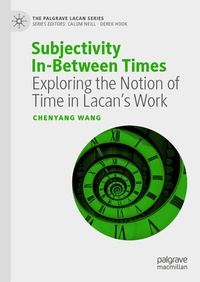
Subjectivity In-Between Times
Description

Reviews / Votes
"Chenyang Wang's masterpiece reminds us that time is for Lacan a logical category, not a category of our experience of reality. Time structures the processes of unconscious reasoning and identification: WHEN something is said or done determines the truth of what is said or is done. In these crazy times this lesson is crucial even for our political activity. So don't be too late, act now and read Wang's book!" (Slavoj Zizek, Professor of Philosophy at the European Graduate School)
"Psychoanalysis, from its very inception, has revealed the complexity of the roles of time in human experience. Yet, systematic reckonings with the multiple modes of analytic temporality remain rare over a century after Freud's initial discoveries. Chenyang Wang's Subjectivity In-Between Times provides a lucid, rigorous, and non-dogmatic exploration of the temporal dimensions of Freudian and Lacanian psychoanalysis. Wang insightfully works through and creatively reinvents analysis's core concepts through theprism of time." (Adrian Johnston, Chair of and Professor in the Department of Philosophy at the University of New Mexico)
"This new book on Lacan and time is an incisive and novel intervention in psychoanalytic studies. It offers a thorough and remarkably clear account of Lacan's work from the perspective of temporalities. In so doing, it asks us to rethink much of Lacanian theory, especially the central idea of the Imaginary, Symbolic and Real, in ways that have important theoretical, clinical and political implications." (Stephen Frosh, Professor of Psychology, Department of Psychosocial Studies, Birkbeck College, University of London, UK)
More details
Other editions
Additional editions
Person
Chenyang Wang is a researcher in the field of psychosocial studies. He completed his PhD thesis on Lacan and time at Birkbeck College, University of London, UK. His work focuses on the intersections between Lacanian psychoanalysis and social research.
Content
Chapter 1 - Introduction.- Chapter 2 - Logical Time.- Chapter 3 - Real time.- Chapter 4 - Symbolic time.- Chapter 5 - Symptomatic Time.- Chapter 6 - Sexed Time.- Chapter 7 - Conclusion.
