

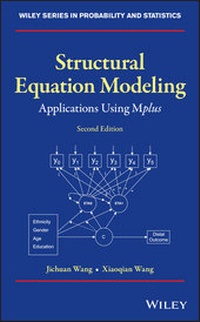
Structural Equation Modeling
Description

Focusing on the conceptual and practical aspects of Structural Equation Modeling (SEM), this book demonstrates basic concepts and examples of various SEM models, along with updates on many advanced methods, including confirmatory factor analysis (CFA) with categorical items, bifactor model, Bayesian CFA model, item response theory (IRT) model, graded response model (GRM), multiple imputation (MI) of missing values, plausible values of latent variables, moderated mediation model, Bayesian SEM, latent growth modeling (LGM) with individually varying times of observations, dynamic structural equation modeling (DSEM), residual dynamic structural equation modeling (RDSEM), testing measurement invariance of instrument with categorical variables, longitudinal latent class analysis (LLCA), latent transition analysis (LTA), growth mixture modeling (GMM) with covariates and distal outcome, manual implementation of the BCH method and the three-step method for mixture modeling, Monte Carlo simulation power analysis for various SEM models, and estimate sample size for latent class analysis (LCA) model.
The statistical modeling program Mplus Version 8.2 is featured with all models updated. It provides researchers with a flexible tool that allows them to analyze data with an easy-to-use interface and graphical displays of data and analysis results.
Intended as both a teaching resource and a reference guide, and written in non-mathematical terms, Structural Equation Modeling: Applications Using Mplus, 2nd edition provides step-by-step instructions of model specification, estimation, evaluation, and modification. Chapters cover: Confirmatory Factor Analysis (CFA); Structural Equation Models (SEM); SEM for Longitudinal Data; Multi-Group Models; Mixture Models; and Power Analysis and Sample Size Estimate for SEM.
* Presents a useful reference guide for applications of SEM while systematically demonstrating various advanced SEM models
* Discusses and demonstrates various SEM models using both cross-sectional and longitudinal data with both continuous and categorical outcomes
* Provides step-by-step instructions of model specification and estimation, as well as detailed interpretation of Mplus results using real data sets
* Introduces different methods for sample size estimate and statistical power analysis for SEM
Structural Equation Modeling is an excellent book for researchers and graduate students of SEM who want to understand the theory and learn how to build their own SEM models using Mplus.
More details
Other editions
Additional editions
Persons
Jichuan Wang, PhD, is Professor in the Department of Pediatrics, Epidemiology, and Biostatistics at the George Washington University (GWU) School of Medicine. He also serves as Senior Biostatistician in the National Children's Medical Center (CNMC) in Washington, DC.
Xiaoqian Wang, PhD, is a Principle Consultant at Mobley Group Pacific Ltd., P.R. China.
Content
Preface ix
1 Introduction to structural equation modeling 1
1.1 Introduction 1
1.2 Model formulation 3
1.2.1 Measurement models 4
1.2.2 Structural models 6
1.2.3 Model formulation in equations 7
1.3 Model identification 11
1.4 Model estimation 14
1.4.1 Bayes estimator 17
1.5 Model fit evaluation 19
1.5.1 The model ¿¿¿¿2 statistic 20
1.5.2 Comparative fit index (CFI) 20
1.5.3 Tucker Lewis index (TLI) or non-normed fit index (NNFI) 21
1.5.4 Root mean square error of approximation (RMSEA) 22
1.5.5 Root mean-square residual (RMR), standardized RMR (SRMR), and weighted RMR (WRMR) 22
1.5.6 Information criteria indices 24
1.5.7 Model fit evaluation with Bayes estimator 25
1.5.8 Model comparison 26
1.6 Model modification 27
1.7 Computer programs for SEM 28
Appendix 1.A Expressing variances and covariances among observed variables as functions of model parameters 30
Appendix 1.B Maximum likelihood function for SEM 32
2 Confirmatory factor analysis 33
2.1 Introduction 33
2.2 Basics of CFA models 34
2.2.1 Latent variables/factors 39
2.2.2 Indicator variables 39
2.2.3 Item parceling 40
2.2.4 Factor loadings 42
2.2.5 Measurement errors 42
2.2.6 Item reliability 44
2.2.7 Scale reliability 44
2.3 CFA models with continuous indicators 45
2.3.1 Alternative methods for factor scaling 52
2.3.2 Model estimated item reliability 57
2.3.3 Model modification based on modification indices 57
2.3.4 Model estimated scale reliability 58
2.3.5 Item parceling 60
2.4 CFA models with non-normal and censored continuous indicators 61
2.4.1 Testing non-normality 61
2.4.2 CFA models with non-normal indicators 62
2.4.3 CFA models with censored data 67
2.5 CFA models with categorical indicators 70
2.5.1 CFA models with binary indicators 72
2.5.2 CFA models with ordinal categorical indicators 76
2.6 The item response theory (IRT) model and the graded response model (GRM) 77
2.6.1 The item response theory (IRT) model 77
2.6.2 The graded response model (GRM) 86
2.7 Higher-order CFA models 91
2.8 Bifactor models 96
2.9 Bayesian CFA models 102
2.10 Plausible values of latent variables 110
Appendix 2.A BSI-18 instrument 113
Appendix 2.B Item reliability 114
Appendix 2.C Cronbach's alpha coefficient 116
Appendix 2.D Calculating probabilities using probit regression coefficients 117
3 Structural equation models 119
3.1 Introduction 119
3.2 Multiple indicators, multiple causes (MIMIC) model 120
3.2.1 Interaction effects between covariates 126
3.2.2 Differential item functioning (DIF) 127
3.3 General structural equation models 137
3.3.1 Testing indirect effects 141
3.4 Correcting for measurement error in single indicator variables 144
3.5 Testing interactions involving latent variables 150
3.6 Moderated mediating effect models 153
3.6.1 Bootstrap confidence intervals 159
3.6.2 Estimating counterfactual-based causal effects in Mplus 160
3.7 Using plausible values of latent variables in secondary analysis 164
3.8 Bayesian structural equation modeling (BSEM) 167
Appendix 3.A Influence of measurement errors 173
Appendix 3.B Fraction of missing information (FMI) 175
4 Latent growth modeling (LGM) for longitudinal data analysis 177
4.1 Introduction 177
4.2 Linear LGM 178
4.2.1 Unconditional linear LGM 178
4.2.2 LGM with time-invariant covariates 184
4.2.3 LGM with time-invariant and time-varying covariates 189
4.3 Nonlinear LGM 192
4.3.1 LGM with polynomial time functions 192
4.3.2 Piecewise LGM 203
4.3.3 Free time scores 210
4.3.4 LGM with distal outcomes 211
4.4 Multiprocess LGM 216
4.5 Two-part LGM 221
4.6 LGM with categorical outcomes 229
4.7 LGM with individually varying times of observation 238
4.8 Dynamic structural equation modeling (DSEM) 241
4.8.1 DSEM using observed centering for covariates 241
4.8.2 Residual DSEM (RDSEM) using observed centering for covariates 245
4.8.3 Residual DSEM (RDSEM) using latent variable centering for covariates 248
5 Multigroup modeling 253
5.1 Introduction 253
5.2 Multigroup CFA models 254
5.2.1 Multigroup first-order CFA 258
5.2.2 Multigroup second-order CFA 289
5.2.3 Multigroup CFA with categorical indicators 306
5.3 Multigroup SEM 316
5.3.1 Testing invariance of structural path coefficients across groups 322
5.3.2 Testing invariance of indirect effects across groups 326
5.4 Multigroup latent growth modeling (LGM) 327
5.4.1 Testing invariance of the growth function 332
5.4.2 Testing invariance of latent growth factor means 335
6 Mixture modeling 339
6.1 Introduction 339
6.2 Latent class analysis (LCA) modeling 340
6.2.1 Description of LCA models 341
6.2.2 Defining the latent classes 347
6.2.3 Predicting class membership 347
6.2.4 Unconditional LCA 348
6.2.5 Directly including covariates into LCA models 360
6.2.6 Approaches for auxiliary variables in LCA models 363
6.2.7 Implementing the PC, three-step, Lanza's, and BCH methods 365
6.2.8 LCA with residual covariances 370
6.3 Extending LCA to longitudinal data analysis 373
6.3.1 Longitudinal latent class analysis (LLCA) 373
6.3.2 Latent transition analysis (LTA) models 375
6.4 Growth mixture modeling (GMM) 392
6.4.1 Unconditional growth mixture modeling (GMM) 394
6.4.2 GMM with covariates and a distal outcome 402
6.5 Factor mixture modeling (FMM) 411
6.5.1 LCFA models 417
Appendix 6.A Including covariates in LTA model 418
Appendix 6.B Manually implementing three-step mixture modeling 434
7 Sample size for structural equation modeling 443
7.1 Introduction 443
7.2 The rules of thumb for sample size in SEM 444
7.3 The Satorra-Saris method for estimating sample size 445
7.3.1 Application of The Satorra-Saris method to CFA models 446
7.3.2 Application of the Satorra-Saris's method to latent growth models 454
7.4 Monte Carlo simulation for estimating sample sizes 458
7.4.1 Application of a Monte Carlo simulation to CFA models 459
7.4.2 Application of a Monte Carlo simulation to latent growth models 463
7.4.3 Application of a Monte Carlo simulation to latent growth models with covariates 467
7.4.4 Application of a Monte Carlo simulation to latent growth models with missing values 469
7.5 Estimate sample size for SEM based on model fit indexes 473
7.5.1 Application of the MacCallum-Browne-Sugawara's method 474
7.5.2 Application of Kim's method 477
7.6 Estimate sample sizes for latent class analysis (LCA) model 479
References 483
Index 507
1
Introduction to structural equation modeling
1.1 Introduction
The origins of structural equation modeling (SEM) stem from factor analysis (Spearman 1904; Tucker 1955) and path analysis (or simultaneous equations) (Wright 1918, 1921, 1934). Integrating the measurement (factor analysis) and structural (path analysis) approaches produces a more generalized analytical framework, called a structural equation model (Jöreskog 1967, 1969, 1973; Keesling 1972; Wiley 1973). In SEM, unobservable latent variables (constructs or factors) are estimated from observed indicator variables, and the focus is on estimation of the relations among the latent variables free of the influence of measurement errors (Jöreskog 1973; Jöreskog and Sörbom 1979; Bentler 1980, 1983; Bollen 1989).
SEM provides a mechanism for taking into account measurement error in the observed variables involved in a model. In social sciences, some constructs, such as intelligence, ability, trust, self-esteem, motivation, success, ambition, prejudice, alienation, conservatism, and so on cannot be directly observed. They are essentially hypothetical constructs or concepts, for which there exists no operational method for direct measurement. Researchers can only find some observed measures that are indicators of a latent variable. The observed indicators of a latent variable usually contain sizable measurement errors. Even for variables that can be directly measured, measurement errors are always a concern in statistical analysis. Traditional statistical methods (e.g. multiple regressions, analysis of variance (ANOVA), path analysis, simultaneous equations) ignore the potential measurement error of variables included in a model. If an independent variable in a multiple regression model has measurement error, then the model residuals would be correlated with this independent variable, leading to violation of the basic statistical assumption. As a result, the parameter estimates of the regression model would be biased and result in incorrect conclusions. SEM provides a flexible and powerful means of simultaneously assessing the quality of measurement and examining causal relationships among constructs. That is, it offers an opportunity to construct the unobserved latent variables and estimate the relationships among the latent variables that are uncontaminated by measurement errors.
Other advantages of SEM include, but are not limited to, the ability to model multiple dependent variables simultaneously; the ability to test overall model fit, direct and indirect effects, complex and specific hypotheses, and parameter invariance across multiple between-subjects groups; the ability to handle difficult data (e.g. time series with autocorrelated error, non-normal, censored, count, and categorical outcomes); and the ability to combine person-centered and variable-centered analytical approaches. The related topics on these model features will be discussed in the following chapters of this book.
This chapter gives a brief introduction to SEM through five steps that characterize most SEM applications (Bollen and Long 1993):
- Model formulation (Section 1.2 ). This refers to correctly specifying the structural equation model that the researcher wants to test. The model may be formulated on the basis of theory or empirical findings. A general structural equation model is formed of two parts: the measurement model and the structural model.
- Model identification (Section 1.3 ). This step determines whether there is a unique solution for all the free parameters in the specified model. Model estimation cannot be implemented if a model is not identified, and model estimation may not converge or reach a solution if the model is misspecified.
- Model estimation (Section 1.4 ). This step estimates model parameters and generates a fitting function. Various estimation methods are available for SEM. The most common method for structural equation model estimation is maximum likelihood (ML).
- Model evaluation (Section 1.5 ). After meaningful model parameter estimates are obtained, the researcher needs to assess whether the model fits the data. If the model fits the data well and the results are interpretable, then the modeling process can stop after this step.
- Model modification (Section 1.6 ). If the model does not fit the data, re-specification or modification of the model is needed. In this instance, the researcher makes a decision regarding how to delete, add, or modify parameters in the model. The fit of the model could be improved through parameter re-specification. Once a model is re-specified, steps 1 through 4 may be carried out again. The model modification may be repeated more than once in real research. In the following sections, we will introduce the SEM process step by step.
Finally, Section 1.7 provides a list of computer programs available for SEM.
1.2 Model formulation
In SEM, researchers begin with the specification of a model to be estimated. There are different approaches to specify a model of interest. The most intuitive way of doing this is to describe one's model using path diagrams, as first suggested by Wright (1934). Path diagrams are fundamental to SEM since they allow researchers to formulate the model of interest in a direct and appealing fashion. The diagram provides a useful guide for clarifying a researcher's ideas about the relationships among variables and can be directly translated into corresponding equations for modeling. Several conventions are used in developing a structural equation model path diagram, in which the observed variables (also referred to as measured variables, manifest variables, or indicators) are presented in boxes, and latent variables or factors are in circles or ovals. Relationships between variables are indicated by lines; the lack of a line connecting variables implies that no direct relationship has been hypothesized between the corresponding variables. A line with a single arrow represents a hypothesized direct relationship between two variables, with the head of the arrow pointing toward the variable being influenced by another variable. The bi-directional arrows refer to relationships or associations, instead of effects, between variables.
An example of a hypothesized general structural equation model is specified in the path diagram shown in Figure 1.1. As mentioned previously, the latent variables are enclosed in ovals and the observed variables are in boxes in the path diagram. The measurement of a latent variable or a factor is accomplished through one or more observable indicators, such as responses to questionnaire items that are assumed to represent the latent variable. In our model, two observed variables (x 1 and x 2) are used as indicators of the latent variable ?1, three indicators (x3-x5) for latent variable ? 2, and three (y 1-y 3) for latent variable ? 1. Note that ?2 has a single indicator, indicating that the latent variable is directly measured by a single observed variable.
Figure 1.1 A hypothesized general structural equation model.
The latent variables or factors that are determined by variables within the model are called endogenous latent variables, denoted by ?; the latent variables, whose causes lie outside the model, are called exogenous latent variables, denoted by ?. In the example model, there are two exogenous latent variables (? 1 and ? 2) and two endogenous latent variables (?1 and ?2). Indicators of the exogenous latent variables are called exogenous indicators (e.g. x 1-x 5), and indicators of the endogenous latent variables are endogenous indicators (e.g. y 1-y 4). The former has a measurement error term symbolized as d, and the latter has measurement errors symbolized as e (see Figure 1.1).
The coefficients ß and ? in the path diagram are path coefficients. The first subscript notation of a path coefficient indexes the dependent endogenous variable, and the second subscript notation indexes the causal variable (either endogenous or exogenous). If the causal variable is exogenous (?), the path coefficient is a ?; if the causal variable is another endogenous variable (?), the path coefficient is a ß. For example, ß12 is the effect of endogenous variable ? 2 on the endogenous variable ? 1; ?12 is the effect of the second exogenous variable ? 2 on the first endogenous variable ?1. As in multiple regressions, nothing is predicted perfectly; there are always residuals or errors. The ?s in the model, pointing toward the endogenous variables, are structural equation residual terms.
Different from traditional statistical methods, such as multiple regressions, ANOVA, and path analysis, SEM focuses on latent variables/factors rather than on the observed variables. The basic objective of SEM is to provide a means of estimating the structural relations among the unobserved latent variables of a hypothesized model free of the effects of measurement errors. This objective is fulfilled through...
