

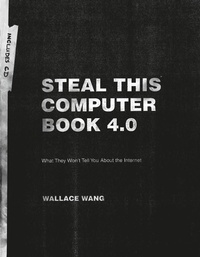
Steal This Computer Book 4.0
What They Won't Tell You About the Internet
Published on 6. May 2006
384 pages
978-1-59327-343-9 (ISBN)
Description

If you thought hacking was just about mischief-makers hunched over computers in the basement, think again. As seasoned author Wallace Wang explains, hacking can also mean questioning the status quo, looking for your own truths and never accepting at face value anything authorities say or do.
The completely revised fourth edition of this offbeat, non-technical book examines what hackers do, how they do it, and how you can protect yourself. Written in the same informative, irreverent, and entertaining style that made the first three editions hugely successful, Steal This Computer Book 4.0 will expand your mind and raise your eyebrows. New chapters discuss the hacker mentality, social engineering and lock picking, exploiting P2P file-sharing networks, and how people manipulate search engines and pop-up ads to obtain and use personal information. Wang also takes issue with the media for "hacking" the news and presenting the public with self-serving stories of questionable accuracy.
Inside, you'll discover:
-How to manage and fight spam and spyware
-How Trojan horse programs and rootkits work and how to defend against them
-How hackers steal software and defeat copy-protection mechanisms
-How to tell if your machine is being attacked and what you can do to protect it
-Where the hackers are, how they probe a target and sneak into a computer, and what they do once they get inside
-How corporations use hacker techniques to infect your computer and invade your privacy
-How you can lock down your computer to protect your data and your personal information using free programs
If you've ever logged onto a website, conducted an online transaction, sent or received email, used a networked computer or even watched the evening news, you may have already been tricked, tracked, hacked, and manipulated. As the saying goes, just because you're paranoid doesn't mean they aren't after you. And, as Wallace Wang reveals, they probably are.
The completely revised fourth edition of this offbeat, non-technical book examines what hackers do, how they do it, and how you can protect yourself. Written in the same informative, irreverent, and entertaining style that made the first three editions hugely successful, Steal This Computer Book 4.0 will expand your mind and raise your eyebrows. New chapters discuss the hacker mentality, social engineering and lock picking, exploiting P2P file-sharing networks, and how people manipulate search engines and pop-up ads to obtain and use personal information. Wang also takes issue with the media for "hacking" the news and presenting the public with self-serving stories of questionable accuracy.
Inside, you'll discover:
-How to manage and fight spam and spyware
-How Trojan horse programs and rootkits work and how to defend against them
-How hackers steal software and defeat copy-protection mechanisms
-How to tell if your machine is being attacked and what you can do to protect it
-Where the hackers are, how they probe a target and sneak into a computer, and what they do once they get inside
-How corporations use hacker techniques to infect your computer and invade your privacy
-How you can lock down your computer to protect your data and your personal information using free programs
If you've ever logged onto a website, conducted an online transaction, sent or received email, used a networked computer or even watched the evening news, you may have already been tricked, tracked, hacked, and manipulated. As the saying goes, just because you're paranoid doesn't mean they aren't after you. And, as Wallace Wang reveals, they probably are.
More details
Other editions
Additional editions
Book
05/2006
4th Edition
No Starch Press
€30.00
Shipment within 3-4 weeks

Wallace Wang
Steal This Computer Book
Book
06/1998
No Starch Press
€42.89
Article exhausted; check for reprint
Person
Wallace Wang is the author of several best-selling computer books including of the Steal This Computer Book series, Steal This File Sharing Book, The Book of Nero 7, and Visual Basic 2005 Express: Now Playing (all No Starch Press). He is also a successful standup comic who has appeared on A&E's "Evening at the Improv" and appears regularly at the Riviera Comedy Club in Las Vegas.
Content
- Intro
- Steal This Computer Book 4.0
- Praise for Steal This Computer Book
- Dedication
- Acknowledgments
- Introduction
- Your Own Revolution
- Communication's the thing
- Truth is nothing but a point of view
- What's in This Book
- I. The Early Hackers
- 1. The Hacker Mentality
- Questioning Authority
- Questioning Assumptions
- Developing Values
- The Three Stages of Hacking
- 2. The First Hackers: The Phone Phreakers
- A Short History of Phone Phreaking
- Phone Phreaking Urban Legends
- The toilet paper crisis in Los Angeles
- The Santa Barbara nuclear hoax
- The president's secret
- True and Verified Phone Phreaking Stories
- Making free phone calls, courtesy of the Israeli Army
- Phone phreaking for escorts in Las Vegas
- Phone Phreaking Tools and Techniques
- Shoulder surfing
- Phone phreaking with color boxes
- Blue box
- Red box
- Green box
- Black box
- Silver box
- Phone phreaking with color box programs
- Phreaking with war dialers and prank programs
- Phreaking cellular phones
- Hacking voice mailboxes
- Hacking VoIP
- 3. Hacking People, Places, and Things
- Social Engineering: The Art of Hacking People
- Studying a target
- Gaining familiarity
- The keys to social engineering
- Picking Locks
- The theory of lockpicking
- The tools and techniques
- Exploring Urban Areas
- Hacking the Airwaves
- Hacking History (or, Hemp for Victory)
- The Japanese textbook controversy
- Hiding history to protect the present
- Watching movies for fun and propaganda
- II. The Pc Pioneers
- 4. Ansi Bombs and Viruses
- The Making of an ANSI Bomb
- How an ANSI bomb works
- Planting an ANSI bomb
- The Spread of Computer Viruses
- Spreading a file-infecting virus
- Parasitic program infectors
- Overwriting file infectors
- Spreading a boot-sector virus
- Spreading a multipartite virus
- Spreading a macro virus
- How Viruses Avoid Detection
- Infection methods
- Stealth
- Polymorphism
- Retaliators
- How Antivirus Programs Work
- Comparing antivirus programs
- Choosing an antivirus program
- Why People Write Viruses
- For fun
- For notoriety
- Finding virus-writing tutorials
- Virus-writing toolkits
- Virus Myths and Hoaxes
- The mobile phone virus hoax
- The nuclear war hoax
- The bait-and-switch virus hoax
- The publicity-seeking virus hoax
- Learning More About Viruses
- The Future Virus Threat
- 5. Trojan Horses and Worms
- The World of Trojan Horses
- Taunting the victim
- Attacking the victim's pocketbook
- The coming of the RATs (remote-access Trojans)
- Sneaking a RAT onto a computer
- How RATs work
- Worms: Self-Replicating Viruses
- Email worms
- IRC/Instant messaging worms
- Internet worms
- Malicious web pages
- Stopping Worms and Trojan Horses
- Tracking the Threats
- 6. Warez (Software Piracy)
- Copying Copy-Protected Software
- Defeating Serial Numbers
- Defeating Product Activation
- Warez Websites
- Usenet Newsgroups: The New Piracy Breeding Ground
- III. The Internet Hackers
- 7. Where the Hackers Are
- Hacker Websites
- Hacker websites for fun and profit
- Attrition.org
- AusPhreak
- Chaos Computer Club
- Cult of the Dead Cow
- New Order
- Nomad Mobile Research Centre
- The Shmoo Group
- Underground News
- Computer security "hacking" websites
- AntiOnline
- DShield
- Hideaway.net
- Insecure.org
- PacketStorm
- Security News Portal
- SecureRoot
- SecurityFocus
- Startplaza.nu
- Sys-Security Research
- Talisker's Security Portal
- WindowsSearch
- Wiretapped
- Hacker search engines
- Hacker Magazines
- 2600
- Blacklisted! 411
- Hacker News Magazine
- The Hackademy Premium
- Phrack
- Private Line
- Hacker Usenet Newsgroups
- General hacking newsgroups
- Computer virus newsgroups
- Encryption newsgroups
- Cracking newsgroups
- Finding Hackers on IRC
- Hacker Conventions
- DefCon
- HOPE (Hackers on Planet Earth)
- Chaos Communication Congress
- PH-Neutral
- RuxCon
- ShmooCon
- SummerCon
- ToorCon
- Don't Panic: Hackers Are People, Too
- 8. Stalking a Computer
- Why Hackers Choose Their Targets
- Finding a Target
- War dialing
- Port scanning
- War driving
- The steps to accessing a WiFi network
- Finding a WiFi network
- Protecting a WiFi network
- Probing sites by Google hacking
- Finding specific webserver software using Google
- Searching specific websites
- Probing a website's defenses
- Finding and copying files using Google
- Guarding against Google hackers
- The Next Step
- 9. Cracking Passwords
- Password Stealing
- Using a keystroke logger
- Spying with a desktop monitoring program
- Using a password recovery program
- Dictionary Attacks
- Brute-Force Password Attacks
- Passwords: The First Line of Defense
- Blocking Access with Biometrics
- Biometric devices
- Defeating biometrics
- Good Enough Security
- 10. Digging into a Computer with Rootkits
- How Operating Systems Work
- The Evolution of Rootkits
- Modifying log files
- Trojaned binaries
- Hooking program calls
- Loadable kernel module (LKM) rootkits
- Opening a Backdoor
- Sniffing for More Passwords
- Killing Rootkits
- 11. Censoring Information
- Censoring the Internet
- URL filtering
- Content filtering
- DNS poisoning
- Port blocking
- The Internet Censors
- Countries that censor the Internet
- The Great Firewall of China
- The Internet censors of Saudi Arabia
- Castro's censors in Cuba
- Internet censorship around the world
- Companies that censor the Internet
- Censorship Begins at Home: Parental Control Software
- Parental control software gone bad: blocking political and educational sites
- Parental control software gone really bad: CYBERsitter
- CYBERsitter on the offensive
- Cyber Patrol vs. cphack
- Project bait and switch: the double standard of censorship
- Researching parental control programs
- Avoiding Internet Censorship
- Accessing banned web pages by email
- Accessing banned web pages through proxy servers
- Reading Banned Books Online
- Secretly reading a banned book in broad daylight
- Secretly browsing the Web in broad daylight
- Is Anyone Censoring the Censors?
- 12. The Filesharing Networks
- A Short History of Internet FileSharing
- How FileSharing Works
- The birth of Gnutella
- The Ares network
- The FastTrack network
- Sharing Large Files
- The Problem with Filesharing
- IV. The Real World Hackers
- 13. The Internet Con Artists
- Charity Scams
- The Area Code Scam
- The Nigerian Scam
- Work-at-Home Businesses
- Stuffing envelopes
- Make-it-yourself kits
- Work as an independent contractor
- Fraudulent sales
- Pyramid Schemes
- The Ponzi scheme
- The infallible forecaster
- The Lonely Hearts Scam
- Internet-Specific Con Games
- Packet sniffers
- Web spoofing
- Phishing
- Keystroke loggers
- Porn dialers
- Online Auction Frauds
- Credit Card Fraud
- Protecting Yourself
- Cagey Consumer
- Council of Better Business Bureaus
- Federal Bureau of Investigation (FBI)
- Federal Trade Commission (FTC)
- Fraud Bureau
- ScamBusters
- Scams on the Net
- ScamWatch
- Securities and Exchange Commission (SEC)
- The Recovery Room Scam
- 14. Finding People on the Internet
- Who Are the Stalkers?
- Stalking on the Internet
- Finding Personal Information on the Internet
- Searching personal websites
- Finding names, addresses, and phone numbers
- 555-1212.com
- Freeality
- ICQ White Pages
- Infobel.com
- InfoSpace
- Lycos People Search
- Switchboard
- USSearch.com
- WhitePages.com
- Yahoo! People Search
- ZabaSearch
- Finding someone using a Social Security number
- Finding people in the military
- Searching public records
- Finding email addresses
- EmailChange
- Meta Email Search Agent (MESA)
- NedSite
- Other options
- Stalking Celebrities
- Protecting Yourself
- 15. Propaganda as News and Entertainment
- The News as Reality TV
- Corporate Influence on the News
- Project Censored: the news you never read about
- Drink milk-the chemicals are good for you
- The objective news from ABC and Wal-Mart
- The mystery bulge on George Bush's back
- The News Only Reports the Facts-And Anything Else Anyone Will Tell Them
- The News as History
- Fear, Future, Fun, and Fakes: The Weekly World News as a Role Model for the News Media
- Fear: attracting an audience
- Future: distracting from the present
- Fun: keeping people happy
- Fakes: lies are more interesting than the truth
- TV Guide and Oprah Winfrey
- Newsweek and Martha Stewart
- O.J. Simpson and Time
- Diversity at the University of Wisconsin
- Bobbi McCaughey, Newsweek, and Time
- Using Satire to Report on Reality
- Blogs as News Sources
- 16. Hacktivism: Online Activism
- Virtual Sit-ins and Blockades
- The world's first Internet strike
- Zapatistas on the Internet
- Disturbance on demand
- Email Bombing
- Web Hacking and Computer Break-ins
- Computer Viruses and Worms
- Activist Video Games
- Google Bombing
- Becoming a Hacktivist
- 17. Hate Groups and Terrorists on the Internet
- Hate Groups on the Internet
- Racist Video Games
- Terrorism: The Communist Threat of the Twenty-first Century
- The myth of cyberterrorism
- Terrorists on the Internet
- The Future of Terrorism
- V. The Future-Hacking for Profit
- 18. Identity Theft and Spam
- Understanding Identity Theft
- How identity theft works
- Minimizing the threat of identity theft
- Protecting your credit rating
- Spam: Junk Mail on the Internet
- Why Companies Spam and How They Do It
- Collecting email addresses
- Newsgroup extractors
- Website extractors
- SMTP server extractors
- P2P network harvesters
- Phishing for email addresses
- Masking the spammer's identity
- Protecting Yourself from Spammers
- Complain to the spammer
- Complain to the spammer's ISP
- Complain to the Internal Revenue Service
- Locating the spammer's postal address
- How Spam Filters Work
- Content (Bayesian) filtering
- Blacklists and whitelists
- DNS lookup lists
- Attachment filtering
- Stopping Spam
- Possible future solutions to spam
- Going on the offensive
- Antispam organizations
- A PostScript: Spam as Propaganda
- 19. Banner Ads, Pop-Up Ads, and Search Engine Spamming
- Banner Ads and Click Fraud
- Pop-Up/Pop-Under Ads
- How to create a pop-up/pop-under ad
- How to stop banner and pop-up/pop-under ads
- Watching Out for Web Bugs
- Tracking the websites you visit
- Using web bugs in spam
- Bugging newsgroups
- Protecting yourself against web bugs
- Spamdexing: Search Engine Spamming
- Keyword stuffing
- Keyword content creators
- Link farming
- Cloaking and code swapping
- Doorway pages
- Spamdexing for hire
- 20. Adware and Spyware
- What Spyware Can Do
- Displaying pop-up ads
- Home page hijacking
- Stealing information
- Why Companies Advertise Through Spyware
- How Spyware Infects a Computer
- Installing infected files
- Installing infected anti-spyware programs
- Drive-by downloads
- Spyware-infected spyware
- Where Spyware Hides
- Eliminating Spyware
- Securing Internet Explorer
- Switching to a safer browser
- Installing a firewall
- Monitoring your startup programs
- Running anti-spyware programs
- VI. Protecting Your Computer and Yourself
- 21. Computing on a Shoestring: Getting Stuff for (Almost) Free
- Internet Comparison Shopping
- Buying a Refurbished Computer
- Save on Printer Supplies
- Free (and Almost-Free) Software
- Getting commercial software cheaply (and legally)
- Bundled software
- Buying obsolete software, upgrades, and OEM versions
- Buying software at academic discounts
- Shareware and freeware
- Name-brand alternatives
- Finding an open-source program
- Free Internet Access
- Free Email Accounts
- Free Web and Blog Space
- The Best Things in Life Are Free
- 22. Computer Forensics: The Art of Deleting and Retrieving Data
- Recovering Deleted Data
- File Shredders
- Storing Deleted Data
- Finding data stored in slack space
- Finding data stored in swap files
- Your history stored in a web browser cache
- Computer Forensics Tools
- File-undeleting programs
- Hex editors
- Magnetic sensors and electron microscopes
- Commercial Forensics Tools
- Protecting Yourself
- 23. Locking Down Your Computer
- Protecting Your Computer (and Its Parts)
- USB blockers
- Alarms
- Remote tracking services
- Protecting Your Data
- Backing up your data
- Update and patch your operating system
- Identifying and closing default weaknesses
- Choosing a firewall
- Switch to a safer browser
- Protecting your email account from spam
- Protecting against phishing
- What's Next?
- A. Epilogue
- B. What's on the Steal This Computer Book 4.0 CD
- Uncompressing, Unzipping, Unstuffing, and So On
- Chapter 1-The Hacker Mentality
- Chapter 2-The First Hackers: The Phone Phreakers
- Chapter 3-Hacking People, Places, and Things
- Chapter 4-ANSI Bombs and Viruses
- Chapter 5-Trojan Horses and Worms
- Chapter 6-Warez (Software Piracy)
- Chapter 7-Where the Hackers Are
- Chapter 8-Stalking a Computer
- Chapter 9-Cracking Passwords
- Chapter 10-Digging into a Computer with Rootkits
- Chapter 11-Censoring Information
- Chapter 12-The Filesharing Networks
- Chapter 13-The Internet Con Artists
- Chapter 14-Finding People on the Internet
- Chapter 15-Propaganda as News and Entertainment
- Chapter 16-Hacktivism: Online Activism
- Chapter 17-Hate Groups and Terrorists on the Internet
- Chapter 18-Identity Theft and Spam
- Chapter 19-Banner Ads, Pop-up Ads, and Search Engine Spamming
- Chapter 20-Adware and Spyware
- Chapter 21-Computing on a Shoestring: Getting Stuff for (Almost) Free
- Chapter 22-Computer Forensics: The Art of Deleting and Retrieving Data
- Chapter 23-Locking Down Your Computer
- Updates
- C. Cd License Agreement
- No Warranty
