

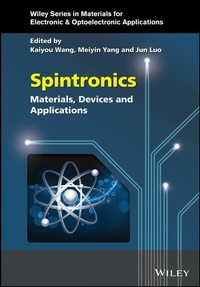
Spintronics
Description

In Spintronics: Materials, Devices and Applications, a team of distinguished researchers delivers a holistic introduction to spintronic effects within cutting-edge materials and applications. Containing the perfect balance of academic research and practical application, the book discusses the potential--and the key limitations and challenges--of spintronic devices.
The latest title in the Wiley Series in Materials for Electronic and Optoelectronic Applications, Spintronics: Materials, Devices and Applications explores giant magneto-resistance (GMR) and tunneling magnetic resistance (TMR) materials, spin-transfer torque and spin-orbit torque materials, spin oscillators, and spin materials for use in artificial neural networks. Applications in multi-ferroelectric and antiferromagnetic materials are presented as well.
This book also includes:
* A thorough introduction to recent research developments in the fields of spintronic materials, devices, and applications
* Comprehensive explorations of skymions, magnetic semiconductors, and antiferromagnetic materials
* Practical discussions of spin-transfer torque materials and devices for magnetic random-access memory
* In-depth examinations of giant magneto-resistance materials and devices for magnetic sensors
Perfect for advanced students and researchers in materials science, physics, electronics, and computer science, Spintronics: Materials, Devices and Applications will also earn a place in the libraries of professionals working in the manufacture of optics, photonics, and nanometrology equipment.
More details
Other editions
Additional editions
Persons
Edited by
Kaiyou Wang is Director of State Key Laboratory of Superlattices & Microstructure, Institute of Semiconductors, Chinese Academy of Sciences, Beijing, China.
Meiyin Yang is Professor at the Key Laboratory of Microelectronic Devices & Integrated Technology, Institute of Microelectronics of Chinese Academy of Sciences, Beijing, China.
Jun Luo is Professor at the Key Laboratory of Microelectronic Devices & Integrated Technology, Institute of Microelectronics of Chinese Academy of Sciences, Beijing, China.
Series Editors
Arthur Willoughby University of Southampton, Southampton, UK
Peter Capper Ex-Leonardo M. W. Ltd, Southampton, UK
Safa Kasap University of Saskatchewan, Saskatoon, Canada
Content
List of Contributors xi
Series Preface xiii
Preface xv
1 Introduction 1 Kaiyou Wang
2 Giant Magnetoresistance (GMR) Materials and Devices for Biomedical and Industrial Applications 3 Kai Wu, Diqing Su, Renata Saha, and Jian-Ping Wang
2.1 Introduction 3
2.2 Giant Magnetoresistance (GMR) Effect 4
2.3 Different Types of GMR Sensors 7
2.3.1 Rigid GMR Sensors 7
2.3.1.1 Long-strip GMR Sensors 7
2.3.1.2 Large-area GMR Sensors 8
2.3.2 Flexible GMR Sensors 9
2.3.3 Printable GMR Sensors 11
2.3.4 Granular GMR Sensors (Thin Film- and Solution-based) 11
2.4 GMR Sensors: Surface Modification and Auxiliary Tools 12
2.4.1 GMR Sensor Surface Modification for Biomedical Applications 12
2.4.2 Integration of a Magnetic Flux Concentrator (MFC) 14
2.4.2.1 Superconducting MFC 14
2.4.2.2 Soft-ferromagnetic Material-based MFC 14
2.4.3 Integration of Microfluidic Channels 16
2.5 GMR-based Biomedical Applications 16
2.5.1 GMR-based Immunoassays 16
2.5.1.1 Wash-free and Non-wash-free Immunoassays 17
2.5.1.2 Different Immunoassay Methods 17
2.5.1.3 GMR for Disease Diagnosis 19
2.5.1.4 GMR-based Point-of-Care (POC) Devices 24
2.5.2 GMR-based Genotyping 25
2.5.3 GMR-based Bio-magnetic Field Recording 28
2.5.4 GMR-based Food and Drug Safety Supervision 32
2.6 GMR-based Industrial Applications 34
2.6.1 GMR for Position Sensing 34
2.6.2 GMR for Current Sensing 35
2.6.3 GMR for Material Defect Inspection 37
2.7 Conclusions and Outlook 39
References 40
3 Tunneling Magnetoresistance (TMR) Materials and Devices for Magnetic Sensors 51 Zitong Zhou, Kun Zhang, and Qunwen Leng
3.1 Principle of Tunneling Magnetoresistance Effect 52
3.1.1 Tunneling Process 52
3.1.2 Spin-dependent Tunneling Process 53
3.1.3 The Julliére Model 54
3.1.4 Typical Structure of the Magnetic Sensing Unit 56
3.2 Material and Process 56
3.2.1 TMR Barrier Materials 56
3.2.2 Ferromagnetic Layers in TMR 59
3.2.3 TMR Film Stack 61
3.2.4 Perpendicular Magnetic Anisotropy (PMA) in TMR 65
3.2.5 Material Fabrication and Pattern Process 65
3.2.5.1 Magnetron Sputtering 66
3.2.5.2 Ion Beam Deposition (IBD) 67
3.2.5.3 Evaporation 67
3.2.5.4 Chemical Vapor Deposition (CVD) 67
3.2.5.5 Photolithography 69
3.2.5.6 Etching 69
3.3 The Noise of TMR Sensors 70
3.3.1 The Source of Noise from TMR Sensors 70
3.3.2 Methods to Suppress the Noise 72
3.3.2.1 Increase the Number of MTJs in TMR Device 72
3.3.2.2 Optimize Free Layer Volume 73
3.3.2.3 Flux Concentrator 73
3.3.2.4 Applying a Bias Magnetic Field 74
3.4 TMR Sensors and Applications 75
3.4.1 TMR Read Heads 75
3.4.2 The TMR Angle Sensors 76
3.4.3 Geomagnetic Measurement 79
3.4.4 Spin-MEMS Combined Application 80
3.4.5 Nondestructive Testing (NDT) 82
3.4.6 Ultra-low Magnetic Field Detection: Biosensor 83
3.5 Conclusion 85
References 86
4 Spin-Transfer Torque Materials and Devices for Magnetic Random-Access Memory (STT-MRAM) 93 Yan Cui and Jun Luo
4.1 The Background and Mechanism of STT-MRAM 93
4.1.1 The Background of STT-MRAM 93
4.1.2 The Mechanism of STT-MRAM 93
4.1.2.1 LLGS Equation 93
4.1.2.2 The Write Mechanism of STT-MRAM 94
4.1.2.3 The Magnetism of STT-MTJ 97
4.1.2.4 The Switching Properties of STT-MTJ 99
4.2 The Integrated Process of STT-MRAM 102
4.2.1 CMP Technology 102
4.2.2 Magnetic Film Deposition Technology 103
4.2.3 Photolithography Technology 103
4.2.4 Etching Technology 103
4.2.5 Dielectric Isolation Technology 104
4.2.6 Contact Technology 104
4.2.7 Passivation Deposition 104
4.3 Testing of the STT-MTJ Device 105
4.4 The Development Status of STT-MRAM 105
References 107
5 Spin-Orbit Torque (SOT) Materials and Devices 113 Yucai Li, Kevin William Edmonds, and Kaiyou Wang
5.1 Spin-Orbit Coupling in Materials 113
5.2 Manipulation of Magnetic Materials by SOT 116
5.2.1 The Mechanism of SOT in Ferromagnets 116
5.2.2 Measurement Techniques of SOT 117
5.2.3 Field-Free SOT Magnetization Switching in Ferromagnets 119
5.2.4 Domain Wall and Skyrmion Motion Driven by SOT 121
5.2.5 Manipulation of Antiferromagnets by SOT 122
5.3 SOT Materials 123
5.3.1 Traditional Materials 123
5.3.2 Interfacial Engineering 124
5.3.3 Oxide Heterostructures 125
5.3.4 The van der Waals Materials and Topological Materials 125
5.4 Devices and Application 128
5.4.1 SOT-MTJ and SOT-MRAM 128
5.4.2 In-memory Computing 129
5.4.3 SOT Artificial Intelligence Device 130
5.4.4 Internet of Things 131
5.5 Conclusion 131
References 132
6 Spin Oscillators 139 Huayao Tu and Zhongming Zeng
6.1 Introduction 139
6.2 Fundamental Physics 140
6.2.1 Spin Transfer Torque and Magnetization Dynamics 140
6.2.2 Spin Hall Effect (SHE) and Spin-Orbit Torque (SOT) 141
6.2.3 Operation Principle of SO 142
6.3 Device Classification 143
6.3.1 Geometries 143
6.3.2 Magnetic Equilibrium States 145
6.3.3 Material Structures 145
6.3.3.1 Spin Valves 145
6.3.3.2 Magnetic Tunnel Junctions 146
6.3.3.3 Bilayer 146
6.3.3.4 Single Layer 147
6.4 Emerging Spin-torque Oscillators Based on Magnetic Solitons 148
6.4.1 Vortex 148
6.4.2 Skyrmion 149
6.5 Functional Properties 150
6.5.1 Frequency 150
6.5.1.1 Modulation Properties 152
6.5.2 Output Power 152
6.5.3 Linewidth 155
6.5.4 Phase-locking and Synchronization 157
6.6 Applications 159
6.6.1 Microwave Source 159
6.6.2 Spin Wave Emitter 160
6.6.3 Microwave Detector and Energy Harvester 160
6.6.4 Magnetic Field Detector 163
6.6.5 Neuromorphic Computing 164
6.7 Summary and Outlook 166
References 167
7 Magnetic Tunnel Junctions for Artificial Neural Network 179 Meiyin Yang, Tengzhi Yang, and Jun Luo
7.1 Introduction of Neural Computing 179
7.2 Hardware Requirements for an Artificial Intelligence Neural Network 182
7.3 Introduction to Magnetic Tunnel Junction Devices 183
7.4 Magnetic Tunnel Junction for Neuron Hardware 185
7.4.1 Introduction of STT-MTJ and SOT-MTJ 185
7.4.2 Different MTJ-Based Neuron Hardware 186
7.4.2.1 Step Function 187
7.4.2.2 Nonlinear Activation Function 188
7.4.2.3 Spike or Probability Based Neuron 189
7.5 Magnetic Tunnel Junctions for Synaptic Devices 192
7.6 Learning Methods Suitable for MTJs 194
7.7 Summary and Outlook 195
References 195
8 Three-Dimensional Magnetic Structures of B20 Chiral Magnets 203 Kejing Ran, Dongsheng Song, Weiwei Wang, Haifeng Du, and Shilei Zhang
8.1 Theoretical Development 203
8.2 Observation Technique 206
8.2.1 Electron Holography 206
8.2.1.1 Historical Survey 206
8.2.1.2 Experimental Setup 207
8.2.2 Resonant Elastic X-ray Scattering 209
8.2.2.1 Historical Survey 209
8.2.2.2 Theoretical Treatment 210
8.2.2.3 Experimental Setup 212
8.3 Experimental Results 214
8.3.1 Magnetic Bobbers 214
8.3.2 Surface Twists 216
References 217
9 Multiferroelectric Materials 221 Xiaobin Guo and Li Xi
9.1 Electric Field-driven Magnetization Switching 222
9.2 Electric Field-driven Exchange Bias Reversal and Antiferromagnetic Domain Wall Motion 229
9.3 Electric Field-driven Antiferromagnetic Vector Switching 237
Acknowledgements 239
References 240
10 Robust Manipulation of Magnetic Properties in (Ga,Mn)As 243 Hailong Wang and Jianhua Zhao
10.1 Background and Introduction 243
10.2 Electric Field Effects on the Magnetic Properties of (Ga,Mn)As 245
10.3 Manipulation of the Magnetism in (Ga,Mn)As by Light and Strain 256
10.4 Giant Modulation of Magnetism via Organic Molecules 257
10.5 Conclusion and Outlook 260
Acknowledgements 262
References 262
11 Antiferromagnetic Materials and Their Manipulations 271 Xionghua Liu and Kaiyou Wang
11.1 Introduction 271
11.2 Antiferromagnetic Materials 272
11.2.1 Metallic Antiferromagnets 272
11.2.2 Insulating Antiferromagnets 273
11.2.3 Semiconducting and Semimetallic Antiferromagnets 274
11.3 Manipulations of Antiferromagnetic States 275
11.3.1 Magnetic Control of Antiferromagnets 275
11.3.2 Strain Control of Antiferromagnets 277
11.3.3 Optical Control of Antiferromagnets 279
11.3.4 Electrical Control of Antiferromagnets 281
11.4 Topological Antiferromagnetic Spintronics 283
11.5 Summaries and Prospects 286
References 286
12 Prospects 295 Meiyin Yang and Kaiyou Wang
Index 299
2
Giant Magnetoresistance (GMR) Materials and Devices for Biomedical and Industrial Applications
Kai Wu1,Diqing Su2,Renata Saha1, and Jian-Ping Wang1,2
1Department of Electrical and Computer Engineering, University of Minnesota, Minneapolis, MN, United States
2Department of Chemical Engineering and Materials Science, University of Minnesota, Minneapolis, MN, United States
CHAPTER MENU
- 2.1 Introduction
- 2.2 Giant Magnetoresistance (GMR) Effect
- 2.3 Different Types of GMR Sensors
- 2.3.1 Rigid GMR Sensors
- 2.3.1.1 Long-strip GMR Sensors
- 2.3.1.2 Large-area GMR Sensors
- 2.3.2 Flexible GMR Sensors
- 2.3.3 Printable GMR Sensors
- 2.3.4 Granular GMR Sensors (Thin Film- and Solution-based)
- 2.4 GMR Sensors: Surface Modification and Auxiliary Tools
- 2.4.1 GMR Sensor Surface Modification for Biomedical Applications
- 2.4.2 Integration of a Magnetic Flux Concentrator (MFC)
- 2.4.2.1 Superconducting MFC
- 2.4.2.2 Soft-ferromagnetic Material-based MFC
- 2.4.3 Integration of Microfluidic Channels
- 2.5 GMR-based Biomedical Applications
- 2.5.1 GMR-based Immunoassays
- 2.5.1.1 Wash-free and Non-wash-free Immunoassays
- 2.5.1.2 Different Immunoassay Methods
- 2.5.1.3 GMR for Disease Diagnosis
- 2.5.1.4 GMR-based Point-of-Care (POC) Devices
- 2.5.2 GMR-based Genotyping
- 2.5.3 GMR-based Bio-magnetic Field Recording
- 2.5.4 GMR-based Food and Drug Safety Supervision
- 2.6 GMR-based Industrial Applications
- 2.6.1 GMR for Position Sensing
- 2.6.2 GMR for Current Sensing
- 2.6.3 GMR for Material Defect Inspection
- 2.7 Conclusions and Outlook
2.1 Introduction
Giant magnetoresistance (GMR) is the large change in electrical resistance of metallic layered structures when the magnetizations of ferromagnetic layers are reoriented relative to one another under the application of an external magnetic field. This effect was at first discovered in 1988 by a team led by Albert Fert on (001) Fe/(001) Cr multilayers [1] and, independently, by another team led by Peter Grünberg on multilayers of Fe and Cr on (110) GaAs substrate [2]. The discovery of GMR was to a large extent due to the significant progress in the thin film deposition technique: molecular beam epitaxy (MBE). By stacking such thin films with nearly a monolayer precision, one can fabricate multilayered structures with properties that are totally distinct from those of the constitutive bulk materials.
The publications reporting the discovery of GMR rapidly attracted attention for its fundamental interest as well as for many potential applications. Nowadays, it has been commercialized in many areas such as magnetic field sensors including biosensors and read/write heads in hard disk drives, as well as detectors of oscillations in microelectromechanical system (MEMS) [3-12]. These achievements wouldn't be possible without an in-depth understanding of the physics of the GMR effect, which requires a quantum-mechanical insight into the electronic spin-dependent transport in magnetic nanomaterials. In this chapter, we will introduce the origin of the GMR effect in Section 2.2 where spin-dependent scattering and two-channel model are explained as well as some basic GMR stack structures are given. In Section 2.3, different types of GMR sensors are introduced, including sensors with different geometries that are fabricated on both rigid and flexible substrates, printable GMR flakes, and granular GMR sensors. GMR sensor surface modifications for biomedical applications, magnetic flux concentrators (MFC) to focus and amplify weak magnetic fields, and microfluidic channels for quantitative and fully automatic on chip assays on sub-microliter volume of biological fluids are introduced in Section 2.4. In Sections 2.5 and 2.6, various biomedical and industrial applications based on GMR sensors are reviewed. The roles of GMR sensors in position sensing, current sensing, and material defect inspection are discussed.
2.2 Giant Magnetoresistance (GMR) Effect
GMR is a quantum mechanical magnetoresistive effect that exists in multilayers composed of alternating ferromagnetic (FM) and non-magnetic (NM) conductive layers. Pioneers in this field, Albert Fert and Peter Griinbergwere are awarded the 2007 Nobel Prize in Physics [1, 2]. The physical origin of the GMR effect is caused by a spin-dependent scattering of the conduction electrons with different spins relative to the magnetizations of FM layers. Briefly, in magnetically ordered materials, the electrical resistance is affected by the scattering of electrons on the magnetic sublattices of the crystal; namely, the non-zero magnetic moments. This scattering is weaker when the electron spins and magnetic moments are parallel and stronger when they are antiparallel. A good review of this mechanism is provided in reference [13].
To qualitatively understand GMR, a simplified Mott model is introduced herein [14]. Assuming that the scattering of conduction electrons at the interface between the FM and NM layers is small, and the electron spins persist long enough, the conduction of up-spin and down-spin electrons are viewed as two conducting channels lying in parallel configuration.
As shown in Figure 2.1 (A1), taking a FM/NM/FM multilayer structure as an example, when the magnetizations of FM layers are aligned parallel, the up-spin electrons pass through the structure almost without scattering since the spins are parallel to the magnetizations of FM layers. On the contrary, the down-spin electrons encounter strong scattering within both FM layers since their spins are antiparallel to the magnetizations of both layers. The conduction occurs in parallel for the two spin channels (also called the two-channel model): thus, the total resistance Rp of this multilayer structure is the sum of resistance in parallel of electrons with up-spin and down-spin, which is expressed as:
Figure 2.1 (A) The two-channel resistor model of a FM/NM/FM multilayer GMR structure when the magnetizations of FM layers are aligned parallel (A1) and antiparallel (A2). (B) RH curves of GMR multilayers with easy axis of the free layer (B1) parallel and (B2) perpendicular to the pinned layer. (C) The CPP (Cl) and CIP (C2) geometries.
(2.1)On the other hand, the RAP , defined as the resistance of this multilayer structure when the magnetizations of FM layers are antiparallel as shown in Figure 2.1(A2), is expressed as:
(2.2)Assuming that for the NM layer the resistance is negligible for both electron spins (up and down). To further simplify equations (2.1) and (2.2), the resistances of up-spin and down-spin channels in Figure 2.1(A1) are expressed by R and R :
(2.3) (2.4)Thus, the simplified RP and RAP for a FM/NM/FM GMR multilayer structure with magnetizations of FM layers aligned parallel and antiparallel are expressed as:
(2.5) (2.6)The GMR ratio (also referred as the MR ratio, unit: %) can be modeled by a simple resistor model expressed as:
(2.7)Apart from the MR ratio, another important figure of merit that is used to evaluate the performance of the MR sensors is the detectivity D. This parameter is better known as the magnetic field resolution or the magnetic field equivalent noise level expressed by:
(2.8)Where Sv is the noise voltage density (unit: V/HZ) , ?V is the total output voltage and ?H is the range of magnetic field that the MR sensor can measure. For MR sensors, the ratio ?V/?H is expressed as
(2.9)where ?R/RP is the MR ratio and Vb is the bias voltage applied to the sensor. Therefore, in order to obtain a high sensitivity GMR sensor, the detectivity D needs to be sufficiently small.
There are two most commonly used stack structures for GMR sensors. Multilayer GMR sensor consists of multiple alternating ferromagnetic layers and nonferromagnetic layers. Spin valve sensors consist of only two ferromagnetic layers separated by a nonmagnetic layer, where the magnetization of one ferromagnetic layer can rotate freely, while the magnetization of the other ferromagnetization layer is fixed to a certain direction.
Typical RH curves of GMR multilayers as well as the spin valves are shown in Figure 2.1(B). For multilayer sensors (Figure 2.1(B1), the magnetizations of the FM layers rotate with the external magnetic field, with the maximum resistance being achieved at zero field where the magnetizations of the two adjacent FM layers are antiparallel. For spin valve sensors where the easy axis of the free layer is perpendicular to the magnetization of pinned layer (Figure 2.1(B2), only the magnetization of the free layer can rotate with the magnetic field, leading to a maximum resistance when the magnetic field is antiparallel to the magnetization of the pinned layer. There are two variations of...
