

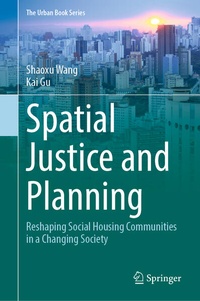
Spatial Justice and Planning
Description

Like many countries around the world, social housing in Aotearoa New Zealand is an area of contention, especially at the building and redevelopment stages. Protecting community character and human rights has been used by social housing tenants to resist changes, but the primary focus on material outcomes neglects broadening access toplanning processes. Compact, mixed tenure and sustainable (re)developments are regarded as the just built environment, as they enable equal accessibility to all. But there are contradictions between the planned spatiality of justice and individuals' socialised sensory space. Reconciliation of morphological differentiations in built forms and social cohesion remains a challenging task.
This book focuses on the re-examination, integration and transferability of spatial justice. It makes a new contribution to urban justice theory by strengthening spatial justice and planning. Social housing areas are expected to adapt to changing social and economic demands while retaining much-valued established community character. This book also provides practical strategies for tackling complex planning problems in social housing redevelopment.
More details
Other editions
Additional editions
Persons
Dr Shaoxu Wang was a researcher at the School of Architecture and Planning, University of Auckland before she began working at Auckland Council. She has an educational background in geography and planning. Focusing on social and spatial inequalities, marginalised groups and social policy analysis, her research bridges sociology, human geography and planning.
Dr Kai Gu is an Associate Professor at the School of Architecture and Planning, University of Auckland. Supported by the British Economic and Social Research Council, the Canadian International Development Agency and the Natural Science Foundation of China, most of his research publications are on urban morphology and planning. His recent research projects explore the spatial composition of urban landscapes and socio-economic processes in the production of (in)justice.
