

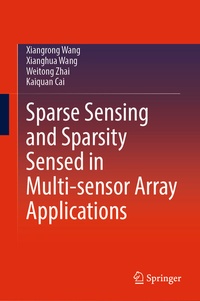
Sparse Sensing and Sparsity Sensed in Multi-sensor Array Applications
Description

The book focuses on sparse multi-sensor array systems and design approaches. Both principles and engineering practice have been addressed, with more weight placed on algorithm development. This is achieved by providing an in-depth study on sparse sensing for several major multi-sensor array applications such as beam-pattern synthesis, adaptive beamforming, target detection, arrival angle estimation, and dual-functional radar communications. Sparsity sensed in multi-sensor arrays refers to the sparse property of the spatial spectrum sensed. The exploitation of the sparsity in the sensed can significantly enhance the performance of signal processing systems. The comprehensive and systematic treatment of theory and practice in different array applications is one of the major features of the book, which is particularly suited for readers who are interested to learn practical solutions in array signal processing. The book benefits researchers, engineers, and graduate students in the fields of signal processing, electrical engineering, telecommunications, etc.
More details
Other editions
Additional editions
Persons
Xiangrong Wang received her Ph.D. degree in signal processing from University of New South Wales, Australia, in 2015. She was a post-doctoral research fellow in the Center for Advanced Communications, Villanova University, USA, from February to September in 2016.
Since then, she has been an associate professor at the School of Electronic and Information Engineering, Beihang University, China. She is a Senior Member of the IEEE, a committee member of IEEE SAM TC and an associate editor of IEEE Transactions on Radar Systems, IET Signal Processing and Digital Signal Processing. Her research interest includes array signal processing, parameter estimation, time-frequency analysis, and spectrum sharing. She has authored 1 textbook, 2 book chapters, and more than 70 papers.
Content
Foundation.- Array Processing Fundamentals.- Multi-Sensor Array Applications.- Sparse Sensing via Antenna Selection.- Sparse Sensing for Determininic Beamforming.- Sparse Sensing for Adaptive Beamforming.- Cognitive-Driven Optimization of Sparse Sensing.- Sparse Sensing for MIMO Array Radar.- Sparse Sensing for Target Detection.- Sparse Sensing for Dual-Functional Radar Communications.- Sparsity Sensed using Sparse Arrays.- Sparsity Sensed with Thinned Antenna Array.- Sparsity Sensed for Enhanced DOA Estimation.
