

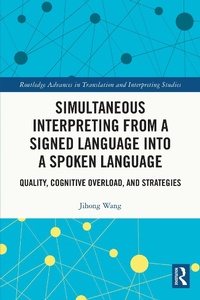
Simultaneous Interpreting from a Signed Language into a Spoken Language
Quality, Cognitive Overload, and Strategies
1st Edition
Published on 27. May 2021
278 pages
978-1-000-37426-1 (ISBN)
Description

This book examines conference-level simultaneous interpreting from a signed language into a spoken language, drawing on Auslan (Australian Sign Language)-to-English simultaneous interpretation data to explore the skills, knowledge, strategies, and cognitive abilities needed for effective interpretations in this language direction.
As simultaneous interpreting from a spoken language into a signed language is the widely accepted norm within the field of signed language interpreting, to date little has been written on simultaneous interpreting in the other language direction. In an attempt to bridge this gap, Wang conducts microanalysis of an experimental corpus of Auslan-to-English simultaneous interpretations in a mock conference setting to investigate different dimensions of quality assessment, interpreting strategies, cognitive load, and the interpreting process itself. The focus on conference-level simultaneous interpreting not only allows for insights into the impact of signed language variation on the signed-to-spoken language simultaneous interpreting process but also sheds light on the unique demands of conference settings such as the requirement of using a formal register.
Acting as a bridge between spoken language interpreting studies and signed language interpreting studies and highlighting implications for future research on simultaneous interpreting of other language combinations (spoken and signed), this book will be of interest to scholars in translation and interpreting studies as well as active practitioners in these fields.
As simultaneous interpreting from a spoken language into a signed language is the widely accepted norm within the field of signed language interpreting, to date little has been written on simultaneous interpreting in the other language direction. In an attempt to bridge this gap, Wang conducts microanalysis of an experimental corpus of Auslan-to-English simultaneous interpretations in a mock conference setting to investigate different dimensions of quality assessment, interpreting strategies, cognitive load, and the interpreting process itself. The focus on conference-level simultaneous interpreting not only allows for insights into the impact of signed language variation on the signed-to-spoken language simultaneous interpreting process but also sheds light on the unique demands of conference settings such as the requirement of using a formal register.
Acting as a bridge between spoken language interpreting studies and signed language interpreting studies and highlighting implications for future research on simultaneous interpreting of other language combinations (spoken and signed), this book will be of interest to scholars in translation and interpreting studies as well as active practitioners in these fields.
More details
Series
Edition
1. Auflage
Language
English
Place of publication
London
United Kingdom
Publishing group
Taylor & Francis Ltd
Target group
College/higher education
Illustrations
21 Tables, black and white; 2 Line drawings, black and white; 22 Halftones, black and white; 24 Illustrations, black and white
ISBN-13
978-1-000-37426-1 (9781000374261)
Copyright in bibliographic data and cover images is held by Nielsen Book Services Limited or by the publishers or by their respective licensors: all rights reserved.
Schweitzer Classification
Other editions
Additional editions
Jihong Wang
Simultaneous Interpreting from a Signed Language into a Spoken Language
Quality, Cognitive Overload, and Strategies
Book
01/2023
1st Edition
Routledge
€63.50
Shipment within 15-20 days
Jihong Wang
Simultaneous Interpreting from a Signed Language into a Spoken Language
Quality, Cognitive Overload, and Strategies
Book
05/2021
1st Edition
Routledge
€206.60
Shipment within 15-20 days
Person
Jihong Wang is a lecturer in Chinese/English translation and interpreting at The University of Queensland, Australia. She completed a PhD thesis on the relationship between professional Auslan/English interpreters' working memory capacity and simultaneous interpreting performance. She conducts research on signed language interpreting, spoken language interpreting, cognitive aspects of interpreting, simultaneous interpreting, remote interpreting, machine interpreting, and sight translation.
Content
Chapter 1: Setting the Stage
Chapter 2: Overview
Chapter 3: Methodology
Chapter 4: Quality, Self-perceived Challenges, and Self-reported Strategies
Chapter 5: Processing Time Regarding Sentence Beginnings, Numbers, and Negation
Chapter 6: Cognitive Overload and Coping Strategies Regarding Numbers
Chapter 7: Cognitive Overload and Coping Strategies Regarding End Negation
Chapter 8: Summary and Recommendations
Chapter 2: Overview
Chapter 3: Methodology
Chapter 4: Quality, Self-perceived Challenges, and Self-reported Strategies
Chapter 5: Processing Time Regarding Sentence Beginnings, Numbers, and Negation
Chapter 6: Cognitive Overload and Coping Strategies Regarding Numbers
Chapter 7: Cognitive Overload and Coping Strategies Regarding End Negation
Chapter 8: Summary and Recommendations
