

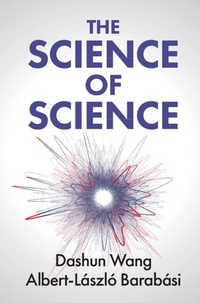
The Science of Science
Published on 10. March 2021
978-1-108-59548-3 (ISBN)
Description

This is the first comprehensive overview of the 'science of science,' an emerging interdisciplinary field that relies on big data to unveil the reproducible patterns that govern individual scientific careers and the workings of science. It explores the roots of scientific impact, the role of productivity and creativity, when and what kind of collaborations are effective, the impact of failure and success in a scientific career, and what metrics can tell us about the fundamental workings of science. The book relies on data to draw actionable insights, which can be applied by individuals to further their career or decision makers to enhance the role of science in society. With anecdotes and detailed, easy-to-follow explanations of the research, this book is accessible to all scientists and graduate students, policymakers, and administrators with an interest in the wider scientific enterprise.
Reviews / Votes
'Wang and Barabasi book is a manifesto for the science of science domain. Graduate students (as well as their mentors) owe the authors a debt of gratitude for this impressive synthesis of what is a fast-evolving field of research.' Pierre Azoulay, Massachusetts Institute of Technology 'Analyzing quantitative aspects of science with state-of-art tools, Wang and Barabasi have written an insightful and comprehensive book that will become a must-read for all scholars interested in science.' Yu Xie, Princeton University 'In their engaging book, Wang and Barabasi take a fresh look at the science of science. They convincingly argue that in the age of big data and AI applying the scientific method to science itself not only helps understand how science works but may even enhance it. We are compelled to consider the determinants of individual careers and what this means in the age of large-scale scientific collaborations. These and other questions around the meaning of scientific impact, in academia and beyond, make the book highly relevant to scientists, academic administrators and funders alike. By the time the final, forward-looking chapter ends we are hooked on all the correlations and predictions, and so it is only fitting that we are invited to join in, to help shape the field which is likely to be driven by a human-machine collaboration.' Magdalena Skipper, Nature 'Overall, I found this book very stimulating. It made me wonder whether in-depth metrics analyses of 'only' the subjective narratives of authors, such as the references list they select, actually creates a foundation on which to form judgement rather than opinion? Namely, what fraction of these publications analysed for their metrics were actually underpinned by their data? As well as provoking thought, this book offers a feast of references, 424 in all. There are such further enticing reads as reference 396, Life3.0: Being Human in the Age of Artificial Intelligence. To conclude, I recommend this book for your library, and maybe even take it for your summer beach reading.' John R. Helliwell, Journal of Applied Crystallography '... a text that should appeal to practicing scientists curious about the structure of the whole scientific enterprise, academic administrators and policy makers interested in evidence-based decision-making, and researchers interested in contributing further to the "science of science." There is no better, handier, and more readable work to appeal to such audiences ... Highly recommended.' M. Oromaner, Choice ConnectMore details
Language
English
Place of publication
Cambridge
United Kingdom
Target group
Professional and scholarly
Illustrations
Worked examples or Exercises
File size
13,34 MB
ISBN-13
978-1-108-59548-3 (9781108595483)
Copyright in bibliographic data and cover images is held by Nielsen Book Services Limited or by the publishers or by their respective licensors: all rights reserved.
Schweitzer Classification
Other editions
Additional editions
Book
03/2021
Cambridge University Press
€127.30
Shipment within 15-20 days
Book
03/2021
Cambridge University Press
€32.50
Available immediately
Persons
Content
Introduction; Part I. The Science of Career: 1. Productivity of a scientist; 2. The H Index; 3. The Matthew Effect; 4. Age and Scientific Achievement; 5. Random Impact Rule; 6. The Q Factor; 7. Hot Streaks; Part II. The Science of Collaboration: 8. The increasing dominance of teams in science; 9. The Invisible College; 10. Coauthorship Networks; 11. Team Assembly; 12. Small and large teams; 13. Scientific Credit; 14. Credit Allocation; Part III. The Science of Impact: 15. Big Science; 16. Citation Disparity; 17. High Impact Papers; 18. Scientific Impact; 19. The Time Dimension of Science; 20. Ultimate Impact; Part IV. Outlook: 21. Can Science be Accelerated?; 22. Artificial Intelligence; 23. Bias and Causality in Science; Part V. Last thought; All the Science of Science: Appendix A1 Modeling team assembly; Appendix A2 Modeling Citations; References; Index.
