

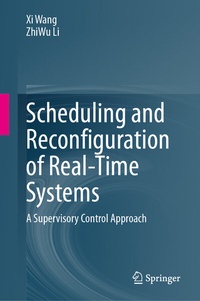
Scheduling and Reconfiguration of Real-Time Systems
Description

This book presents a methodology for the real-time scheduling problems of real-time systems (RTS) from the viewpoint of control theory. Generally, any system can be viewed as an RTS if it performs real-time application functions and behaves correctly depending on given logical activities and satisfying specified deadlines for the activities. This monograph provides broad views and detailed introductions to supervisory control theory (SCT) and its application in real-time scheduling and reconfiguration. Based on three popular SCT modelling frameworks, discrete-event system (DES), timed DES (TDES), and state-tree structures (STS), the authors provide RTS modelling frameworks; thereafter, SCT is used to find their safe execution sequences.
As the main contribution, we use (untimed) DES events to represent the execution and preemption of each individual RTS task. This modelling formalism brings the possibilities to model the preemptions of tasks' executions. Furthermore, in somecases, priorities cannot be assigned to real-time tasks. In order to solve this problem, a matrix-based priority-free conditional-preemption (PFCP) relation is provided, which generalizes fixed-priority (FP) RTS scheduling. As a natural extension, a generalized modular modelling framework is presented to model the task parameters instead of the global real-time task. The modular models are taken to be generic entities, which also considers the exact execution time of real-time tasks. STS are undoubtedly recognized as a computationally efficient SCT framework which manages the state explosion problem significantly. Hence, building on the (untimed) modular RTS models, a novel STS-based RTS modeling framework is formulated, by assigning dynamic priorities as specified optimality criteria, which can be utilized to model sporadic RTS processing both sporadic and (multi-period) periodic tasks, providing a small set of the safe execution sequences which rank at the top.
More details
Other editions
Additional editions
Persons
Zhiwu Li received the B.S., M.S., and Ph.D. degrees in Mechanical Engineering, Automatic Control, and Manufacturing Engineering, respectively, all from Xidian University, Xi'an, China, in 1989, 1992, and 1995, respectively. He joined Xidian University in 1992. Over the past decade, he held a visiting professorship at the University of Toronto, Technion (Israel Institute of Technology), Martin-Luther University of Halle-Wittenberg, Conservatoire National des Arts et Métiers (CNAM), University of Cagliari, and Meliksah Universitesi. He is now with the Institute of Systems Engineering, Macau University of Science and Technology, Taipa, Macau. His research interests include Petri net theory and applications, supervisory control of discrete-event systems, and systems engineering. Dr. Li is a recipient of an Alexander von Humboldt Research Grant, Alexander von Humboldt Foundation, Germany. He is a fellow of IEEE (2016).
